

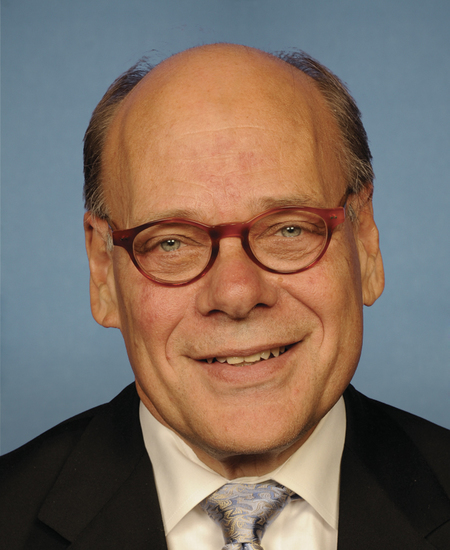
Photo of Steve Cohen
D United States House · District 9 · Tennessee

Rep. Steve Cohen

Compare
Total votes
2,837
all sessions
Attendance
97%
97 missed
Lower than 82% of chamber peers
With party
98%
of cast votes
Near the chamber average
Bipartisan score
1%
crosses aisle rarely
Near the chamber average
Sponsored
2,762
bills & resolutions
Higher than 96% of chamber peers
Committees
7
assignments
2,762 bills and resolutions

Sponsored bills

Total
2,762
Primary
196
Co-sponsor
2,566
This page
2,762
matching current filters
Co-sponsor HR 7384
In committee · United States House · Co-sponsor
Preventing Mass Casualties from Release of Hydrofluoric Acid at Refineries Act of 2026

Maddy summaryThis bill prohibits petroleum refineries from using hydrofluoric acid (HF) for gasoline production. New refineries cannot use HF after the law takes effect, and existing refineries must switch to safer alternatives within 5 years. Refineries that fail to comply face a $37,500 civil penalty per violation, and the law blocks waivers for this requirement. The measure targets 40 refineries using HF - potentially exposing 14 million nearby residents to severe health risks - and mandates adoption of commercially available, safer refining methods already used in most U.S. refineries.

In committee Feb 4, 2026 1 co-sponsor
Co-sponsor HR 7335
In committee · United States House · Co-sponsor
Humanitarian Standards for Individuals in ICE and CBP Custody Act

Maddy summaryHR 7335 establishes comprehensive humanitarian standards for individuals held in U.S. Immigration and Customs Enforcement (ICE) and U.S. Customs and Border Protection (CBP) custody. The bill requires facilities to provide immediate health screenings within 12 hours (6 hours for high-risk individuals like children, pregnant people, or those with medical conditions), ensure access to adequate water, sanitation, food (with 2,000+ calories daily for adults), and age-appropriate shelter. It mandates specific facility standards including separate housing for males and females, accessible accommodations for people with disabilities, daily outdoor access for those detained over 48 hours, and proper medical equipment and personnel on-site. The bill also requires regular inspections, staff training on humanitarian protocols, and public reporting of sexual abuse complaints. These standards directly affect all individuals detained by ICE or CBP, with special protections for vulnerable groups like children, pregnant people, and those with medical needs.

In committee Feb 4, 2026 1 co-sponsor
Co-sponsor HR 7333
In committee · United States House · Co-sponsor
Family Violence Prevention and Services Improvement Act of 2026

Maddy summaryThe Family Violence Prevention and Services Improvement Act of 2026 amends federal law to enhance support for victims of family violence, domestic violence, and dating violence. The bill authorizes $270 million annually for fiscal years 2027-2031 to fund state, tribal, and community programs, with specific funding reserved for tribal programs (12.5%), national hotlines ($20.5 million for general hotline, $4 million for Indian hotline), and services for underserved populations. It requires grantees to provide trauma-informed, culturally appropriate services while prohibiting discrimination and protecting victim confidentiality, and mandates accessibility for people with disabilities and limited English proficiency. The bill also establishes new technical assistance centers, Tribal resource centers, and community-based prevention programs to address the needs of underserved populations including Native Hawaiians, Alaska Natives, and racial and ethnic minorities.

In committee Feb 3, 2026 1 co-sponsor
Co-sponsor HR 4469
In committee · United States House · Co-sponsor
PRESUME Act

Maddy summaryHR 4469, the PRESUME Act, simplifies eligibility for veterans exposed to radiation during military service. It removes the requirement for veterans to provide specific radiation dose evidence to qualify as "radiation-exposed veterans" under VA benefits. This change directly affects veterans who participated in nuclear testing or other radiation-related military activities and previously had to prove exact exposure levels. The bill amends 38 U.S.C. § 1112(c) to state the VA Secretary "may not require evidence of a certain dose of radiation" for this classification, streamlining access to medical benefits.

In committee Feb 3, 2026 1 co-sponsor
Co-sponsor HR 7322
In committee · United States House · Co-sponsor
True Shutdown Fairness Act

Maddy summaryHR 7322, the True Shutdown Fairness Act, requires federal agencies to pay regular wages to most employees and contractor workers during government shutdowns in fiscal year 2026, instead of furloughing them. It applies to all standard federal employees (excluding those on emergency duty) and contractor workers whose jobs would normally halt during a funding gap. Agencies must pay covered employees within 7 days of the bill's enactment for ongoing shutdowns, and contractors receive reimbursement for costs incurred keeping workers paid. The bill also prohibits agencies from implementing layoffs or placing employees on administrative leave for more than 10 days during a shutdown.

In committee Feb 2, 2026 1 co-sponsor
Primary HR 7310
In committee · United States House · Lead sponsor
Deadly Force Independent Review Act of 2026

Maddy summaryThis bill requires all federal law enforcement agencies to investigate every use of deadly force by their officers, including making evidence available to state/local authorities. It mandates independent reviews by agency inspectors general to ensure investigations were thorough and properly supported, and directs the Council of Inspectors General to create uniform national guidelines for these reviews and data collection. Agencies must submit quarterly reports to Congress containing detailed data on each incident - such as location, officer/target demographics (race, gender, age), nature of force used, and reasons given - while protecting all personally identifiable information from public release. The law directly affects federal law enforcement officers, agencies, and oversight bodies by standardizing investigations and increasing transparency through mandated reporting.

In committee Feb 2, 2026 0 co-sponsors
Primary HR 6357
In committee · United States House · Lead sponsor
TVA IRP Act

Maddy summaryHR 6357, the TVA IRP Act, creates a new Office of Public Participation at the Tennessee Valley Authority (TVA) to improve public engagement in TVA's planning processes. The bill requires TVA to establish a formal public participation process for its integrated resource planning, including a 100-day public comment period before releasing draft plans and requiring responses to public discovery requests within 15 days. TVA must now include specific elements in its resource plans, such as long-term demand forecasts, transmission investment summaries, and sensitivity analyses for factors like fuel costs and extreme weather. The bill mandates that TVA disclose its modeling assumptions 100 days before draft plan release and document how public input influenced the final plan.

In committee Feb 2, 2026 0 co-sponsors
Co-sponsor HJRES 144
In committee · United States House · Co-sponsor
Providing for congressional disapproval under chapter 8 of title 5, United States Code, of the rule submitted by the Department of Veterans Affairs relating to "Reproductive Health Services".

Maddy summaryHJRES 144 is a congressional disapproval resolution targeting a specific rule issued by the Department of Veterans Affairs (VA) on December 31, 2025, which addressed "Reproductive Health Services" (90 Fed. Reg. 61310). This resolution directs Congress to disapprove the VA rule under Chapter 8 of Title 5, U.S. Code, meaning the rule would have no legal effect if passed. The bill directly affects the VA's implementation of reproductive health services for veterans, as it seeks to nullify the agency's existing policy. This is a procedural measure, not a substantive policy change, aimed solely at blocking the VA's rule through congressional action.

In committee Jan 27, 2026 1 co-sponsor
Co-sponsor HR 7230
In committee · United States House · Co-sponsor
Buying American Cotton Act of 2026

Maddy summaryThis bill creates a tax credit for businesses selling products made with U.S.-grown cotton. The credit equals 24% of the cotton's market value if processed only in the U.S. or in countries with U.S. trade deals, or 18% for other processing locations. To qualify, cotton must be digitally traced from U.S. farms to finished products and certified by the USDA as meeting origin requirements. It directly affects clothing and textile manufacturers selling qualifying products in the U.S. market.

In committee Jan 22, 2026 1 co-sponsor
Co-sponsor HR 7206
In committee · United States House · Co-sponsor
Farm and Family Relief Act

Maddy summaryHR 7206, the Farm and Family Relief Act, provides direct financial assistance to agricultural producers facing market challenges during the 2025 crop year. It establishes one-time payments for eligible crop producers (including wheat, corn, soybeans, and cotton) when expected costs exceed expected returns, with payment limits based on farming income (capping at $125,000 or $250,000 depending on farming income percentage). The bill allocates $5 billion for specialty crop producers, $500 million for timber industry assistance, and $330 million for sugar beet producers through cooperative block grants. Additionally, it delays certain cost-shift provisions in food assistance programs and terminates specific tariff-imposing executive orders.

In committee Jan 22, 2026 1 co-sponsor
Showing 211 to 220 of 2,762 bills
Previous 1 … 21 22 23 … 277 Next