

Maddy summaryThis bill amends Section 3019 of the FAST Act to explicitly include local governments alongside state governments in transportation procurement provisions. It modifies two specific references in the law - inserting "or local" before "government" in the text and updating a subsection heading - to clarify that cooperative procurement arrangements can involve local governments. The change directly affects state and local government entities participating in transportation infrastructure procurement under the FAST Act. It makes no new policy requirements but adjusts existing language for clarity.
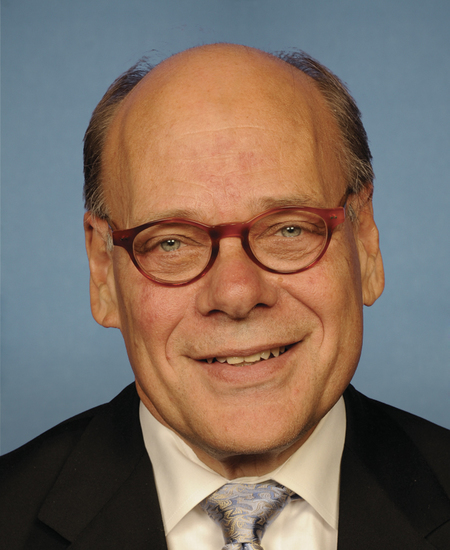
Rep. Steve Cohen
Sponsored bills
Denying Infinite Security and Government Resources Allocated toward Convicted and Extremely Dishonorable Former Protectees Act or the DISGRACED Former Protectees Act This bill removes Secret Service protection from any individual who is convicted and sentenced for a federal or state felony.
Maddy summaryThis bill requires the EPA to establish new water quality standards and discharge limits for PFAS chemicals (like "forever chemicals") within strict deadlines. It mandates the EPA to publish human health criteria by 2027 and set industry-specific discharge limits for targeted sectors (e.g., chemical manufacturing, electroplating, landfills) by 2025-2027. The bill also requires immediate monitoring of PFAS discharges from these industries and wastewater treatment facilities, and allocates $200 million annually (2024-2028) to help treatment works address PFAS contamination. These changes directly affect regulated industries, wastewater systems, and communities near water sources contaminated by PFAS.
Maddy summaryHR 8061, the Crime Victims Fund Stabilization Act of 2024, ensures stable funding for the Crime Victims Fund by directing certain False Claims Act collections into it from 2024 through 2029. Specifically, it adds a provision requiring that amounts collected under the False Claims Act (excluding whistleblower rewards and government reimbursement for damages) be deposited into the fund during this period. This directly affects crime victims who rely on the fund for services like counseling and emergency aid, as it prevents potential shortfalls in funding. The bill makes a concrete policy change by redirecting specific federal civil penalties into the fund, rather than altering the fund's existing purposes or eligibility rules.
Maddy summaryHR 8026, the CDBG Modernization Act of 2024, requires the Department of Housing and Urban Development (HUD) to study and update the formulas used to distribute Community Development Block Grant (CDBG) funds to cities and counties. The bill specifically aims to replace the "age of housing" factor in current formulas, which has created funding inequities, and develop revised formulas that better target resources to communities with the greatest development needs. HUD must submit a report within one year, including updated formulas, and conduct a new study every 10 years to ensure ongoing equitable distribution. This bill directly affects all cities and counties receiving CDBG funds by changing how their allocations are calculated.
Maddy summaryHR 3303, the Maternal Health for Veterans Act, requires the Department of Veterans Affairs (VA) to annually report on maternity care coordination programs and maternal health outcomes for veterans receiving care through VA facilities or VA-contracted providers. The bill mandates the VA to collect data on maternal outcomes - including disparities affecting high-risk demographic groups - and submit recommendations to Congress by September 2028. It authorizes $15 million annually (2024-2028) for VA maternity care coordination programs, supplementing existing funding without reducing current resources. The law directly affects veterans using VA maternity services, aiming to improve care through data-driven strategies.
Maddy summaryThe BUILD for Veterans Act of 2023 requires the Department of Veterans Affairs to improve management of its physical infrastructure, including buildings, land, and related systems used to deliver services to veterans. The bill establishes specific requirements for better staffing, performance metrics, and strategic planning for capital asset management, with deadlines for reports to Congress. It mandates a comprehensive review of climate resilience for VA facilities and requires centralized management of asset disposal and reuse. These provisions aim to enhance the efficiency and effectiveness of VA's infrastructure management to better serve veterans.
Maddy summaryHR 1083, the Caring for Survivors Act of 2023, increases financial support for surviving spouses of veterans. It amends Title 38 to raise dependency and indemnity compensation from a fixed $1,154 to 55% of the monthly compensation rate under section 1114(j), effective six months after enactment. The bill also modifies eligibility for survivors of veterans who died before 1993, ensuring they receive the greater of their current benefit or the new calculation. Additionally, it reduces the required continuous service rating period for survivors from 10 years to five years when a veteran was totally disabled at death. These changes directly affect surviving spouses, particularly those with veterans who died prior to 1993.
Maddy summaryHRES 1148 is a resolution passed by the U.S. House of Representatives that condemns the Iranian government for supporting terrorism, regional proxy conflicts, and internal suppression of dissent - including its crackdown on protests following Mahsa Amini's death in 2022. It specifically calls for maintaining sanctions against Iran, supporting the Iranian Resistance's Ten-Point Plan (which advocates for a democratic, secular, nonnuclear Iran), and protecting Iranian political refugees in Albania. The resolution also affirms the Iranian people's right to self-determination under international law and urges the U.S. to recognize their struggle for freedom. As a non-binding resolution, it does not create new laws but formally expresses congressional stance.
Maddy summaryHRES 1142 is a non-binding House resolution recognizing the 10th anniversary of Boko Haram's 2014 kidnapping of 276 Chibok schoolgirls in Nigeria and urging the Nigerian government to intensify efforts against Boko Haram. It specifically calls on Nigeria to prioritize recovering abducted women and girls, account for missing persons, reduce stigma against survivors, and allow family reunifications. The resolution also urges the U.S. government to implement existing anti-terrorism strategies and track missing persons for inclusion in annual reports. This resolution directly affects the Nigerian government and the remaining 98+ Chibok girls still held captive, alongside other victims of Boko Haram's violence. It does not create new law but formalizes a call for coordinated action to address ongoing captivity and conflict in Nigeria's northeast region.