

Preventing Anti-Semitic Hate Crimes Act This bill requires a designated officer or employee of the Department of Justice (DOJ) to facilitate the expedited review of anti-Semitic hate crimes and reports of anti-Semitic hate crimes. Further, the bill requires DOJ to issue guidance for state, local, and tribal law enforcement agencies on expanding public education campaigns to raise awareness of anti-Semitic hate crimes. Finally, the bill increases the statutory maximum prison term for an individual who is convicted of a federal hate crime offense after a prior conviction for a hate crime offense under federal law or a hate crime felony under state law.
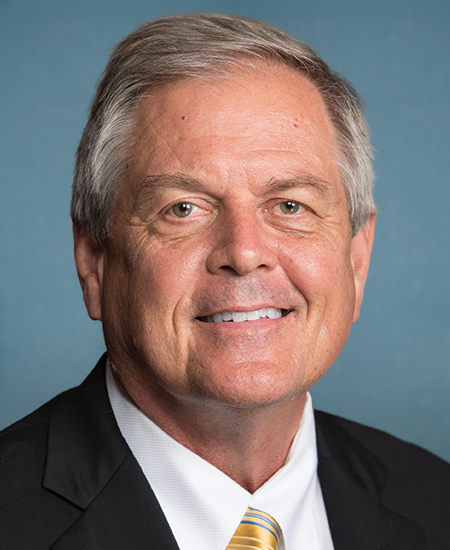
Rep. Ralph Norman
Sponsored bills
Human-Animal Chimera Prohibition Act of 2021 This bill establishes new federal crimes related to conduct involving certain types of human-animal chimeras. The term human-animal chimera means an organism that, from an early stage of development, contains human and nonhuman parts. This bill makes is unlawful to create or attempt to create a prohibited human-animal chimera, transfer or attempt to transfer a human embryo into a nonhuman womb, transfer or attempt to transfer a nonhuman embryo into a human womb, or transport or receive for any purpose a prohibited human-animal chimera. A violator is subject to civil and criminal penalties.
Separation of Powers Restoration Act of 202 1 This bill modifies the scope of judicial review of agency actions to authorize courts reviewing agency actions to decide de novo (i.e., without giving deference to the agency's interpretation) all relevant questions of law, including the interpretation of (1) constitutional and statutory provisions, and (2) rules made by agencies. No law may exempt a civil action from the standard of review required by this bill except by specific reference to such provision.
Conrad State 30 and Physician Access Reauthorization Act This bill modifies the Conrad 30 Waiver program, which incentivizes qualified foreign physicians to serve in underserved communities. It also extends statutory authority for the program for three years from this bill's enactment. Aliens coming to the United States under a J-1 nonimmigrant visa to receive medical training typically must leave the country and reside for two years abroad before being eligible to apply for an immigrant visa or permanent residence. The Conrad program waives this requirement for individuals who meet certain qualifications, including serving for a number of years at a health care facility in an underserved area. The bill increases the number of waivers that a state may obtain each fiscal year from 30 to 35 if a certain number of waivers were used the previous year, and provides for further adjustments depending on demand. An alien physician may be employed at an academic medical center to meet the Conrad program's employment requirements if the alien's work is in the public interest, even if the medical center is not in an underserved area. Employment contracts for alien physicians under the Conrad program shall contain certain information, such as the maximum number of on-call hours per week the physician shall have to work. Certain alien physicians (along with the physician's spouse and children) shall be exempt from the direct annual numerical limits on immigration, including those physicians that have met certain requirements related to visas for physicians to serve in underserved areas.
Protecting Access for Hunters and Anglers Act of 2022 This bill bars the Department of the Interior and the Department of Agriculture from prohibiting or regulating the use of lead ammunition or tackle on federal land or water that is under the jurisdiction of such departments and made available for hunting or fishing. The bill makes exceptions for specified existing regulations and where the applicable department determines that a decline in wildlife population at the specific unit of federal land or water is primarily caused by the use of lead in ammunition or tackle, based on the field data from such unit, and the state approves the regulations.
Stop the Sexualization of Children Act This bill prohibits the presentation of sexually oriented materials to children under the age of 10. The bill defines sexually oriented material as any (1) depiction or description of sexual activity; (2) lewd or lascivious depiction or description of human genitals; or (3) topic involving gender identity, gender dysphoria, transgenderism, sexual orientation, or related subjects. Specifically, the bill prohibits (1) the use of federal funds to develop, implement, facilitate, or fund any sexually oriented program, event, or literature for children under the age of 10; and (2) the use of federal facilities or properties to host or promote such programs, events, or literature. The bill grants a parent or guardian a private right of action against a government official, government agency, or private entity that violates this bill. Additionally, the bill prohibits federal agencies from disbursing federal funds to a government agency or private entity for three fiscal years if the agency or entity has received two or more injunctions for violations of the bill in a five-year period.
This resolution expresses the sense of the House of Representatives that the courts should find New York's Concealed Carry Improvement Act unconstitutional and that all states should pass legislation supporting Second Amendment rights.
Credit Union Board Modernization Act This bill revises the frequency of meetings required to be held by a credit union's board of directors. Specifically, the bill requires monthly meetings for new credit unions during their first five years and for credit unions with a low soundness rating. All other credit unions must hold at least six meetings annually, with at least one meeting held during each fiscal quarter. Currently, all credit union boards must meet at least once a month.
This bill designates the facility of the United States Postal Service located at 110 Johnson Street in Pickens, South Carolina, as the Specialist Four Charles Johnson Post Office.
This bill designates the facility of the United States Postal Service located at 810 South Pendleton Street in Easley, South Carolina, as the Private First Class Barrett Lyle Austin Post Office Building.