

No Fly for Illegals Act This bill limits using federal funds to compensate an airline for transporting an alien who is not lawfully present in the United States. Specifically, federal funds may not be used to compensate an airline for such an individual's entry into the United States or for relocation within the United States unless the transportation is to remove the individual from the United States or to protect the individual from an imminent threat to life or physical safety.
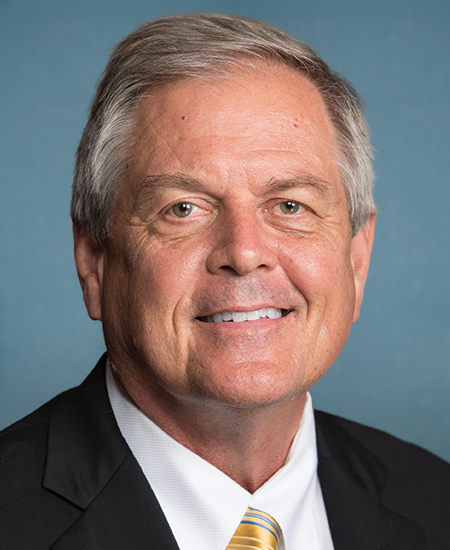
Rep. Ralph Norman
Sponsored bills
No Frivolous Application for Short-Barreled Shotguns Act or the NFA SBS Act This bill removes certain short-barreled shotguns from the definition of firearms for purposes of the National Firearms Act. It also eliminates the prohibition on the sale or transportation of such shotguns in interstate commerce and treats persons who acquire or possess a short-barreled shotgun as meeting the registration or licensing requirements for such shotguns where such requirements are determined by reference to the National Firearms Act. The bill preempts state or local laws that impose a tax or recordkeeping requirements on short-barreled shotguns. The Department of Justice must destroy records relating to the registration of shotguns described by this bill within one year after the enactment of this bill.
No Taxpayer Funding for the Central American Minors Program Act This bill prohibits using federal funds to carry out the Central American Minors program, a Department of Homeland Security and Department of State program that reunites qualified children from El Salvador, Guatemala, and Honduras with their parent who is lawfully present in the United States.
Second Amendment is Essential Act of 2021 This bill directs the Department of Homeland Security to designate the business of importing, manufacturing, or dealing firearms, or importing or manufacturing ammunition, as a critical infrastructure sector. Additionally, the bill states that individuals who are employed by those entities are critical infrastructure workers. The term critical infrastructure means systems and assets, physical or virtual, so vital to the United States that the incapacity or destruction of such systems and assets would have a debilitating impact on security, national economic security, national public health and safety, or any combination of those matters.
Brian A. Terry Memorial Eliminate the ATF Act This bill abolishes the Bureau of Alcohol, Tobacco, Firearms and Explosives and transfers its authorities, functions, personnel, and assets to the Department of Justice (DOJ). It also transfers authorities, functions, personnel, and assets of the Department of the Treasury's Alcohol and Tobacco Tax and Trade Bureau to DOJ. Additionally, the bill establishes the Border Patrol Agent Killed in Action Trust Fund. Amounts in the fund shall be made available for purposes of (1) providing grants to the surviving spouse, child, or parent of a U.S. Border Patrol agent killed in the line of duty on or after December 1, 2009; and (2) awarding grants to states for establishing firearm safety programs.
World Deserves To Know Act This bill requires sanctions on certain members of the Chinese Communist Party (CCP) and officials of Chinese health agencies. It also addresses related issues. The President must impose visa- and property-blocking sanctions on any foreign person who is a CCP official and who is knowingly responsible for or complicit in (1) the disappearances of whistleblowers and citizen journalists in China relating to COVID-19, or (2) limiting free speech and academic freedom in China relating to COVID-19. The President must also impose such sanctions on specified individuals who have leadership positions in China's Center for Disease Control and Prevention and China's National Health Commission (NHC). The authority to impose such sanctions shall end when the President certifies to Congress that an independent and unimpeded investigation into the potential origin of COVID-19 from the Wuhan Institute of Virology has taken place. The bill also bars federal funds and certain federal student assistance from going to institutions of higher education that enter into a contract with any element or China-based affiliate of the NHC. Federal funding to the National Academy of Sciences may not be used to enter into a contract with any element or China-based affiliate of the NHC. The Government Accountability Office must report to Congress a review of all funds that the National Institutes of Health have made available to the NHC since FY2010. This report must also be publicly available.
H-2B Returning Worker Exception Act of 2021 This bill modifies the H-2B (temporary nonagricultural workers) nonimmigrant visa program, including by exempting certain workers from an annual numerical limit on such visas and requiring civil penalties for program violations. Under this bill, if a worker seeking a H-2B visa has been counted toward the 66,000 annual cap on such visas in one of the three preceding fiscal years, that worker shall not be counted against the cap again. Furthermore, the Department of Homeland Security (DHS) must impose a civil monetary penalty on an employer for (1) failing to meet requirements related to an H-2B visa petition, or (2) making a willful misrepresentation of material fact in such a petition. DHS must also ensure the establishment of an electronic platform (1) for employers to submit and request approval of an H-2B petition, and (2) to act as a single point of access for applicants and the relevant government agencies. The Department of Labor must maintain a publicly available online database of all job orders by H-2B employers. Furthermore, Labor may take certain actions to enforce program requirements, such as imposing penalties and seeking injunctions. The bill provides statutory authority for the current practice of limiting the program to workers who are nationals of countries approved by DHS. DHS may make exceptions to this limitation in individual cases if it is in the U.S. interest to do so. DHS shall select approved countries based on various factors, such as the rate of overstay by H-2B visa holders from each country.
Firearm Due Process Protection Act This bill expands the grounds for pursuing judicial remedies related to certain firearm transfers. Additionally, the bill establishes procedural rules applicable to actions for judicial remedies. Current law authorizes judicial remedies for an individual who is erroneously denied a firearm (e.g., an individual is denied a firearm but the individual is eligible to receive or possess a firearm). This bill authorizes remedies for an individual who experiences an extended delay (i.e., a delay of more than 60 days) on a firearm transfer. Additionally, the bill requires an expedited hearing on an action for judicial remedies and places the burden of proof on the respondent to show by clear and convincing evidence that the individual was ineligible to receive or possess a firearm.
Protecting Our Wellbeing by Expanding Russian Sanctions Act or the POWERS Act This bill expands existing sanctions against foreign persons engaged in certain activities related to the Nord Stream 2 and TurkStream pipelines, two Russian pipelines that were constructed to supply natural gas to Europe. Currently, these sanctions apply to foreign persons that (1) provided pipe-laying vessels for the construction of either pipeline, (2) facilitated certain transactions for such vessels, (3) provided certain underwriting services or insurance for such vessels, or (4) provided certain services for such vessels or Nord Stream 2. Under this bill, these sanctions must also apply to any foreign person that engaged in any transaction with such sanctioned persons. The bill also reinstates any sanctions that were previously waived with respect to Nord Stream 2 AG (the company established to construct and operate the pipeline) or any of its corporate officers. Such reinstated sanctions may not be waived except by an act of Congress.
Safeguarding United States Research Act This bill imposes certain reporting requirements on the sponsor of an F, M, or J (student or exchange visitor) visa and authorizes the Department of Homeland Security (DHS) to revoke such a visa in certain instances. It also expands disclosure requirements for applicants of federal research and development awards. The Department of State must require a sponsor of a J visa to report any change to the visa holder's primary field of study. The State Department and DHS shall require a sponsor of an F, M, or J visa to report when the visa holder is participating in a federally funded research program. DHS may review and revoke an F, M, or J visa in certain instances, such as finding that (1) the visa holder misrepresented an intention to pursue a field of study, or (2) the visa holder's participation in a federally funded research program poses a national security risk. The bill also imposes certain limits on the ability to appeal such a revocation decision. The bill also requires applications for federal research and development awards to disclose any in-kind contributions received by the applicant. Furthermore, if an applicant works for an institution that is required to file disclosures relating to the receipt of foreign gifts, the application for the federal award must include a certification that the applicant has provided the employing institution all the information necessary to comply with that disclosure requirement.