

Maddy summaryHRES 334 is a symbolic resolution recognizing "Community College Month" to celebrate over 1,000 community colleges across the United States. It highlights how these institutions support accessible higher education, workforce training, and economic prosperity - serving 10.2 million students annually while charging affordable tuition (averaging $3,860 for in-district students). The resolution does not create new laws or requirements but formally acknowledges community colleges' role in strengthening local communities and the national economy. This acknowledgment applies broadly to all community colleges and their students, without imposing any obligations.
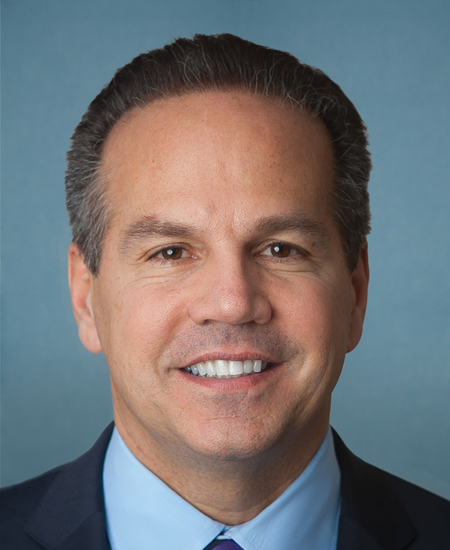
Rep. David N. Cicilline
Sponsored bills
Maddy summaryThe Child Labor Exploitation Accountability Act requires U.S. Department of Agriculture (USDA) contractors to annually disclose if they or their subcontractors faced serious labor violations - including child labor violations under the Fair Labor Standards Act - in the past three years. Contractors with such violations must report corrective steps, and those failing to address issues or repeating violations face a five-year ban from USDA contracts (including the year of listing and the next four years). The law mandates annual reports to Congress tracking the number of contractors on the ineligible list and the program's effectiveness. This policy directly affects agricultural businesses and suppliers contracting with the USDA, aiming to enforce labor compliance through financial consequences.
Maddy summaryThe Water Affordability, Transparency, Equity, and Reliability Act of 2023 establishes a new trust fund funded by increasing the corporate tax rate from 21% to 24.5% to support water infrastructure and affordability programs. It allocates funds to clean water programs (42%), safe drinking water funding (42.5%), household water wells (1%), colonias assistance (0.5%), Indian health services (3%), and water operator job training (0.5%). The bill requires the EPA to conduct a study and submit a report on water affordability, discrimination in water services, public participation in regionalization, and data collection related to service disconnections. It includes specific provisions for colonias, household water wells, and job training programs for water system operators to improve water access and equity.
This resolution recognizes the independence of the Republic of Artaskh, also known as Nagorno-Karabakh (the region is internationally recognized to be part of Azerbaijan). The resolution also urges the United States to support international recognition of an independent Artaskh and to cease foreign and military assistance to Azerbaijan, condemns Azerbaijan's blockade and aggression, and supports Armenia's sovereignty and territorial integrity.
Maddy summaryThe Armenian Genocide Education Act (HR 2803) establishes a Library of Congress program to support U.S. schools in teaching about the Armenian Genocide of 1915-1923. The program will develop educational resources, provide teacher training, and maintain an online resource center to help schools incorporate accurate historical information into curricula. It prioritizes schools without existing Armenian Genocide education programs, with $2 million authorized annually for five years. The Librarian of Congress will report yearly on the program’s activities to Congress.
Competitive Prices Act This bill makes consciously parallel pricing coordination (i.e., a tacit agreement among two or more persons to raise, lower, change, maintain, or manipulate pricing for the purchase or sale of reasonably interchangeable products or services) a prohibited form of price fixing. In a civil action for a claimed violation, the plaintiff may shift the burden of proof to the defendant by demonstrating that two or more persons (1) engaged in substantially similar conduct within a substantially similar time period with respect to the pricing of reasonably interchangeable products, and (2) had a similar motivation to coordinate their efforts to change or manipulate the pricing of those products or services. The defendant may rebut such a presumption of a violation by demonstrating the action was motivated by business judgment that is economically rational in the absence of a tacit agreement, such as by showing the action was in response to, or in anticipation of, changing market conditions for the product or service. If the defendant rebuts the presumption, the plaintiff must demonstrate by a preponderance of the evidence that the defendant entered a tacit agreement to change or manipulate the pricing for the product or service, such as by showing the business judgment of the defendant was not rational in the absence of such a tacit agreement.
Maddy summaryThe Dignity for Detained Immigrants Act establishes new standards for Department of Homeland Security detention facilities, requiring them to meet or exceed the American Bar Association's Civil Immigration Detention Standards. The bill mandates annual, unannounced inspections by the DHS Inspector General, public reporting on facility compliance, and a phased-out timeline for private detention facilities (phasing out by 3 years after enactment). It prohibits solitary confinement for all detainees, requires community-based alternatives to detention for vulnerable individuals, and mandates detailed public reporting on facility conditions, staffing, and detainee demographics. The legislation directly affects all immigrants held in DHS custody, including children, vulnerable persons, and primary caregivers, with specific protections for these groups in detention procedures.
Maddy summaryHRES 269 is a non-binding resolution passed by the U.S. House of Representatives on March 30, 2023. It recognizes the federal government's duty to develop and implement a Transgender Bill of Rights to protect transgender and nonbinary people. The resolution outlines key provisions, including ensuring access to gender-affirming medical care, ending discrimination in employment and housing, and improving legal recognition of gender identity on government documents. It also calls for addressing systemic barriers in education, safety, and economic security faced by transgender and nonbinary individuals.
Maddy summaryThis bill directs the U.S. government to develop diplomatic strategies with allies to counter China's surveillance balloon program, including sharing intelligence about balloon violations and coordinating international responses. It requires the Commerce Department to evaluate export controls on aerospace technologies linked to China's military surveillance and mandates a report on these controls within 180 days. The bill also authorizes sanctions against Chinese officials managing the balloon program, including property blocking and visa restrictions, starting 180 days after enactment. These measures target China's global surveillance efforts and aim to protect U.S. airspace sovereignty through diplomatic, economic, and regulatory tools.
Maddy summaryThis bill allows the Department of Veterans Affairs (VA) to use existing funds more flexibly to assist homeless veterans and veterans in HUD housing programs. It authorizes the VA to provide immediate needs like food, shelter, transportation for appointments, and communication devices (e.g., phones, tablets) to support veterans' stability and health. The law expands how VA funds can be applied beyond traditional housing assistance, focusing on urgent, practical support. It directly affects homeless veterans and those in HUD's housing assistance program by enabling faster, more adaptable aid. The bill amends existing VA law to improve responsiveness to veterans' immediate survival and health needs.