

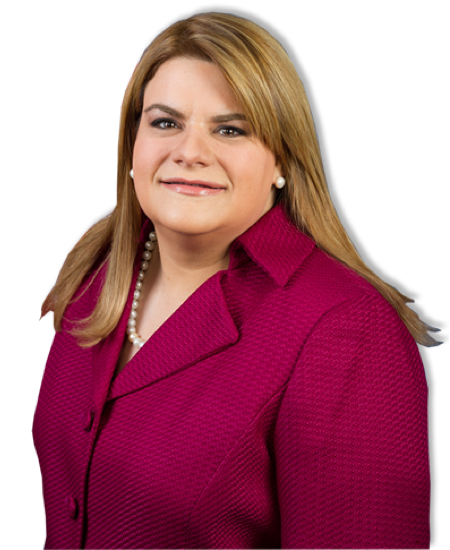
Photo of Jenniffer González-Colón
R United States House · District At-Large · Former member · Puerto Rico

Rep. Jenniffer González-Colón

Compare
Total votes
552
all sessions
Attendance
33%
822 missed
Among the lowest in the chamber
With party
59%
of cast votes
Among the lowest in the chamber
Bipartisan score
21%
some cross-party votes
Higher than 99% of chamber peers
Sponsored
718
bills & resolutions
Near the chamber average
Committees
0
assignments
718 bills and resolutions

Sponsored bills

Total
718
Primary
85
Co-sponsor
633
This page
718
matching current filters
Co-sponsor HR 2734
In committee · United States House · Co-sponsor
Ocean Acidification Research Partnerships Act

Ocean Acidification Research Partnerships Act This bill requires the National Oceanic and Atmospheric Administration (NOAA) to provide grants for collaborative research projects on ocean acidification developed and conducted through partnerships between the seafood industry and the academic community. NOAA must prioritize projects that (1) address ecosystems and communities vulnerable to the impacts of ocean acidification, (2) demonstrate support from local stakeholders, or (3) utilize seafood industry assets as research and monitoring platforms. NOAA may provide grants to a partnership in which a marine-dependent industry is substituted for the seafood industry.

In committee Apr 20, 2023 1 co-sponsor
Co-sponsor HR 2693
In committee · United States House · Co-sponsor
Pay Our Coast Guard Parity Act of 2023

Maddy summaryHR 2693, the Pay Our Coast Guard Parity Act of 2023, ensures Coast Guard members, civilian staff, and qualifying contractors receive pay and benefits during specific funding gaps. It requires Congress to appropriate funds for Coast Guard personnel pay, allowances, and key benefits (like death gratuities and housing allowances) if a Coast Guard-specific funding lapse occurs - when Coast Guard funding isn’t approved before a fiscal year starts but Department of Defense funding is. The bill mandates these payments continue until a full appropriation is enacted or for up to two weeks after the lapse begins, with costs charged to future appropriations. This addresses a gap in funding continuity for Coast Guard personnel during government shutdowns affecting only the Coast Guard.

In committee Apr 19, 2023 1 co-sponsor
Co-sponsor HR 1624
In committee · United States House · Co-sponsor
Puppy Protection Act of 2023

Maddy summaryThe Puppy Protection Act of 2023 sets new standards for businesses that sell dogs (dealers), directly affecting pet stores and breeders operating under the Animal Welfare Act. It requires specific housing with space allowances based on dog size (e.g., 12-30 square feet per dog), temperature control (45-85°F), clean food twice daily, and daily exercise or socialization with humans/dogs for at least 30 minutes. The bill also mandates annual veterinary exams including dental care, strict breeding limits (e.g., age restrictions, maximum 2 litters in 18 months), and efforts to place retired breeding dogs in homes instead of selling them to other breeders. Regulations must be finalized within 18 months of enactment.

In committee Apr 19, 2023 1 co-sponsor
Co-sponsor HJRES 27
Vetoed · United States House · Co-sponsor
Providing for congressional disapproval under chapter 8 of title 5, United States Code, of the rule submitted by the Department of the Army, Corps of Engineers, Department of Defense and the Environmental Protection Agency relating to "Revised Definition of 'Waters of the United States'".

Maddy summaryHJRES 27 is a congressional resolution seeking to block a federal rule that redefined which waterways fall under the Clean Water Act's protections. It targets a rule submitted by the Army Corps of Engineers, Department of Defense, and Environmental Protection Agency (EPA) on January 18, 2023, which aimed to revise the "Waters of the United States" definition. The resolution would formally disapprove this rule under a specific federal procedure (Chapter 8 of Title 5), preventing it from taking effect. This would directly affect how federal agencies regulate pollution and development near water bodies, including wetlands and smaller streams.

Vetoed Apr 18, 2023 1 co-sponsor
Co-sponsor HR 2480
In committee · United States House · Co-sponsor
Optimizing Postpartum Outcomes Act of 2023

Maddy summaryThe Optimizing Postpartum Outcomes Act of 2023 requires the Health and Human Services Secretary to issue guidance within one year on covering pelvic health services (like pelvic floor exams and physical therapy) during the postpartum period under Medicaid and CHIP programs. This guidance will include best practices for payment models, financing options, and standardized terminology to improve access for postpartum women. It also mandates a GAO study on coverage gaps for postpartum services and funds a new CDC-led education campaign to train healthcare providers and inform postpartum women about pelvic health care. The bill directly affects postpartum women enrolled in Medicaid or CHIP, aiming to standardize and expand access to these specific health services.

In committee Apr 14, 2023 1 co-sponsor
Primary HR 1702
In committee · United States House · Lead sponsor
To amend PROMESA to include certain ethics provisions to provide for the disqualification of certain advisors to the Financial Oversight and Management Board, and for other purposes.

Maddy summaryHR 1702 amends PROMESA to add ethics rules for advisors to Puerto Rico's Financial Oversight and Management Board (FOMB). It disqualifies third-party advisory firms from advising the FOMB if they represent clients competing for or working on government contracts overseen by the Board. Firms must certify they have no such conflicts, and knowingly providing false information carries legal penalties. The Board must refer violations to federal prosecutors for further action. This directly affects consulting firms seeking to advise the FOMB on Puerto Rico's government contracts.

In committee Apr 14, 2023 0 co-sponsors
Co-sponsor HR 2630
In committee · United States House · Co-sponsor
Safe Step Act

Maddy summaryHR 2630, the Safe Step Act, requires group health plans and health insurance issuers to establish a clear, transparent process for patients or their doctors to request exceptions to medication step therapy protocols. These protocols typically force patients to try cheaper drugs first before covering more expensive alternatives. The bill mandates that plans must approve exceptions when prior treatments failed, delay would cause serious harm, a treatment is unsafe, or a patient is stable on a previously approved drug, with strict 72-hour (or 24-hour in emergencies) decision timelines. It also requires plans to publish the exception process online and limit documentation requests to only necessary medical information. This law directly affects health insurers, employers offering health plans, and patients using step therapy for prescription drugs.

In committee Apr 13, 2023 1 co-sponsor
Co-sponsor HRES 285
In committee · United States House · Co-sponsor
Establishing a "Bill of Rights" to support United States law enforcement personnel nationwide in their work to protect our communities.

This resolution recognizes law enforcement agencies and officers for their tireless work to protect us and make our communities safer. It also condemns calls to defund, disband, dismantle, or abolish the police.

In committee Apr 10, 2023 1 co-sponsor
Co-sponsor HR 2389
In committee · United States House · Co-sponsor
Resident Physician Shortage Reduction Act of 2023

Resident Physician Shortage Reduction Act of 2023 This bill increases the number of residency positions eligible for graduate medical education payments under Medicare for qualifying hospitals, including hospitals in rural areas and health professional shortage areas. Current law provides for an increase of up to 200 positions per fiscal year beginning in FY2023, with a total increase of 1,000 positions; each hospital may receive up to 25 additional positions. Current law also provides for an additional increase of up to 200 positions for FY2026, with at least 100 of these positions for psychiatry or related specialties; each hospital may receive up to 10 additional positions. The bill provides for an additional increase of 2,000 positions per fiscal year from FY2025-FY2031; during this period, each hospital may receive up to 75 additional positions in total under the bill and current law. Additionally, one-third of the positions that are made available under the bill must be allocated to hospitals that are already operating above applicable resident limits. The bill also requires the Government Accountability Office to report on strategies to increase the diversity of the health professional workforce, including with respect to representation from rural, low-income, and minority communities.

In committee Apr 7, 2023 1 co-sponsor
Co-sponsor HR 1839
In committee · United States House · Co-sponsor
Combating Illicit Xylazine Act

Maddy summaryHR 1839, the Combating Illicit Xylazine Act, makes the illicit use and distribution of xylazine a federal crime by adding it to the Controlled Substances Act. The bill broadly defines xylazine to cover numerous chemical variants and prohibits human use or non-licit distribution, while preserving legitimate veterinary and pharmaceutical uses. It requires tracking xylazine in drug supply chains and mandates two reports to Congress within 1 and 4 years on its prevalence, sources, and whether it should be rescheduled. The bill directly affects individuals distributing or using xylazine illicitly, including as an additive to drugs like fentanyl, and aims to address its public health risks. Congress declared illicit xylazine an "emerging drug threat" under existing law.

In committee Apr 7, 2023 1 co-sponsor
Showing 271 to 280 of 718 bills
Previous 1 … 27 28 29 … 72 Next