

Advancing Uniform Transportation Opportunities for Veterans Act or the AUTO for Veterans Act This bill authorizes the Department of Veterans Affairs (VA) to provide (or assist in providing) an eligible veteran or service member with an additional automobile or other conveyance under the VA automobile allowance and adaptive equipment program. Currently, a veteran or service member with a specified service-connected disability or impairment may not receive more than one automobile or other conveyance under the program. The bill authorizes the additional benefit for such veterans and service members if 10 years have passed since the person last received such benefit.
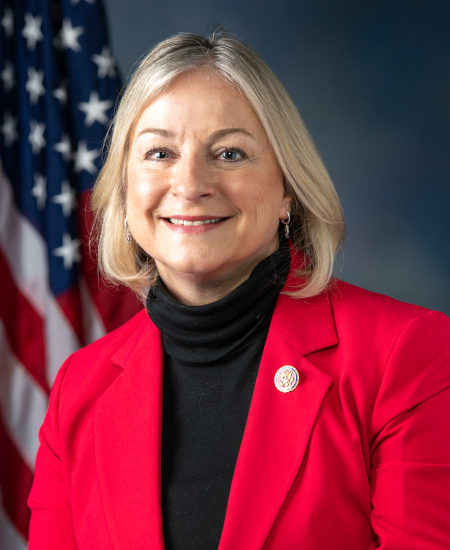
Rep. Susan Wild
Sponsored bills
Supporting Eating Disorders Recovery Through Vital Expansion Act or the SERVE Act This bill provides for inpatient and outpatient treatment of eating disorders under TRICARE for dependents of members of the uniformed services. Dependents are eligible for such care regardless of (1) their age, except with respect to residential service; and (2) whether the eating disorder is their primary or secondary diagnosis. The bill also requires the Department of Defense (DOD) and the Department of Homeland Security (with respect to the Coast Guard) to identify, treat, and rehabilitate members of the armed forces who have an eating disorder. Finally, DOD and the Department of Veterans Affairs must jointly develop, publish, and disseminate clinical practice criteria and guidelines on the identification and treatment of eating disorders.
Stay in Line To Vote Act This bill prohibits states from restricting the provision of food or drink to individuals who are at a polling place to cast their ballots in a federal election.
Providing Responsible Emergency Plans for Animals at Risk of E merging Disasters Act or the PREPARED Act This bill establishes requirements governing the care of animals by entities, such as zoos, in emergencies or disasters. Specifically, the bill requires each research facility, dealer, exhibitor, intermediate handler, and carrier to develop and follow a contingency plan to provide for the humane handling, treatment, transportation, housing, and care of their animals in the event of an emergency or disaster.
Transformation to Competitive Integrated Employment Act This bill addresses employment standards for individuals with disabilities. The bill directs the Department of Labor to award grants to states and certain eligible entities to assist them in transforming their business and program models to support individuals with disabilities by providing competitive integrated employment, assisting disabled individuals in finding and retaining work in such employment, providing integrated employment and integrated community participation and wraparound services for such individuals, and ensuring that such services comply with federal regulations for individuals receiving home and community-based services. The bill also prohibits the issuance of new special certificates that allow payment of subminimum wages to disabled individuals and phases out existing certificates over a four-year period. The bill directs Labor's Office of Disability Employment to award grants to provide technical assistance and other strategic support to employers transitioning from special certificates to competitive integrated employment for disabled individuals. Labor must contract with a nonprofit entity to conduct an evaluation of the impact of these transitions.
This resolution calls on the government of Azerbaijan to immediately return all Armenian prisoners of war and captured civilians. The resolution also urges the Department of State to engage with Azerbaijani authorities to bring about this result.
Meeting IMD Needs with Direction Act or the MIND Act This bill temporarily allows states to receive federal Medicaid payment for services provided in institutions for mental diseases (IMDs) during the public health emergency relating to COVID-19 (i.e., coronavirus disease 2019) and for 180 days after the emergency ends. Current law generally prohibits federal payment under Medicaid for services provided in IMDs for individuals under the age of 65 (although states may receive payment through certain mechanisms, such as through a Medicaid demonstration waiver).
Energy Innovation and Carbon Dividend Act of 2021 This bill imposes a fee on the carbon content of fuels, including crude oil, natural gas, coal, or any other product derived from those fuels that will be used so as to emit greenhouse gases into the atmosphere. The fee is imposed on the producers or importers of the fuels and is equal to the greenhouse gas content of the fuel multiplied by the carbon fee rate. The rate begins at $15 per metric ton of CO2-e in 2021, increases by $10 each year, and is subject to further adjustments based on the progress in meeting specified emissions reduction targets. The bill includes exemptions for fuels used for agricultural or nonemitting purposes, exemptions for fuels used by the Armed Forces, rebates for facilities that capture and sequester carbon dioxide, and border adjustment provisions that require certain fees or refunds for carbon-intensive products that are exported or imported. The fees must be deposited into a Carbon Dividend Trust Fund and used for administrative expenses and dividend payments to U.S. citizens or lawful residents. The fees must be decommissioned when emissions levels and monthly dividend payments fall below specified levels.
This resolution urges the Department of State to take action on unpaid Peruvian agrarian reform bonds by encouraging Peru to negotiate in good faith with U.S. bondholders regarding payment of these bonds.
Public Servants Protection and Fairness Act of 2021 This bill establishes an alternative formula to calculate Social Security retirement benefits for those who receive pensions for certain non-covered employment. (The existing formula is known as the windfall elimination provision.) The alternative formula adjusts an individual's total lifetime earnings based on the proportion of covered earnings (i.e., earnings subject to Social Security payroll taxes). It applies to individuals who (1) first become eligible for benefits after 2022, (2) have earnings from non-covered service performed after 1977, and (3) have less than 30 years of coverage (i.e., years in which a beneficiary is considered to have contributed a substantial amount into the Social Security trust funds). Beneficiaries receive the higher benefit amount as calculated under the alternative method or the existing formula. In addition, the bill provides rebates for certain beneficiaries currently impacted by the existing formula. The Social Security Administration must include non-covered earnings in Social Security account statements, and the Government Accountability Office must study the availability of certain information related to retirement plans maintained by state and local governments.