

Maddy summaryHRES 1063 is a non-binding resolution passed by the U.S. House of Representatives to reaffirm America's commitment to NATO ahead of its 75th anniversary. It formally recognizes NATO's role in collective security, emphasizes Article 5's importance for mutual defense, and supports Finland and Sweden's membership. The resolution also calls on NATO allies to meet the 2% defense spending target, but does not create new laws or affect specific individuals or groups.
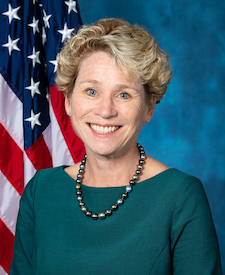
Rep. Chrissy Houlahan
Sponsored bills
Maddy summaryThe Public Service Freedom to Negotiate Act of 2024 establishes federal minimum standards for collective bargaining rights for public employees and supervisory employees. The Federal Labor Relations Authority will determine if each state's laws "substantially provide" for these rights, and if not, federal standards will apply to that state. These standards include the right to self-organization, collective bargaining, recognition of labor organizations, and procedures for resolving disputes. The bill preserves existing collective bargaining agreements and excludes certain employee categories like emergency services workers from some provisions.
Maddy summaryThe READ Act Reauthorization Act of 2023 extends the authorization period for the Reinforcing Education Accountability in Development Act (commonly known as the READ Act) from five to ten fiscal years. This change allows U.S. international education programs, administered by agencies like USAID, to operate without annual reauthorization for a longer period. The bill directly affects programs providing educational support in developing countries, such as teacher training and literacy initiatives. The key mechanism is amending Section 4(a) of the existing law to adjust the funding duration, ensuring continued program stability.
Maddy summaryHR 6462, the READINESS Act, helps federal employees who are spouses of military members or Foreign Service officers when their spouse receives a permanent relocation order. The bill requires federal agencies to offer these employees one of four options within 30 days: full-time remote work, a local transfer to a position of equal grade, a remote transfer, or unpaid leave for up to 36 months. Agencies must report all requests and actions taken annually to the Office of Personnel Management (OPM), with OPM then summarizing this data for Congress each year. This directly affects federal employee spouses facing relocation due to a service member's permanent duty station change, aiming to reduce employment disruption.
Maddy summaryThis bill prohibits distributing AI-generated audio or video that misrepresents a federal election candidate's speech or appearance in a way a reasonable person would believe was authentic, during election campaigns. It specifically bans such content when distributed with intent to influence votes or raise funds, affecting candidates, political committees, and entities involved in federal elections. Exceptions apply for news organizations (with clear authenticity disclaimers) and satirical content. Candidates can sue violators for damages or seek court orders to stop distribution, with the burden of proof on the plaintiff.
Maddy summaryThis bill requires federal employees convicted of certain sex crimes after its enactment to forfeit their retirement pensions. It specifically applies to convictions for offenses listed in Title 18 (such as child sexual abuse, trafficking, and exploitation) or equivalent state crimes under federal jurisdiction. The law automatically terminates pension payments for these individuals starting on the date of conviction or the bill's enactment, whichever comes later. It affects federal retirees convicted of designated sex crimes after the law takes effect, removing taxpayer-funded retirement benefits for these offenses.
Maddy summaryHRES 1203 is a symbolic resolution designating July 17, 2024, as "Glioblastoma Awareness Day." It expresses congressional support for raising public awareness about glioblastoma, a highly aggressive brain cancer with a 6.9% 5-year survival rate and limited treatment options. The resolution encourages greater public understanding of the disease's challenges, honors those affected by it, and urges continued research and collaboration. This is a non-binding awareness measure with no new funding or policy changes.
Maddy summaryHR 8353, the Preparing Election Administrators for AI Act, requires the Election Assistance Commission (EAC) to create voluntary guidelines for state and local election offices within 60 days of the bill's enactment. These guidelines must address AI risks and benefits in election administration, cybersecurity threats from AI, how AI impacts election information accuracy, and strategies to combat AI-generated disinformation. The EAC will develop these guidelines in consultation with the National Institute of Standards and Technology (NIST). The bill directly affects election administrators by providing non-binding tools to manage AI technology use in elections.
Maddy summaryThis bill authorizes the placement of a memorial honoring women who contributed to World War II efforts on the National Mall or adjacent federal land in Washington, D.C. It specifically removes a location restriction (under 40 U.S.C. § 8908) to allow the memorial - previously authorized by the 2023 Consolidated Appropriations Act - to be situated within Area I of the National Mall or the National Mall Reserve. The memorial would commemorate over 18 million women who worked as pilots, engineers, mechanics, and codebreakers during the war. The bill directly affects the Women Who Worked on the Home Front Foundation, which is tasked with establishing the memorial.
Maddy summaryThis bill designates the U.S. Postal Service facility at 101 South 8th Street in Lebanon, Pennsylvania, as the "Lieutenant William D. Lebo Post Office Building." It requires all federal references - including laws, maps, and documents - to use this new name for the location. The bill has no policy provisions or financial impact; it solely changes the facility's official name. It was passed by Congress and signed into law on May 7, 2024.