

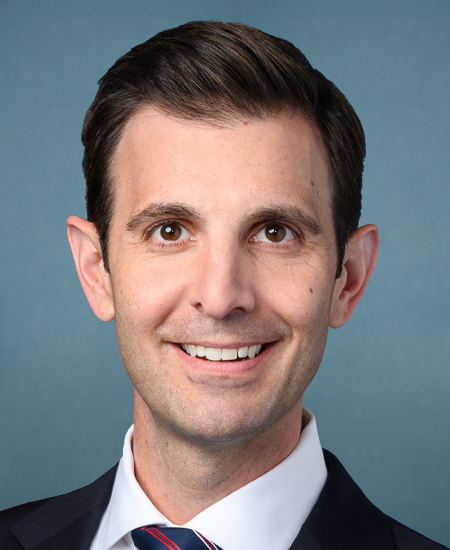
Photo of Christopher R. Deluzio
D United States House · District 17 · Pennsylvania On the 2026 ballot

Rep. Christopher R. Deluzio

Compare
Total votes
1,879
all sessions
Attendance
100%
8 missed
Higher than 96% of chamber peers
With party
96%
of cast votes
Near the chamber average
Bipartisan score
2%
crosses aisle rarely
Near the chamber average
Sponsored
1,131
bills & resolutions
Higher than 90% of chamber peers
Committees
6
assignments
1,131 bills and resolutions

Sponsored bills

Total
1,131
Primary
59
Co-sponsor
1,072
This page
1,131
matching current filters
Co-sponsor HR 1307
In committee · United States House · Co-sponsor
Office of Gun Violence Prevention Act of 2025

Maddy summaryThe Office of Gun Violence Prevention Act of 2025 would create a new office within the Department of Justice to coordinate federal efforts on reducing gun violence. The office, led by a Director appointed by the Attorney General, would integrate existing DOJ programs, evaluate data gaps, and develop evidence-based recommendations for Congress and the President. It would also establish an advisory council including survivors of gun violence, public health officials, and community representatives to guide its work. The office would produce annual reports detailing gun violence trends and policy proposals, while collaborating with agencies like Health and Human Services and the FBI.

In committee Feb 13, 2025 1 co-sponsor
Co-sponsor HR 1284
In committee · United States House · Co-sponsor
Fighting Trade Cheats Act of 2025

Fighting Trade Cheats Act of 2025 This bill increases penalties for, and establishes additional enforcement mechanisms related to, fraudulent and grossly negligent violations of U.S. customs laws. Specifically, the bill increases the maximum civil penalty for a fraudulent violation to three times the domestic value of the merchandise. (Currently, the maximum penalty is the domestic value of the merchandise.) It prohibits a person who commits a fraudulent violation from importing merchandise into the United States for a five-year period. Additionally, the bill increases the maximum civil penalty for a grossly negligent violation to the lesser of (1) 3 times the domestic value of the merchandise; or (2) 10 times the lawful duties, taxes, and fees. (Currently, the maximum penalty is the lesser of the domestic value of the merchandise or four times the lawful duties, taxes, and fees.) It prohibits a person who commits a grossly negligent violation from importing merchandise into the United States for a two-year period. Further, the bill applies these importation bans to an affiliated person (e.g., a family member or employee) of the person who committed the fraudulent or grossly negligent violation. The bill establishes a private right of action for an interested party (e.g., a manufacturer) affected by customs fraud or grossly negligent violations. The bill prohibits any person (or an affiliated person) who commits a fraudulent or grossly negligent violation from participating in the U.S. Customs and Border Protection's Importer of Record program, and further requires revocation of their importer of record numbers.

In committee Feb 13, 2025 1 co-sponsor
Co-sponsor HJRES 54
In committee · United States House · Co-sponsor
Proposing an amendment to the Constitution of the United States providing that the rights protected and extended by the Constitution are the rights of natural persons only.

Maddy summaryThis bill proposes a constitutional amendment stating that only "natural persons" (living humans) have rights protected by the U.S. Constitution, explicitly denying constitutional rights to corporations, LLCs, and other artificial entities. It would require governments to regulate campaign contributions and spending to prevent money from influencing elections, banning the view that spending to influence elections constitutes protected speech under the First Amendment. The amendment would not affect the constitutional right to a free press. This change would directly impact how corporations and other non-human entities can legally challenge laws or regulations in court.

In committee Feb 12, 2025 1 co-sponsor
Co-sponsor HR 1269
In committee · United States House · Co-sponsor
Honoring Our Fallen Heroes Act of 2025

Maddy summaryHR 1269, the Honoring Our Fallen Heroes Act of 2025, expands benefits for public safety officers (like police and firefighters) who develop certain cancers linked to their work. It adds 22 specific cancers - including lung, mesothelioma, and breast cancer - to the list of conditions presumed to be "exposure-related" and sustained in the line of duty. This presumption applies if the officer served at least 5 years, was diagnosed with the cancer within 15 years after last active duty, and the cancer directly caused death or permanent disability. The bill also establishes a process for adding new cancers every 3 years based on medical evidence from agencies like NIOSH, and allows claims to be filed within 3 years of the law's enactment.

In committee Feb 12, 2025 1 co-sponsor
Co-sponsor HR 1235
In committee · United States House · Co-sponsor
Federal Infrastructure Bank Act of 2025

Maddy summaryThe Federal Infrastructure Bank Act of 2025 would create a new Federal Infrastructure Bank to provide financing for infrastructure projects across the United States. The bank would offer loans, equity investments, and loan guarantees to eligible entities like state governments, corporations, and public-private partnerships for projects including roads, bridges, ports, airports, and energy systems. The bill requires at least 10% of the bank's funding to support rural infrastructure projects and prohibits funding for projects influenced by China or located outside the United States. The bank would maintain risk-based capital at no less than 10% and would be regulated by the Federal Reserve System.

In committee Feb 12, 2025 1 co-sponsor
Co-sponsor HR 1275
In committee · United States House · Co-sponsor
Focus on Learning Act

Maddy summaryThe Focus on Learning Act requires the Surgeon General to study how personal mobile devices affect student learning, mental health, and school climate in elementary and secondary schools. It establishes a pilot program offering $5 million over five years to school districts that implement "device-free" environments - requiring secure storage for students' personal phones during school hours - while allowing exceptions for health needs, students with disabilities, or language translation. Schools in the pilot must obtain parental input, maintain staff communication systems, and detail their device policies before participating. The study and pilot aim to test whether reducing personal device use during school improves academic outcomes and school environment, with results to be reported to Congress.

In committee Feb 12, 2025 1 co-sponsor
Co-sponsor HR 1217
In committee · United States House · Co-sponsor
Orphan Well Grant Flexibility Act of 2025

Maddy summaryHR 1217, the Orphan Well Grant Flexibility Act of 2025, amends federal grant rules for cleaning up orphaned oil and gas wells by removing the requirement for states to measure methane emissions as a condition for receiving funding. It allows states to use estimated data from well plugging projects (without needing to collect new monitoring data) for reporting purposes. The bill also mandates a National Academies study to analyze how well-plugging activities affect local economies, housing, and water quality in communities where many wells are cleaned up, requiring input from all U.S. regions and agencies like HUD. This study must be completed within 18 months after the final grant is awarded, using existing federal funding.

In committee Feb 11, 2025 1 co-sponsor
Co-sponsor HR 1189
In committee · United States House · Co-sponsor
National Plan for Epilepsy Act

Maddy summaryHR 1189, the National Plan for Epilepsy Act, creates a coordinated federal strategy to address epilepsy through a National Plan for Epilepsy. The plan requires the Secretary of Health and Human Services to establish an annual assessment, maintain a diverse Advisory Council (including people with epilepsy, caregivers, and experts), and coordinate research and care across federal agencies. Key provisions include annual progress reports to Congress, data sharing between agencies, and recommendations to improve diagnosis, treatment access, and reduce epilepsy-related disparities. The plan expires December 31, 2035, and directly affects the estimated 3.4 million people in the U.S. living with epilepsy and their caregivers.

In committee Feb 11, 2025 1 co-sponsor
Co-sponsor HR 1101
In committee · United States House · Co-sponsor
Taxpayer Data Protection Act

Maddy summaryThis bill restricts access to Treasury payment systems (including the Bureau of the Fiscal Service) to only Treasury employees with a "fully successful" performance rating and at least one year of civil service, or contractors/outsiders with security clearances, required privacy/cybersecurity training, ethics agreements, and no conflicts of interest. It treats non-government users accessing these systems as government employees for ethics rules and defines specific actions (like stopping payments) as "personal and substantial participation" in government matters. The Treasury Inspector General must investigate any unauthorized access within 30 days and report to Congress, detailing the breach, security risks, and any halted payments. The bill directly affects Treasury staff, contractors, and any external entities accessing federal payment systems.

In committee Feb 11, 2025 1 co-sponsor
Co-sponsor HR 965
Passed · United States House · Co-sponsor
Housing Unhoused Disabled Veterans Act

Maddy summaryHR 965, the Housing Unhoused Disabled Veterans Act, amends the U.S. Housing Act of 1937 to exclude certain disability benefits from income calculations for housing assistance. Specifically, it removes benefits received under Chapters 11 or 15 of Title 38 (veterans' disability compensation) from income counts for the Section 8 supported housing program and eligibility for other housing assistance. This change directly helps disabled veterans receiving these benefits by making them more likely to qualify for HUD-administered housing programs. The bill applies to veterans renting residential units on Department property under HUD housing assistance programs established after the bill's enactment.

Passed Feb 11, 2025 1 co-sponsor
Showing 551 to 560 of 1,131 bills
Previous 1 … 55 56 57 … 114 Next