

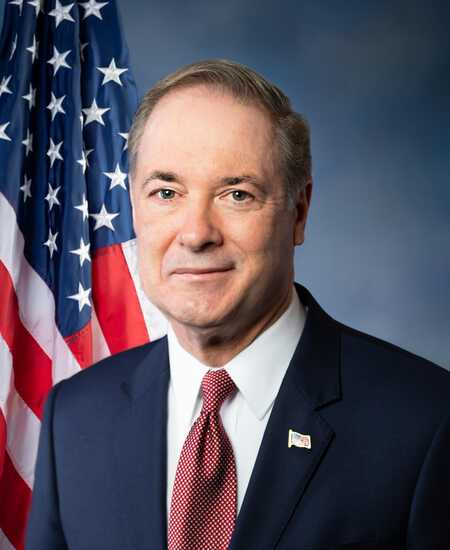
Photo of John Joyce
R United States House · District 13 · Pennsylvania On the 2026 ballot

Rep. John Joyce

Compare
Total votes
2,837
all sessions
Attendance
100%
6 missed
Higher than 92% of chamber peers
With party
93%
of cast votes
Lower than 78% of chamber peers
Bipartisan score
4%
crosses aisle rarely
Higher than 76% of chamber peers
Sponsored
637
bills & resolutions
Lower than 82% of chamber peers
Committees
4
assignments
637 bills and resolutions

Sponsored bills

Total
637
Primary
56
Co-sponsor
581
This page
637
matching current filters
Co-sponsor HR 2400
In committee · United States House · Co-sponsor
Reentry Act of 2023

Maddy summaryThis bill allows Medicaid coverage for incarcerated individuals during the 30 days preceding their release from public institutions. It directly affects people transitioning from prisons or jails back into communities by extending health coverage during this critical period. The key mechanism amends the Social Security Act to remove a Medicaid exclusion for this 30-day window. Additionally, it requires an 18-month report analyzing correctional healthcare standards, current discharge practices, and the potential impact of this coverage extension on post-release health access.

In committee Apr 7, 2023 1 co-sponsor
Co-sponsor HR 1826
In committee · United States House · Co-sponsor
PSA Screening for HIM Act

Maddy summaryHR 1826 (PSA Screening for HIM Act) requires health insurance plans and issuers to cover prostate cancer screenings without out-of-pocket costs for men aged 40 and over who are at high risk of prostate cancer. This directly affects African-American men and men with a family history of prostate cancer (defined as having a first-degree relative diagnosed with or who died from prostate cancer). The bill mandates coverage for evidence-based screenings under the same requirements as other preventive services, effective for plan years starting January 1, 2024. It aims to address disparities in prostate cancer outcomes by removing financial barriers to early detection for high-risk groups.

In committee Apr 7, 2023 1 co-sponsor
Co-sponsor HR 1781
In committee · United States House · Co-sponsor
Ensuring Access to General Surgery Act of 2023

Maddy summaryThe Ensuring Access to General Surgery Act of 2023 directs the Health Resources and Services Administration (HRSA) to study how to accurately identify areas in the U.S. with insufficient access to general surgeons, particularly in rural and underserved communities. The study will evaluate current methods for designating health professional shortage areas and propose a new approach using hospital service areas, surgeon-to-population ratios, and factors like wait times and transportation access. HRSA must report findings to Congress within one year and may later establish a formal process to designate "general surgery shortage areas" through rulemaking. If implemented, this would publicly list affected areas to better target resources addressing surgical care gaps.

In committee Mar 31, 2023 1 co-sponsor
Co-sponsor HR 1671
In committee · United States House · Co-sponsor
Increasing Access to Dental Insurance Act

Maddy summaryThis bill amends the Affordable Care Act to allow individuals to enroll in standalone dental plans through health insurance Exchanges without needing to also have a separate health insurance plan. It directly affects consumers seeking dental coverage who may not qualify for or prefer not to enroll in a comprehensive health plan. The key provision removes a federal restriction that previously prevented enrollment in these dental plans solely based on lack of separate health insurance. This change makes it easier for people to access dental insurance options through the same marketplaces used for health coverage.

In committee Mar 31, 2023 1 co-sponsor
Co-sponsor HR 1
Passed · United States House · Co-sponsor
Lower Energy Costs Act

Maddy summary# Summary of the TAPP American Resources Act This comprehensive legislation, titled the "TAPP American Resources Act" (or "Transparency, Accountability, and Permitting Process for American Resources Act"), is a major overhaul of federal energy and natural resource permitting processes. The key provisions include: 1. **Streamlined Permitting Processes**: - Creates a 50-year term limit for pipeline rights-of-way - Allows oil and gas exploration on non-Federal surface estate without Federal permits - Reduces royalty rates for oil and gas leases from 16.67% to 12.5% - Limits judicial review of permits to cases involving "imminent and substantial environmental harm" 2. **NEPA Reforms**: - Expands categorical exclusions for certain energy projects - Allows use of previously completed environmental assessments for similar projects - Limits environmental reviews to areas directly affected by the proposed action - Reduces consideration of downstream effects of oil and gas consumption 3. **Mining and Mineral Development**: - Designates mining as a "covered sector" for permitting improvement - Creates a memorandum of agreement process for mining projects - Requires mineral resource assessments before land withdrawals - Ensures uranium is considered a critical mineral 4. **Revenue Sharing**: - Changes distribution of Gulf of Mexico revenue to states (37.5% to Gulf states, 62.5% to general fund) - Creates parity in offshore wind revenue sharing with offshore oil and gas - Eliminates administrative fees under the Mineral Leasing Act 5. **Water Quality Certification**: - Limits certification requirements to specific provisions of Clean Water Act sections - Requires states to publish certification requirements within 30 days - Sets 90-day timeline for states to identify additional materials needed The legislation represents a significant shift toward expediting domestic energy production while reducing regulatory burdens, with a focus on oil, gas, and mineral development on federal lands. It includes numerous amendments to existing laws including the National Environmental Policy Act, Mineral Leasing Act, Outer Continental Shelf Lands Act, and Clean Water Act.

Passed Mar 30, 2023 1 co-sponsor
Co-sponsor HR 5
Passed · United States House · Co-sponsor
Parents Bill of Rights Act

Maddy summaryHR 5, the Parents Bill of Rights Act, would require public schools receiving federal funding to provide parents with greater access to educational information. The bill mandates that schools post curricula online or widely distribute it to parents, include school budgets in report cards, and provide specific information about school activities including violent incidents and plans to eliminate gifted programs. It also guarantees parents the right to meet with teachers twice a year, review library materials, and address school boards. These requirements would apply to all local educational agencies and schools covered by the Elementary and Secondary Education Act. The bill amends existing education laws to strengthen parental transparency and involvement in their children's education.

Passed Mar 27, 2023 1 co-sponsor
Primary HR 1354
In committee · United States House · Lead sponsor
Information and Communication Technology Strategy Act

Maddy summaryHR 1354, the Information and Communication Technology Strategy Act, requires the Commerce Secretary to produce a report within one year of enactment assessing the U.S. information and communication technology (ICT) supply chain. The report must identify critical technologies for economic competitiveness, evaluate U.S. and trusted vendor capacity, and analyze dependence on "untrusted" vendors (defined as companies posing national security risks under existing law). Based on this report, the Secretary must develop a government-wide strategy within 180 days to strengthen trusted ICT vendors and reduce reliance on untrusted sources. The strategy will outline specific agency roles, needed resources, and potential changes to federal programs or laws to support this goal.

In committee Mar 24, 2023 0 co-sponsors
Co-sponsor HCONRES 17
In committee · United States House · Co-sponsor
Expressing the sense of Congress that the Federal Government should not impose any restrictions on the export of crude oil or other petroleum products.

Maddy summaryHCONRES 17 is a non-binding congressional resolution expressing that the U.S. Congress believes the federal government should not impose restrictions on crude oil or petroleum product exports. It cites the 2015 repeal of export bans, U.S. growth as a top oil producer, and 2019 status as a net petroleum exporter as reasons for this position. The resolution specifically urges against overly restrictive regulations on energy production and any export restrictions under the Energy Policy and Conservation Act. It does not change existing law but formally states congressional sentiment on this policy matter.

In committee Mar 23, 2023 1 co-sponsor
Co-sponsor HR 1155
In committee · United States House · Co-sponsor
Keeping America’s Refineries Act

Maddy summaryHR 1155, the Keeping America’s Refineries Act, exempts certain petroleum refineries from a specific requirement under the Clean Air Act. It directly affects refineries operating alkylation units that use hydrofluoric acid (HF), specifically those with valid Clean Air Act permits or that meet American Petroleum Institute safety standards. The bill prohibits the EPA from mandating that these refineries assess "safer technology" or alternative risk management measures for HF use in their hazard assessments. This change removes a regulatory step requiring refineries to evaluate safer alternatives for HF acid, focusing solely on their existing operational compliance.

In committee Mar 23, 2023 1 co-sponsor
Primary HR 1131
In committee · United States House · Lead sponsor
To require the Administrator of the Environmental Protection Agency to authorize the use of flexible air permitting with respect to certain critical energy resource facilities, and for other purposes.

Maddy summaryHR 1131 requires the EPA to revise its air permitting rules to allow "flexible air permitting" for specific energy facilities. This applies to owners or operators of facilities processing "critical energy resources" (as defined by the Energy Secretary), which are essential energy sources with vulnerable supply chains. The bill directs the EPA to adopt the existing 2009 flexible permitting framework (from the Federal Register) to enable these facilities to adjust operations more easily. This change would streamline permitting for facilities deemed critical to U.S. energy security, without altering environmental standards.

In committee Mar 23, 2023 0 co-sponsors
Showing 321 to 330 of 637 bills
Previous 1 … 32 33 34 … 64 Next