

Maddy summaryThis bill helps spouses of U.S. military members (active or reserve duty, honorably discharged) who have filed for immigration as immediate relatives. It removes specific inadmissibility barriers, including certain criminal history checks unrelated to immigration status, for these spouses during visa processing. It also allows spouses previously removed from the U.S. to apply for visas from abroad and temporarily return as nonimmigrants to reunite with their service member spouse while their applications are pending.
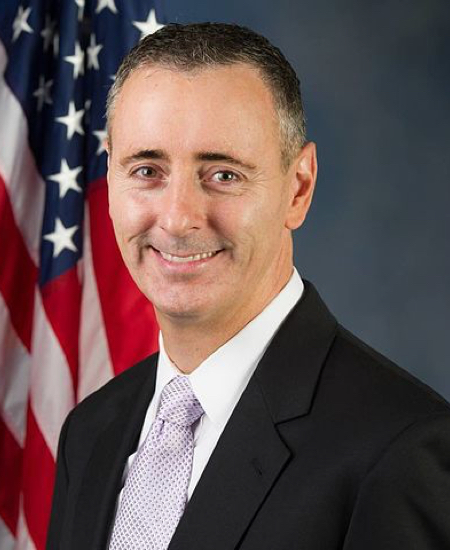
Rep. Brian K. Fitzpatrick
Sponsored bills
Maddy summaryHR 3505, the Barriers to Suicide Act of 2025, creates a federal grant program administered by the Department of Transportation to fund the installation of proven safety barriers and nets on specific high-risk structures. The program provides competitive grants (up to 80% federal funding) to states, local governments, or other eligible entities for projects installing suicide deterrents on bridges, buildings, parking garages, highway-rail crossings, or rail stations. It prioritizes areas with high suicide rates and mandates a study by the Comptroller General to evaluate effective deterrents for non-bridge structures and their costs, with a report due within one year of enactment. The bill authorizes $10 million annually from 2026-2030 for this initiative.
Maddy summaryHR 3523 requires the Treasury Secretary to designate foreign organizations engaged in fraud against U.S. citizens or lawful permanent residents as "Foreign Financial Threat Organizations" (FFTOS). This directly affects foreign entities that deceive U.S. residents into sending money or assets through fraudulent schemes. Key mechanisms include freezing the assets of designated FFTOS, blocking their communication with U.S. residents, and subjecting them to penalties similar to terrorist designations. The bill mandates annual reports to Congress detailing designations, assets seized, and funds returned to victims.
Maddy summaryThe AGRITOURISM Act (HR 3470) creates a new Office of Agritourism within the U.S. Department of Agriculture (USDA) to support farm-based tourism businesses. The Office, led by a Director appointed by the Secretary, will coordinate USDA programs and provide technical assistance to help small and family-run farms diversify income through activities like farm tours, on-farm sales, accommodations, and farm-related events. It will update USDA programs to reflect best practices, share resources with agritourism businesses, and facilitate partnerships to promote rural economic development. This bill directly affects rural agricultural businesses and the USDA’s approach to fostering sustainable tourism in rural communities.
Maddy summaryThis bill requires the VA to notify veterans filing claims without representation about free help from recognized veterans service organizations and trained representatives. It mandates an online tool listing accredited representatives (updated quarterly) and adds fee warnings to VA websites, including links to the tool and a site for reporting unauthorized fees. The VA must also review its processes for recognizing representatives within 180 days and report findings to Congress. The bill directly affects veterans navigating VA claims by improving access to verified assistance and transparency around fees. It focuses on concrete procedural changes to enhance claimant awareness, not on outcome predictions.
Maddy summaryHR 3501 would require Medicare providers to screen beneficiaries aged 65 and older for cognitive impairment during annual wellness visits and initial preventive physical exams, using tools approved by the National Institute on Aging. The screening must be documented in the patient’s medical record. This change applies to visits starting January 1, 2026, and aims to support early detection of conditions like Alzheimer’s through standard preventive care. The bill directly affects Medicare beneficiaries, providers, and caregivers by integrating cognitive screening into routine preventive services.
Maddy summaryHR 2240 requires federal agencies to analyze data gaps related to law enforcement safety and wellness. Specifically, it mandates three reports within 270 days of enactment: one on attacks against officers (including ambushes), another on unreported aggressive incidents not meeting crime thresholds, and a third on officer mental health impacts and existing wellness resources. The reports will examine current data collection limitations, training effectiveness, and potential improvements to reporting systems like the Law Enforcement Officers Killed and Assaulted Data Collection. This bill focuses on gathering information to inform future policy decisions, not on creating new programs or funding. It directly affects federal agencies (Attorney General, FBI, National Institute of Justice) and aims to improve understanding of officer safety challenges.
Maddy summaryThis bill creates two new tax credits to support homebuyers. It provides a first-time homebuyer credit of up to $50,000 for down payments on primary residences, with income limits ($150,000 single filers, $225,000 head of household, $300,000 joint filers). A separate starter home construction credit offers 15% (30% for first-time buyers) of costs for new homes under 1,200 square feet priced at or below 80% of local median home prices. The credits require repayment if the home is sold or no longer used as a primary residence within five years, with exceptions for new purchases, death, divorce, or military service.
Stronger Communities through Better Transit Act This bill requires the Department of Transportation (DOT) to establish a grant program to support operating projects for public transportation and related service improvements, particularly in underserved communities and areas of persistent poverty. Specifically, the bill requires DOT to allocate funding under the program for urbanized areas, states, and Indian tribes that are recipients of funds under either the Federal Transit Administration's (FTA's) Urbanized Area Formula Funding program or Formula Grants for Rural Areas program. Eligible recipients may use funding for operating costs associated with projects that improve public transportation service for transit-dependent populations and support increased transit ridership (e.g., service expansion, information technology enhancements, and workforce development). DOT must apportion the funding so that recipients receive funds that are proportional to their share of operating costs. The bill also provides for an increased federal cost share for operating assistance for projects or programs carried out in areas of persistent poverty or underserved communities. DOT must set up a multimodal access measurement interface for public agencies to aid transit agencies in determining and reporting on access to jobs and essential services. A grant recipient must (1) report specific information to the FTA for inclusion in the National Transit Database, and (2) survey transit riders and non-riding residents regarding transit service improvements. Further, the bill expands the purposes of the public transportation programs to include supporting public transportation's role in combating climate change through growing/retaining transit ridership.
Maddy summaryHRES 421 is a resolution memorializing 345 law enforcement officers killed in the line of duty during 2024, listing each officer's name. It expresses the House of Representatives' support for law enforcement, acknowledges the sacrifice of these officers, and recognizes the need for adequate resources to protect officers while they serve the public. The resolution also extends condolences to the families of fallen officers. As a ceremonial resolution, it does not create new laws or policies but serves as a formal tribute.