Coastal and Ocean Acidification Stressors and Threats Research Act of 2021 or the COAST Research Act of 2021 This bill addresses the effects of ocean and coastal acidification on marine organisms and ecosystems. Specifically, the bill reauthorizes through FY2026 and revises the Ocean Acidification Program of the National Oceanic and Atmospheric Administration and the ocean acidification grant program of the National Science Foundation. The bill expands those programs, as well as the ocean acidification activities of the National Aeronautics and Space Administration (NASA), to include efforts to research and monitor the effects of coastal acidification.
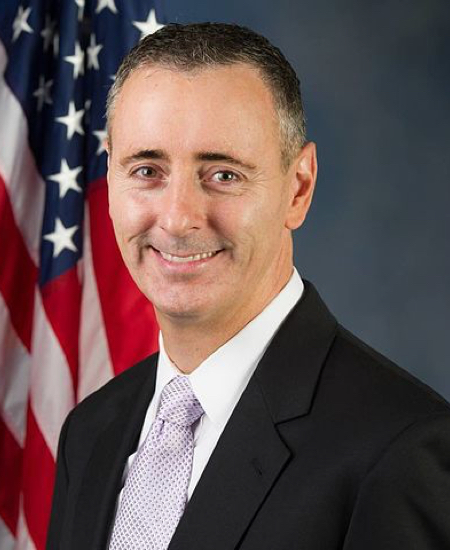
Rep. Brian K. Fitzpatrick
Sponsored bills
Crimea Annexation Non-Recognition Ac t This bill prohibits any federal agency from taking any action or extending any assistance that recognizes or implies recognition of Russia's sovereignty over Crimea, its airspace, or its territorial waters.
Ghost Army Congressional Gold Medal Act This bill directs the Speaker of the House of Representatives and the President pro tempore of the Senate to award a Congressional Gold Medal to the 23rd Headquarters Special Troops and the 3133d Signal Service Company, known as the Ghost Army , collectively, in recognition of its service during World War II.
Rural STEM Education Research Act This bill specifies federal scientific research and development efforts towards STEM (science, technology, engineering, and mathematics, including computer science) workforce development and rural STEM education. (Sec. 3) The bill amends the objectives of the Manufacturing Extension Partnership program to include the provision to secondary schools of information about the job skills needed in manufacturing companies, and the promotion and expansion of certification systems offered through local high schools. The activities of a manufacturing extension center are expanded to include local high schools in the facilitation of collaborations and partnerships between manufacturing companies and schools to help those entities better understand the specific needs of manufacturers and to help manufacturers better understand the skill sets that students learn in school programs. The National Institute of Standards and Technology (NIST) must award prizes to stimulate research and development of creative technologies in order to deploy affordable and reliable broadband connectivity to underserved rural communities. NIST may award not more than a total of $5 million in prizes. (Sec. 4) The Office of Science and Technology Policy must establish a broadband research and development working group to address national research challenges and opportunities for improving broadband access and adoption across the United States. (Sec. 5) The National Science Foundation (NSF) shall enter into an agreement with the National Academy of Sciences under which the National Academy of Sciences agrees to evaluate aspects of STEM education and workforce development in rural areas. (Sec. 6) The Government Accountability Office shall conduct a study on the engagement of rural populations in federal STEM programs. (Sec. 7) Experimental Program to Stimulate Competitive Research (EPSCoR) programs shall consider modifications to award structures to increase the capacity of rural communities to provide quality STEM education and STEM workforce development programming to students and teachers. (Sec. 8) The NSF must award grants to institutions of higher education or nonprofit organizations for (1) research and development to advance innovative approaches to support and sustain high-quality STEM teaching in rural schools, (2) research and development of programming to identify the barriers rural students face in accessing high-quality STEM education, (3) development of innovative solutions to improve the participation and advancement of rural students in grades Pre-K through 12 in STEM studies, and (4) research on online STEM education courses for rural communities. The NSF may establish a pilot program of regional cohorts in rural areas to provide peer support, mentoring, and hands-on research experiences for rural STEM educators of students in grades Pre-K through 12 in order to build an ecosystem of cooperation among educators, researchers, academia, and local industry.

This resolution recognizes the 50th anniversary of the ratification of the Environmental Rights Amendment in Pennsylvania.
This resolution expresses support for the designation of National CASA/GAL Volunteers Day to commend the work of court-appointed special advocate (CASA) and guardian ad litem (GAL) volunteers.
This resolution expresses support for the designation of National Brain Aneurysm Awareness Month.
This resolution expresses support for the designation of DIPG Awareness Day. DIPG is diffuse intrinsic pontine glioma, a terminal childhood brain cancer.
Credit for Caring Act of 2021 This bill allows an eligible caregiver a tax credit of up to $5,000 for 30% of the cost of long-term care expenses that exceed $2,000 in a taxable year. The bill defines eligible caregiver as an individual who has earned income for the taxable year in excess of $7,500 and pays or incurs expenses for providing care to a spouse or other dependent relative with long-term care needs.
Institutional Grants for New Infrastructure, Technology, and Education for HBCU Excellence Act or the IGNITE HBCU Excellence Act This bill establishes a grant program to support long-term improvements of historically Black colleges and universities (HBCUs) and graduate programs at HBCUs. Specifically, the bill requires the Department of Education (ED) to award grants to HBCUs to improve campus facilities. A recipient must use grant funds for certain activities, such as constructing or renovating facilities, carrying out major repairs, and strengthening the safety and security of a campus. Any new construction, modernization, or renovation projects must meet building code and energy and water conservation requirements. Further, HBCUs must seek to procure contracts from certain small businesses, including those owned and controlled by veterans and service-disabled veterans. The bill prohibits the use of grant funds for specified activities, including for the payment of routine and predictable maintenance costs, minor repairs, and utility bills. The Government Accountability Office must study the implementation of the grant program. The bill also requires ED to repay the outstanding balance of principal, interest, fees, and costs and any related reimbursements for certain capital financing loans.