

Increasing Access to Mental Health in Schools Act This bill directs the Department of Education (ED) to establish a grant program and a student loan forgiveness program to increase the number of school-based mental health services providers in elementary and secondary schools. First, ED must award grants to partnerships between educational agencies and graduate institutions to increase the number of school-based mental health services providers employed by low-income local educational agencies (LEAs). Grant funds may be used for specified purposes, including to provide student loan forgiveness and tuition credits and to support recruitment, hiring, and training. In addition, ED must establish a program to provide student loan forgiveness for individuals who (1) are not, and have never been, participants in the grant program established by the bill; and (2) have been employed by low-income LEAs for five or more consecutive school years as mental health services providers.
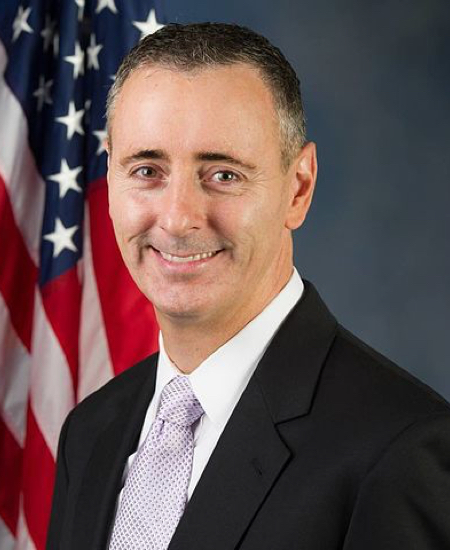
Rep. Brian K. Fitzpatrick
Sponsored bills
Veteran Education Empowerment Act This bill reauthorizes through FY2029 and otherwise revises a Department of Education (ED) grant program for student veteran centers. Specifically, ED must make grants to institutions of higher education (IHEs) or consortia of IHEs to establish, maintain, improve, or operate a student veteran center. A student veteran center is a dedicated space on a campus that provides students who are veterans or members of the Armed Forces with (1) a lounge or meeting space for themselves, their spouses or partners, their children, and veterans in the community; and (2) a centralized office for student veteran services that serves as a single point of contact to coordinate comprehensive support services for student veterans.
Taiwan Fellowship Act This bill directs the Department of State to establish a program to provide fellowships in Taiwan to qualifying U.S. government employees. Each program fellow shall work in (1) a Taiwanese government agency; or (2) a nongovernmental organization, such as the American Institute in Taiwan, whose interests are associated with the interests of the fellow's employing U.S. government agency. (In 1979, the United States established diplomatic relations with China and ended formal diplomatic ties with Taiwan. The American Institute in Taiwan is a private organization that has a contract with the State Department to represent U.S. interests in Taiwan and provide consular services.)
Turkey and Ecumenical Patriarchate Religious Freedom Act of 2021 This bill requires reports on religious freedom in Turkey. The Department of State must report to Congress on the State Department's policy for promoting religious freedom in Turkey. If the U.S. Commission on International Religious Freedom recommends putting Turkey on the State Department's special watch list of countries that engage in or tolerate severe violations of religious freedom but the State Department does not do so, the President must report to Congress a justification for the decision. The President shall not have to make this report if Turkey is added to the special watch list or designated a country of particular concern for religious freedom.
This resolution supports the designation of ALS Awareness Month. Amyotrophic lateral sclerosis (ALS) is a progressive neurodegenerative disease, also known as Lou Gehrig's disease, that affects nerve cells in the brain and spinal cord.
This resolution expresses support for policies and other efforts to prevent childhood sunburns, such as exempting sunscreen from over-the-counter medication bans in schools.
Preventing Lead Poisoning Act of 2021 This bill requires coverage under the Children's Health Insurance Program (CHIP) of screening blood lead tests. Specifically, CHIP must cover a child's test once at the age of 12 months and once at the age of 24 months, or once between the ages of 24 months and 72 months if the child has never been assessed, as well as testing at such other times as recommended by a child's health care provider. The bill also provides statutory authority for these requirements (regarding testing intervals) for state Medicaid programs.
Stamp Out Lyme Disease Act This bill directs the U.S. Postal Service to issue a Lyme Disease Research Semipostal Stamp, with all proceeds being transferred to the National Institute of Allergy and Infectious Diseases.
Trees for Residential Energy and Economic Savings Act of 2021 or the TREES Act of 2021 This bill directs the Department of Energy (DOE) to establish a grant program for states, local governments, Indian tribes, and other entities to facilitate tree planting projects that reduce residential energy consumption. Under the program, DOE may award grants to facilitate the planting of at least 300,000 trees annually in residential neighborhoods.
Increasing Access to Osteoporosis Testing for Medicare Beneficiaries Act of 2021 This bill specifies that certain Medicare payment rules applicable to imaging services shall apply to dual-energy x-ray absorptiometry services used in bone mass scans beginning in 2022. The Centers for Medicare & Medicaid Services must establish national minimum payment amounts for such services.