Veteran Readiness and Employment National Emergency Extended Deadline Act or the VR&E NEED Act This bill extends a veteran's eligibility for the Veteran Readiness and Employment program when educational institutions are temporarily or permanently closed due to an emergency situation, or there is another reason that prevents a veteran from participating. Specifically, the period of eligibility must not run during the period the veteran is prevented from participating in the program. The period must resume on a date, determined by the Department of Veterans Affairs, that is not earlier than the first day after the veteran is able to resume participation and not later than 90 days after that day.
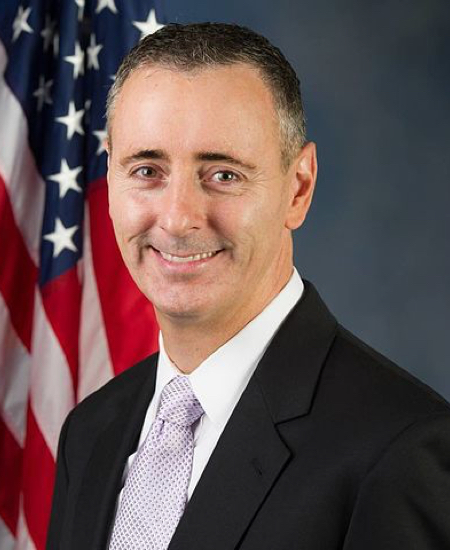
Rep. Brian K. Fitzpatrick
Sponsored bills
Resources to Prevent Youth Vaping Act This bill directs the Food and Drug Administration (FDA) to collect user fees on products that it deems by regulation to be tobacco products, including electronic nicotine delivery systems, and addresses related issues. Currently, the FDA is authorized to collect user fees only on specified classes of tobacco products. The bill increases the total amount of such fees to be collected for FY2022. For each fiscal year after, the total amount of such fees shall be adjusted according to changes in a price index. Starting in FY2024, the FDA must assess user fees on classes of products that it has deemed by regulation to be tobacco products, unless the FDA fails to finalize a formula for assessing such fees on time. Once it is finalized, the FDA may only revise this formula by regulation. The bill also requires each tobacco manufacturer and importer to periodically submit certain information related to the tobacco products that it sells or distributes in the United States. The FDA must annually report to Congress about its use of such tobacco product fees.
This concurrent resolution expresses the sense of Congress that government entities should consider using a portion of proceeds from litigation against opioid manufacturers and distributors for drug take-back programs.
ABLE Employment Flexibility Act This bill permits employers to make tax-exempts contributions to ABLE (Achieving Better Life Experience) accounts in lieu of making contributions to existing tax-exempt defined contribution retirement plans. An ABLE account is established to pay the expenses (e.g., food, education, housing, transportation, employment training and support, and health care expenses) of a designated beneficiary who is disabled.
Cargo Flight Deck Security Act of 202 1 This bill requires all-cargo aircraft to be equipped with intrusion-resistant cockpit doors that remain locked while such aircraft is in flight. The requirement takes effect on January 1, 2023, regardless of whether the Federal Aviation Administration has issued regulations to implement such requirement.
United States Call Center Worker and Consumer Protection Act of 2021 This bill establishes restrictions on businesses that relocate call centers or redirect customer service calls to locations outside the United States. Specifically, a business must notify the Department of Labor that it intends to move its customer service call center overseas and Labor must maintain a publicly available list of such businesses. Subject to narrow exceptions, a business appearing on such list is ineligible to receive federal grants or guaranteed loans for five years after the business is added to the list. Further, agencies must condition the awarding of government contracts on the requirement that any call center activity pursuant to the contract must be performed in the United States. Additionally, the bill requires call center employees to disclose their physical location at the beginning of each call initiated or received, unless all employees of the business participating in the communication are located in the United States, among other exceptions.
Averting Loss of Life and Injury by Expediting SIVs Act of 2021 or the Allies Act of 2021 This bill increases the number of special immigrant visas available to qualified Afghan nationals who worked for the U.S. government or the North Atlantic Treaty Organization (NATO) missions in Afghanistan. The bill also relaxes certain qualifications for such visas. Specifically, this bill makes available an additional 8,000 visas for principal aliens under this special visa program, to be available until all such visas have been issued. (The numerical limitations in this program apply only to the principal alien who applies for the visa, not to any accompanying spouse or child.) Under this bill, an alien may qualify based on a credible basis for concern about the possibility of an ongoing serious threat in Afghanistan due to their work with the U.S. government or a NATO mission, where currently the alien must have experienced such a threat. The bill also eliminates a requirement for each applicant to submit a credible sworn statement describing that threat. Furthermore, for an applicant qualifying for a visa by performing duties for U.S. military personnel stationed with a NATO mission, this bill eliminates a requirement that the duties performed qualify as sensitive and trusted duties. If an alien submits a visa application that included an accompanying spouse or child but the alien passes away before the application is granted, the surviving spouse or child shall remain eligible to receive a visa under that application. Currently, a surviving spouse or child retains eligibility only if the application was approved before the alien passed away.
PFAS Action Act of 2021 This bill establishes requirements and incentives to limit the use of perfluoroalkyl and polyfluoroalkyl substances, commonly referred to as PFAS, and remediate PFAS in the environment. PFAS are man-made and may have adverse human health effects. A variety of products contain PFAS, such as nonstick cookware or weatherproof clothing. The bill directs the Environmental Protection Agency (EPA) to designate the PFAS perfluorooctanoic acid (PFOA) and perfluorooctanesulfonic acid (PFOS) as a hazardous substances under the Comprehensive Environmental Response, Compensation, and Liability Act of 1980, thereby requiring remediation of releases of those PFAS into the environment. Within five years, the EPA must determine whether the remaining PFAS should be designated as hazardous substances. The EPA must publish human health water quality criteria under the Clean Water Act for each measurable PFAS and class of such substances and establish standards to limit discharges of PFAS from industrial sources into waters of the United States. In addition, the EPA must issue a national primary drinking water regulation for PFAS that, at a minimum, includes standards for PFOA and PFOS. Among other requirements, the EPA must also issue a final rule adding PFOA and PFOS to the list of hazardous air pollutants, test all PFAS for toxicity to human health, and regulate the disposal of materials containing PFAS. The EPA must also require PFAS manufacturers to submit analytical reference standards for PFAS. The EPA and states may use those standards for (1) the development of information, protocols, and methodologies, and (2) activities relating to the implementation of enforcement of requirements. Finally, the bill provides incentives to address PFAS, such as grants to help community water systems treat water contaminated by PFAS and grants to schools for testing and filtrating PFAS from drinking water.

VOCA Fix to Sustain the Crime Victims Fund Act of 2021 This bill adds a new source of revenue for the Crime Victims Fund and makes changes to formula grants supported by the fund. Specifically, the bill directs revenues collected from deferred prosecution and non-prosecution agreements to be deposited into the Crime Victims Fund. Currently, such revenues are deposited into the general fund of the Treasury. Additionally, the bill increases the percentage—from 60% to 75%—of state compensation payments to crime victims in the prior fiscal year used to calculate formula grants for state victim compensation programs. Finally, the bill directs states to waive the matching requirement for recipients of state victim assistance formula grants during and for one year after a pandemic-related national emergency. It also allows states to waive the matching requirement pursuant to a policy established by the state.
Student Records Protection Act This bill revises the requirements for an accrediting agency to be recognized by the Department of Education (ED) as a reliable authority on the quality of education being offered at an institution of higher education (IHE). It also requires an IHE to establish a records management plan for accreditation purposes. Specifically, an accrediting agency must require an IHE to submit for approval a records management plan upon notification by the IHE that it intends to cease its operations. The plan must include a plan for the custody, continued access, and disposition of student records (e.g., student transcripts, billing, and financial-aid records). Further, the IHE must submit the plan to ED. Under current law, an IHE must be accredited by an accrediting agency to participate in federal student-aid programs.