Halt Obesity in America Act This bill expands eligibility for the High Obesity Program, which is an obesity-reduction grant program managed by the Centers for Disease Control and Prevention for land-grant universities in states with eligible counties. Currently, an eligible county is one where the adult obesity rate is over 40%; the bill reduces that rate to 35%.
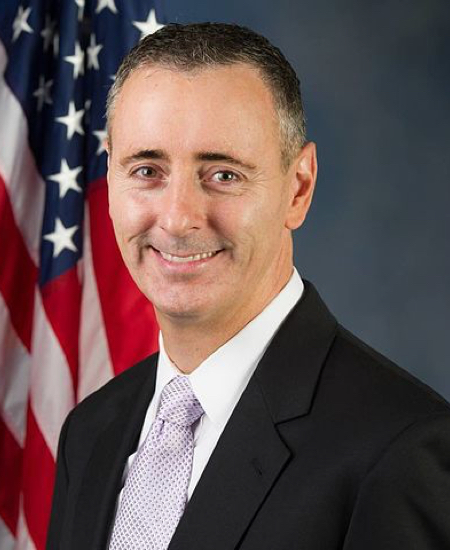
Rep. Brian K. Fitzpatrick
Sponsored bills
Darren Drake Act This bill directs the Department of Homeland Security to develop and disseminate best practices for vehicle rental companies and dealers to report suspicious behavior to law enforcement at the point of sale of a rental vehicle. The best practices must include guidance on defining and identifying suspicious behavior in a manner that protects civil rights and civil liberties.
Caring for Survivors Act of 2021 This bill increases the monthly rate of dependency and indemnity compensation payable to surviving spouses through the Department of Veterans Affairs. The bill also adjusts the amount payable to surviving spouses and children of veterans who were rated as totally disabled for a period of less than 10 years before their death.
United States Cadet Nurse Corps Service Recognition Act of 2021 This bill recognizes service as a member of the U.S. Cadet Nurse Corps between July 1, 1943, and December 31, 1948, as active duty service. The active duty designation entitles qualifying individuals to certain benefits afforded to veterans, such as burial benefits (not including interment or inurnment at Arlington National Cemetery) and honorary veteran status. Under the bill, the Department of Defense (DOD) must issue individuals who served in the corps during the specified period a discharge from their service under honorable conditions if such a discharge is warranted based on the duration and nature of the service. Such individuals are not entitled to Department of Veterans Affairs benefits aside from those related to burials and memorials. The bill also authorizes DOD to produce a service medal or other commendation, memorial plaque, or grave marker to honor the individuals.
This resolution recognizes and appreciates the dedication and devotion demonstrated by the men and women of law enforcement. It also condemns calls to defund, disband, dismantle, or abolish the police.
EB-5 Reform and Integrity Act of 2021 This bill reauthorizes the EB-5 Regional Center program through FY2026 and makes various changes to the program, such as imposing various oversight requirements. (EB-5 visas provide permanent resident status to qualified alien investors. A regional center allows EB-5 aliens to pool investments to meet various investment and job creation requirements.) Oversight-related provisions include requiring each center to (1) notify the Department of Homeland Security (DHS) of proposed changes to the center's structure, (2) maintain certain records and make such records available to DHS for audits, (3) obtain approval for each particular investment offering, and (4) annually report to DHS. The bill prohibits certain individuals and entities from involvement in a center, such as (1) a person who had committed a violation involving fraud in the previous 10 years, (2) a non-U.S. national not admitted for permanent residence, or (3) a foreign government official. DHS shall deny petitions, such as a petition to certify a regional center or to classify an alien as an alien investor, if approval would threaten U.S. national interest. The bill provides various enforcement authority to DHS and U.S. Citizenship and Immigration Services, including the ability to permanently bar an individual from participating in the regional center program. The bill establishes the EB-5 Integrity Fund to fund program enforcement activities. The bill contains various provisions related to EB-5 petitions, such as a provision authorizing DHS to extend an alien's conditional permanent residence status.

Safer Schools Act of 2021 This bill establishes a pilot program through which the Department of Justice must award grants to public elementary and secondary schools to conduct independent facility security risk assessments and make hard security improvements (e.g., video monitoring and alert notification equipment).
Khalid Jabara and Heather Heyer National Opposition to Hate, Assault, and Threats to Equality Act of 2021 or the Jabara-Heyer NO HATE Act of 2021 This bill creates grants for state and local governments to combat hate crimes. It also authorizes additional penalties for hate crime offenses. Specifically, it establishes grants for states to create state-run hate crimes reporting hotlines. It also authorizes grants for states and local governments to implement the National Incident-Based Reporting System and to conduct law enforcement activities or crime reduction programs to prevent, address, or respond to hate crimes. Finally, in the case of an individual convicted of a hate crime offense and placed on supervised release, the bill allows a court to order that the individual participate in educational classes or community service as a condition of supervised release.
Camp Lejeune Justice Act of 2021 This bill allows certain individuals to sue and recover damages for harm from exposure to contaminated water at Camp Lejeune in North Carolina between August 1, 1953, and December 31, 1987. This action is available only to individuals who were exposed to contaminated water for at least 30 days. The bill prohibits the U.S. government from asserting specified immunity from litigation in response to such a lawsuit. The bill also prohibits an individual who brings such an action from bringing a separate tort action against the United States based on the same harm.
Healthcare Workforce Resilience Act This bill makes previously unused immigrant visas available to nurses and physicians who petition for such a visa before the date that is 90 days after the end of the declared national emergency relating to the COVID-19 (i.e., coronavirus disease 2019) outbreak. The number of visas available shall be the total number of unused employment-based immigrant visas from FY1992-FY2020, up to 40,000. Of such visas, 25,000 shall be reserved for nurses and 15,000 for physicians. Certain family members may accompany the principal beneficiary of a visa provided under this bill, and visas for such family members shall (1) be made available from the unused visas from FY1992-FY2020, and (2) not be counted against the 40,000 cap. Visas provided under this bill shall be exempt from per-country limitations.