Public Safety Enhancement Act of 2021 This bill reauthorizes through FY2026 the Community Oriented Policing Services (COPS) grant program. Additionally, the bill requires a certain amount of funds made available under the COPS grant program to be used for the hiring and retention of law enforcement officers.
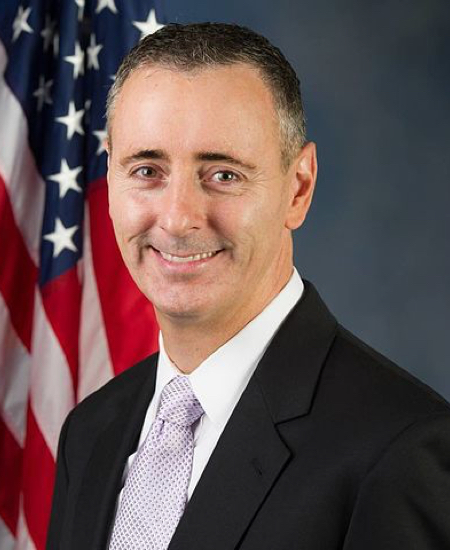
Rep. Brian K. Fitzpatrick
Sponsored bills
Improving Patient Access to Care and Treatment Act This bill increases the number of days—from 14 to 60—within which a practitioner must administer certain narcotic drugs (e.g., buprenorphine) to a patient for maintenance or detoxification treatment (i.e., substance use disorder treatment) after receiving the drugs from a pharmacy.
National Response to Exploitation and Sexual abuse of Children in Unaddressed Emergencies Act or the Child RESCUE Act This bill directs the Department of Justice to establish a national working group—the United States Working Group on Children in Imminent Danger—to study policing strategies and resource needs to rescue children who are victims of child sexual abuse material or victims of sexual abuse involving child sexual abuse material. The working group must report to Congress on its findings and conclusions, as well as recommendations for legislation.
Smarter Pretrial Detention for Drug Charges Act of 2021 This bill removes the presumption of pretrial detention for an individual who is charged with a federal drug offense for which the maximum term of imprisonment is 10 years or more.
Guardianship Accountability Act of 20 21 This bill requires the Department of Health and Human Services (HHS) to create a National Resource Center on Guardianship for the publication of resources and data relating to court-determined adult guardianships. Further, the bill requires HHS to award at least 5% of certain grant funds for state programs related to overseeing the administration of court-appointed guardian arrangements.
Fostering Overseas Rule of law and Environmentally Sound Trade Act of 2021 or the FOREST Act of 2021 This bill restricts certain commodities produced on illegally deforested land from accessing the U.S. market. Specifically, the bill prohibits the importation of any product made wholly or in part of a covered commodity produced from illegally deforested land. The bill outlines requirements for import declarations of covered commodities. The U.S. Trade Representative (USTR) must, within 30 days, publish (1) an initial list of covered commodities that consists of palm oil, soybeans, cocoa, cattle, rubber, and wood pulp; and (2) an initial list of covered products that are defined by the bill in accordance with the Harmonized Tariff Schedule. These lists must be updated at least on an annual basis. Further, the USTR must identify foreign countries without adequate and effective protection against illegal deforestation caused by the production of commodities that are likely to enter the United States. The USTR must develop an action plan that includes benchmarks for each identified country. Additionally, the bill creates an interagency working group to provide advice and recommendations to the USTR, U.S. Customs and Border Protection, and other relevant agencies. The bill provides funding to assist foreign governments in combating illegal deforestation. The bill also includes illegal deforestation as a specified unlawful activity under a federal financial crime statute. The bill establishes a federal procurement preference for commodities that are not produced from land subject to deforestation.
Providing Officers With Electronic Resources Act or the POWER Act This bill authorizes the Office of Community Oriented Policing Services within the Department of Justice to make grants to law enforcement agencies to purchase a chemical screening device and to train personnel to use, and interpret data collected by, such device.
Good Samaritan Health Professionals Act of 2021 This bill extends liability protection for harm caused by acts or omissions by volunteer health care professionals in the course of providing certain health care services during specified public-health or national emergencies or major disasters. However, such liability protection shall not apply if (1) the harm was caused by willful or criminal misconduct, gross negligence, reckless misconduct, or a conscious flagrant indifference to the rights or safety of the individual harmed; or (2) the health care professional provided services under the influence of alcohol or an intoxicating drug.
Counter-Kleptocracy Act This bill addresses prevention and elimination of corruption globally. The Department of State must (1) annually rank, using specified standards, foreign countries based on their efforts to eliminate corruption; and (2) designate an anti-corruption contact in the diplomatic mission of any country that does not meet the standards. The State Department must also evaluate whether to sanction foreign persons engaged in significant corruption (1) in countries that make de minimis or no efforts to meet the standards, or (2) connected to a designated Russian pipeline project. The President may temporarily sanction foreign persons engaging in public corruption activities (e.g. bribery). The bill makes it a federal crime for foreign officials to demand or accept bribes to influence the performance of an official act or otherwise confer an improper advantage. Officials who engage in this conduct are subject to a fine, a prison term, or both. Funds recovered by prosecuting this crime shall be deposited into a new fund in the Treasury for anti-corruption initiatives. The Department of Justice must make publicly available an accounting of property relating to foreign government corruption that is forfeited to the United States. The bill addresses issues concerning U.S. visas, including related to (1) abuse of investor visas by corrupt foreign officials or criminals, and (2) foreign individuals denied admission to the United States because of adverse foreign policy consequences. The bill also prohibits extraditions based solely on, and otherwise addresses, International Criminal Police Organization communications.
Frederick Douglass Trafficking Victims Prevention and Protection Reauthorization Act of 2021 This bill reauthorizes through FY2026 and revises programs and activities to support survivors of human trafficking and prevent such trafficking domestically and abroad. The bill expands and authorizes programs for survivors, including a program to prevent re-exploitation. It also extends through FY2026 a special assessment on certain persons convicted of a human trafficking offense, which funds programs for human-trafficking survivors. Additionally, the bill provides privacy and other protections for survivors, including specified financial protections and protections against retaliation for survivors who pursue civil claims against a perpetrator. The bill also allows courts to reduce sentences for certain individuals who commit human trafficking crimes as minors. To prevent trafficking domestically, federal departments must incorporate anti-trafficking efforts into contracting activities and personnel policies, and the bill supports private sector efforts to address human trafficking in its policies and services. Furthermore, the bill supports the identification, investigation, and prosecution of human trafficking crimes, with an expanded focus on forced labor. To prevent trafficking globally, the bill prohibits access to a trade program for developing countries and otherwise restricts development assistance for countries that fail to meet minimum standards for eliminating trafficking. It also changes the criteria for determining whether a country has met applicable standards. In addition, the bill authorizes sanctions on persons convicted of severe forms of trafficking and requires integration of counter-trafficking activities into foreign assistance programs. The bill also requires reporting by the Government Accountability Office, federal agencies, and states concerning human trafficking.