Human Trafficking Awareness Training Act This bill authorizes the Federal Law Enforcement Training Centers to establish a human trafficking awareness training program for state, local, tribal, territorial, and educational institution law enforcement personnel.
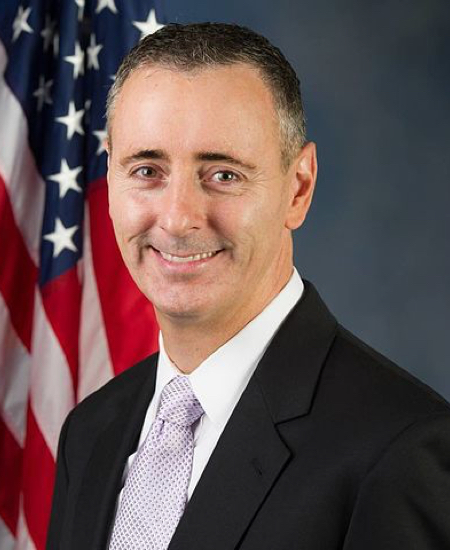
Rep. Brian K. Fitzpatrick
Sponsored bills
Put Trafficking Victims First Act of 2021 This bill sets forth provisions intended to help assess the prevalence of human trafficking in the United States and improve support for victims of trafficking and service providers. The Department of Justice (DOJ) must work with federal entities and other stakeholders to do the following: establish a working group to improve the collection and analysis of data on the incidence of trafficking, report on efforts to develop methodologies to determine the prevalence of human trafficking, and survey survivors to estimate the prevalence of human trafficking and improve services for victims. DOJ must also report on efforts to increase restitution to victims of trafficking.
Fentanyl Trafficker Elimination Act This bill increases the term of imprisonment for drug trafficking offenses involving large quantities of fentanyl or fentanyl analogues. Specifically, the bill requires life imprisonment for illegally importing or exporting, or illegally manufacturing, distributing, dispensing, or possessing with intent to manufacture, distribute, or dispense, 400 grams or more of fentanyl or 100 grams or more of a fentanyl analogue, regardless of prior offenses or if death or serious bodily injury occurs. (Currently, such offenses carry a minimum sentence of 10 years imprisonment and a maximum sentence of life imprisonment for a first offense; penalties increase with subsequent offenses or if death or serious bodily injury occurs.)
COPS on the Beat Grant Program Reauthorization and Parity Act of 2022 This bill reauthorizes through FY2031 and makes changes to the Community Oriented Policing Services grant program. Among the changes, the bill reduces the required matching contribution for certain rural communities during the first three years of a grant and eliminates the preference for agencies that exceed the matching requirements; allows grant funds to be used to increase wages of career law enforcement officers in states or localities that have a median household income of less than 70% of the national median household income and qualify for a reduced matching contribution; and provides statutory authority for the Office of Community Oriented Policing Services within the Department of Justice. Additionally, the bill requires the Government Accountability Office to report on whether law enforcement workforces are representative of the communities they serve, the percentage of law enforcement employees who live in the community they serve, the average pay of officers compared to the cost of living in the community they serve, and recommendations for improvements.
Guaranteeing Ukrainian Autonomy by Reinforcing its Defense (GUARD) Act of 2022 This bill provides support for Ukraine and imposes sanctions related to Nord Stream 2, the pipeline constructed to increase exports of natural gas from Russia. The Department of State must periodically report to Congress a determination as to whether Russia's government meets the criteria to be designated a state sponsor of terrorism. The bill authorizes the State Department to provide Foreign Military Financing assistance to Ukraine in FY2022. The bill also authorizes providing Ukraine with lethal assistance, such as anti-armor weapon systems and anti-aircraft weapons systems. From FY2022-FY2026, Ukraine shall have priority access to excess defense articles. During the same time period, the bill also authorizes providing Ukraine with assistance, including (1) International Military Education and Training assistance; (2) assistance to strengthen cybersecurity and intellectual property enforcement; (3) support and training for banking reform, subsidy reform, corporate governance, and the privatization of state-owned enterprises; and (4) assistance to combat corruption and improve the rule of law. Within 15 days of this bill's enactment, the President must impose sanctions on any entity responsible for planning, constructing, or operating Nord Stream 2, as well as any corporate officer of such an entity. The bill also subjects the President's authority to waive certain sanctions to congressional review. The U.S. Agency for Global Media may expand broadcasting in countries of the former Soviet Union to combat Russian disinformation. The bill requires reports to Congress on various topics, including a strategy on using U.S. diplomacy to support Ukraine.

Falun Gong Protection Act This bill requires the President to impose visa- and property-blocking sanctions on foreign persons that are knowingly responsible for, are complicit in, or have engaged in the involuntary harvesting of organs in China. The sanctions shall not apply to certain activities, such as authorized U.S. intelligence or law enforcement activities. The President must (1) maintain an updated list of foreign persons subject to the sanctions, and (2) impose the sanctions according to the most recent version of the list.
Protect Black Women and Girls Act of 2021 This bill establishes an Interagency Task Force to examine the conditions and experiences of Black women and girls to identify and assess the efficacy of policies and programs of federal, state, and local governments designed to improve outcomes for such individuals and to make recommendations to improve such policies and programs. The task force shall (1) cover issues involving Black women and girls in education, economic development, health care, justice and civil rights, and housing; and (2) submit recommendations at specified intervals to Congress, the President, and each state or local government on policies, practices, programs, and incentives that may be adopted to improve outcomes. The U.S. Commission on Civil Rights shall conduct a comprehensive study and collect data with respect to the effects on Black women and girls of a wide range of specified economic, health, criminal justice, and social services factors.
Halt All Lethal Trafficking of Fentanyl Act or the HALT Fentanyl Act This bill places fentanyl-related substances as a class into schedule I of the Controlled Substances Act. A schedule I controlled substance is a drug, substance, or chemical that has a high potential for abuse; has no currently accepted medical value; and is subject to regulatory controls and administrative, civil, and criminal penalties under the Controlled Substances Act. Additionally, the bill establishes a new, alternative registration process for schedule I research that is funded by the Department of Health and Human Services or the Department of Veterans Affairs or that is conducted under an investigative new drug exemption from the Food and Drug Administration. The bill also makes several other changes to registration requirements for conducting research with controlled substances, including permitting a single registration for related research sites in certain circumstances, waiving the requirement for a new inspection in certain situations, and allowing a registered researcher to perform certain manufacturing activities with small quantities of a substance without obtaining a manufacturing registration.
Opioid Quota Openness, Transparency, and Awareness Act of 2021 or the Opioid QuOTA Act of 2021 This bill requires the Drug Enforcement Administration to make publicly available on its website certain information regarding opioid procurement quotas. The term opioid procurement quota means the maximum quantity of opioid analgesics that a registered manufacturer may procure.
Protect American Taxpayer Dollars from Illegal Immigration Act This bill prohibits expending federal funds for legal settlements to individuals who violated certain laws relating to the proper time and place to enter the United States, if the settlement pertains to claims based solely on the lawful detention of such an individual as part of a family unit after the individual's entry into the United States at the southern border after January 20, 2017.