

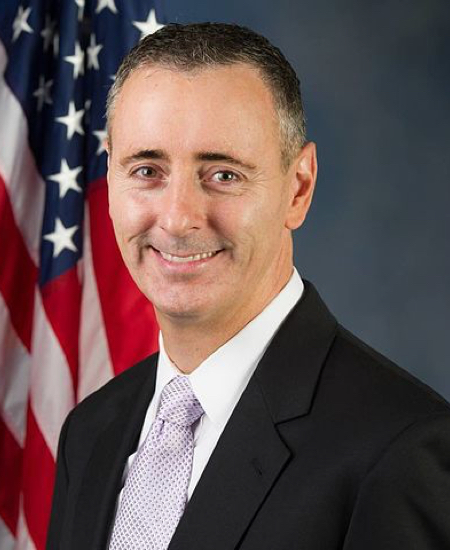
Photo of Brian K. Fitzpatrick
R United States House · District 1 · Pennsylvania On the 2026 ballot

Rep. Brian K. Fitzpatrick

Compare
Total votes
2,837
all sessions
Attendance
100%
9 missed
Higher than 75% of chamber peers
With party
76%
of cast votes
Lower than 98% of chamber peers
Bipartisan score
12%
some cross-party votes
Higher than 97% of chamber peers
Sponsored
4,059
bills & resolutions
Higher than 99% of chamber peers
Committees
6
assignments
4,059 bills and resolutions

Sponsored bills

Total
4,059
Primary
180
Co-sponsor
3,879
This page
4,059
matching current filters
Co-sponsor HR 1672
In committee · United States House · Co-sponsor
Maintaining Investments in New Innovation Act

Maddy summaryThis bill extends the exclusivity period for certain advanced drugs from 7 to 11 years. It defines "advanced drug product" as a drug using genetically targeted technology to modulate gene function (e.g., suppress or activate genes). This change directly affects pharmaceutical companies developing these specific advanced therapies by granting them longer market exclusivity. The policy change modifies the Social Security Act to provide extended protection for these innovative drugs, allowing companies more time to recoup research and development costs.

In committee Feb 27, 2025 1 co-sponsor
Co-sponsor HR 1751
In committee · United States House · Co-sponsor
Stop Electronic Stalking Act of 2025

Maddy summaryHR 1751, the Stop Electronic Stalking Act of 2025, amends federal stalking law to explicitly include unauthorized use of geotracking devices. It adds "uses an unauthorized geotracking device" to the definition of stalking under Title 18, U.S. Code, and defines two key terms: a "geotracking device" as any tool that remotely tracks a person's location, and "unauthorized" as use without the person's consent or after consent was revoked. This bill directly affects individuals who use such devices to track others without permission, making this specific conduct a federal stalking offense. The law does not create new penalties but expands existing stalking provisions to cover digital location tracking. It focuses on clarifying the legal definition of stalking related to modern technology.

In committee Feb 27, 2025 1 co-sponsor
Co-sponsor HR 1673
In committee · United States House · Co-sponsor
To designate the facility of the United States Postal Service located at 28 East Airy Street in Norristown, Pennsylvania, as the "Charles L. Blockson Post Office Building".

Maddy summaryThis bill designates the U.S. Postal Service facility at 28 East Airy Street in Norristown, Pennsylvania, as the "Charles L. Blockson Post Office Building." It updates all official federal references - such as laws, maps, and documents - to use this new name for the facility. The bill directly affects the postal service location and federal records referencing it. This is a ceremonial naming bill with no substantive policy changes.

In committee Feb 27, 2025 1 co-sponsor
Co-sponsor HR 1710
In committee · United States House · Co-sponsor
PLO and PA Terror Payments Accountability Act of 2025

Maddy summaryThis bill requires the U.S. President to impose sanctions on foreign individuals and entities that support the Palestinian Authority (PA) and Palestine Liberation Organization (PLO) system of paying terrorists and their families. It targets those who work for PA/PLO entities facilitating these payments (like the Commission of Prisoners or Institute for Care of Martyrs' Families), provide such payments, or materially assist the system. Sanctions include blocking U.S. property, denying visas, and revoking existing visas for targeted individuals. The bill terminates if the Secretary of State certifies the PA/PLO has ended these payments. (Based on HR 1710, PLO and PA Terror Payments Accountability Act of 2025)

In committee Feb 27, 2025 1 co-sponsor
Co-sponsor HR 1726
In committee · United States House · Co-sponsor
Project Safe Neighborhoods Reauthorization Act of 2025

Maddy summaryThis bill reauthorizes the Project Safe Neighborhoods program through fiscal years 2026-2030, extending funding for a nationwide initiative that helps local law enforcement reduce violent crime. It allows agencies to use funds for hiring crime analysts, covering overtime for officers and support staff, and purchasing technology to aid crime reduction efforts. The bill also requires the Attorney General to submit annual reports to Congress detailing how funds are spent, community outreach activities, and specific violent crime statistics (like murder and assault) in each program area. The program directly affects law enforcement agencies in all 94 federal judicial districts across all 50 states and territories.

In committee Feb 27, 2025 1 co-sponsor
Co-sponsor HR 1650
In committee · United States House · Co-sponsor
Telehealth Expansion Act of 2025

Maddy summaryThis bill makes permanent a provision requiring health insurance plans to cover telehealth services without applying deductibles, which was previously temporary. It directly affects health insurance plans and their members who use telehealth services, ensuring no out-of-pocket cost for these visits under the plan. The key mechanism removes specific language in tax code provisions that limited this coverage to certain time periods, applying the rule permanently to all plan years starting in 2025. The bill does not create new telehealth services or infrastructure but changes how existing telehealth visits are covered by insurance.

In committee Feb 27, 2025 1 co-sponsor
Co-sponsor HR 1667
In committee · United States House · Co-sponsor
Acupuncture for Our Seniors Act of 2025

Maddy summaryHR 1667, the Acupuncture for Our Seniors Act of 2025, would expand Medicare coverage to include acupuncture services provided by qualified practitioners. It adds "qualified acupuncturist services" to Medicare’s coverage under Section 1861 of the Social Security Act, defining a qualified acupuncturist as a state-licensed practitioner or a physician legally authorized to perform acupuncture. The bill establishes payment rules by including these services in the physician fee schedule and adjusting hospital billing procedures to allow separate billing for acupuncture in inpatient settings. This change would directly affect Medicare beneficiaries receiving acupuncture, as well as acupuncturists and healthcare providers who would now bill Medicare for these services. The provisions would take effect 270 days after the bill’s enactment.

In committee Feb 27, 2025 1 co-sponsor
Co-sponsor HR 1699
In committee · United States House · Co-sponsor
TOTAL Care Act

Maddy summaryHR 1699, the TOTAL Care Act, removes referral requirements for obstetrical and gynecological (OB/GYN) care under the TRICARE Prime health plan. It allows female TRICARE Prime beneficiaries to directly choose an OB/GYN provider as their primary care manager, eliminating the need for a prior referral from another provider. The bill establishes a 5-year pilot program to test this change, requiring the Secretary of Defense to report on enrollment shifts, cost impacts, and other outcomes after four years. This directly affects female military family members enrolled in TRICARE Prime who opt into the pilot.

In committee Feb 27, 2025 1 co-sponsor
Co-sponsor HR 1657
In committee · United States House · Co-sponsor
Humane Cosmetics Act of 2025

Maddy summaryHR 1657, the Humane Cosmetics Act of 2025, prohibits cosmetic companies from conducting or contracting animal testing for products sold in the U.S. beginning one year after the law takes effect. It also bans the sale or transport of cosmetics developed using such testing after that date, with limited exemptions (e.g., for foreign regulatory requirements or when no non-animal safety alternatives exist). The bill directly affects cosmetic manufacturers, retailers, and distributors by requiring them to shift to non-animal testing methods. The Food and Drug Administration (FDA) will enforce the law, including reviewing records and imposing civil penalties for violations.

In committee Feb 27, 2025 1 co-sponsor
Primary HR 1684
In committee · United States House · Lead sponsor
PAST Act of 2025

Maddy summaryThe PAST Act of 2025 amends the Horse Protection Act to ban harmful practices known as "soring," which deliberately cause pain to horses to exaggerate their gait for shows. It specifically prohibits devices like action devices (e.g., boots causing friction) and weighted shoes on Tennessee Walking Horses, Racking Horses, and Spotted Saddle Horses at events. The bill increases penalties, including escalating disqualifications for repeat offenses (180 days → 1 year → 3 years) and raises fines for violations to $5,000 per offense. It also requires stricter licensing for inspectors and mandates public posting of violation records to help event organizers enforce rules.

In committee Feb 27, 2025 0 co-sponsors
Showing 1,131 to 1,140 of 4,059 bills