

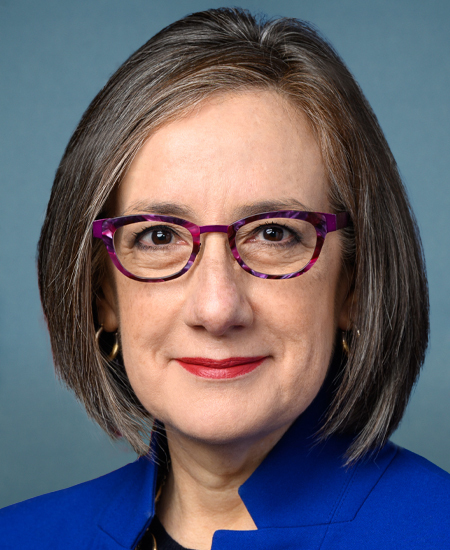
Photo of Andrea Salinas
D United States House · District 6 · Oregon On the 2026 ballot

Rep. Andrea Salinas

Compare
Total votes
1,879
all sessions
Attendance
99%
13 missed
Higher than 89% of chamber peers
With party
96%
of cast votes
Near the chamber average
Bipartisan score
2%
crosses aisle rarely
Near the chamber average
Sponsored
1,363
bills & resolutions
Higher than 94% of chamber peers
Committees
6
assignments
1,363 bills and resolutions

Sponsored bills

Total
1,363
Primary
62
Co-sponsor
1,301
This page
1,363
matching current filters
Co-sponsor HR 4304
In committee · United States House · Co-sponsor
Fair Accounting for Income Realized from Betting Earnings Taxation Act

Maddy summaryHR 4304, the FAIR Bet Act, amends the tax code to allow gamblers to deduct 100% of their wagering losses instead of the current 90% limit. This change directly affects individuals who report gambling losses on their federal income tax returns. The key provision modifies Section 165(d) of the Internal Revenue Code to remove the 90% restriction on deducting gambling losses. The bill does not alter how gambling winnings are taxed, only the deduction available for losses.

In committee Feb 12, 2026 1 co-sponsor
Co-sponsor HRES 1058
In committee · United States House · Co-sponsor
Recognizing that it is the duty of the Federal Government to develop and implement a Transgender Bill of Rights to protect and codify the rights of transgender and nonbinary people under the law and ensure their access to medical care, shelter, safety, and economic security.

Maddy summaryHRES 1058 is a non-binding House resolution recognizing the federal government’s duty to develop a Transgender Bill of Rights. It calls for specific policy changes, including amending civil rights laws to explicitly prohibit discrimination based on gender identity in employment, housing, and public accommodations; protecting access to gender-affirming medical care; and streamlining legal recognition of gender identity on federal documents like passports and voter registration. The resolution also proposes expanding protections for transgender and nonbinary individuals in healthcare, education, immigration, and correctional facilities, while emphasizing community-led policy development. As a resolution, it does not create new law but sets a framework for future legislative action.

In committee Feb 11, 2026 1 co-sponsor
Co-sponsor HR 7481
In committee · United States House · Co-sponsor
Department of Homeland Security Appropriations Act, 2026

Department of Homeland Security Appropriations Act, 2026 This bill provides FY2026 appropriations for various agencies and offices within the Department of Homeland Security (DHS), except for U.S. Immigration and Customs Enforcement (ICE), U.S. Customs and Border Protection (CBP), and management and oversight activities of the Office of the Secretary. Specifically, the bill provides appropriations to DHS for  the Federal Protective Service, the Office of Inspector General, the Transportation Security Administration, the U.S. Coast Guard, the U.S. Secret Service, the Cybersecurity and Infrastructure Security Agency, the Federal Emergency Management Agency (FEMA), U.S. Citizenship and Immigration Services, the Federal Law Enforcement Training Centers, and the Science and Technology Directorate. The bill does not provide appropriations for some agencies and activities that have been funded in prior DHS appropriations acts, including ICE, CBP, and management and oversight activities of the Office of the Secretary.

In committee Feb 11, 2026 1 co-sponsor
Co-sponsor HR 7500
In committee · United States House · Co-sponsor
Responsible Firearms Marketing Act

Maddy summaryHR 7500, the Responsible Firearms Marketing Act, directs the Federal Trade Commission (FTC) to study whether firearm advertising or marketing practices are unfair or deceptive, particularly those targeting minors, implying illegal use, or promoting semiautomatic assault weapons. After a two-year study, the FTC must report to Congress and then create enforceable regulations within 18 months to ban such practices. The law specifically prohibits manufacturers, dealers, and importers from using ads that appeal to people under 18, suggest illegal activity, or market assault weapons. Violations would be enforced under existing FTC authority, treating them as unfair or deceptive acts under current law. This bill directly affects firearm industry marketing practices but does not regulate gun sales or ownership.

In committee Feb 11, 2026 1 co-sponsor
Co-sponsor HR 7499
In committee · United States House · Co-sponsor
Firearm Safety Act of 2025

Maddy summaryThe Firearm Safety Act of 2025 removes an existing exemption that prevents the Consumer Product Safety Commission from regulating firearms as consumer products. By amending the Consumer Product Safety Act, the bill allows the commission to apply its standard safety rules to guns, similar to how it regulates other household items. This change directly affects manufacturers and sellers of firearms by potentially subjecting them to federal safety standards and testing requirements. The legislation does not alter existing gun laws or create new bans, but rather changes the regulatory framework under which firearm safety is overseen.

In committee Feb 11, 2026 1 co-sponsor
Co-sponsor HR 7497
In committee · United States House · Co-sponsor
Supporting Trauma-Informed Education Practices Act of 2026

Maddy summaryHR 7497 establishes a new grant program to fund trauma-informed mental health support in schools, authorizing $50 million annually from 2027-2031. It directly affects students, teachers, school staff, and community mental health providers by requiring grantees to develop collaborative services between schools and local mental health systems. Key provisions include funding evidence-based staff training on trauma-informed practices, creating school-community partnerships, and ensuring culturally competent services for students - including those with disabilities. The bill mandates that funds supplement, not replace, existing resources and requires grantees to coordinate with agencies like child welfare and juvenile justice through formal interagency agreements.

In committee Feb 11, 2026 1 co-sponsor
Co-sponsor HR 7494
In committee · United States House · Co-sponsor
Preventing Domestic Violence Homicides Through Lethality Assessment Training and Technical Assistance Act

Maddy summaryThis bill establishes a national resource center to help states, local governments, and tribes adopt programs designed to prevent domestic violence homicides. It authorizes the Attorney General to award grants to nonprofit or tribal organizations that have proven experience in creating and evaluating these safety initiatives. The funded programs would train first responders to better identify high-risk situations and connect victims quickly with community support services using evidence-based tools. A total of $5,000,000 is authorized annually starting in fiscal year 2026 to support these efforts.

In committee Feb 11, 2026 1 co-sponsor
Co-sponsor HR 1742
In committee · United States House · Co-sponsor
Access to Reproductive Care for Servicemembers Act

Maddy summaryThis bill requires the military to approve leave for abortion and fertility care without commanders needing to know the specific procedure. It mandates reimbursement for travel, lodging, meals, and transportation costs when care isn't available nearby, and prohibits punishment for using this leave. It directly affects active-duty service members and their dependents who face barriers to reproductive care due to military restrictions or location. The policy change removes command discretion in approving leave for time-sensitive reproductive health services.

In committee Feb 11, 2026 1 co-sponsor
Co-sponsor HR 5221
In committee · United States House · Co-sponsor
PART Act

Maddy summaryThe PART Act requires new vehicles to have catalytic converters marked with a unique identification number that links directly to the vehicle's identification number, stored in a law enforcement-accessible database. It establishes a $7 million grant program to help repair shops, dealers, law enforcement, and fleet owners purchase equipment for marking converters with visible, durable identifiers (using die or pin stamping and high-visibility paint). The bill also mandates that businesses buying catalytic converters keep detailed seller records (including vehicle information) for two years and use traceable payments, banning cash or cryptocurrency transactions. Additionally, it creates new federal criminal penalties for stealing or trafficking in catalytic converters, with potential sentences of up to five years in prison.

In committee Feb 10, 2026 1 co-sponsor
Co-sponsor HR 2110
In committee · United States House · Co-sponsor
Safe Vehicle Access for Survivors Act

Safe Vehicle Access for Survivors Act This bill requires providers of connected vehicle services, upon the request of a domestic violence survivor, to terminate or disable an identified domestic abuser’s access to a vehicle’s connected capabilities and data. Specifically, within two business days of receiving a request from a survivor, a covered provider must, if technically feasible (1) terminate or disable the connected vehicle account associated with the identified abuser or the relevant vehicle, or the vehicle’s connected capabilities; or (2) instruct the survivor on how to terminate or disable connected services directly. Covered providers may not make the termination of connected vehicle services or accounts contingent on any requirement other than the provision of specified information by the survivor. For example, a provider may not require a survivor to pay a fee or extend their contract with the provider. Under the bill, an abuser is an individual identified by a survivor who committed or allegedly committed certain acts against the survivor, including domestic violence, sexual assault, stalking, and sex trafficking. A survivor is an adult against whom such an act was committed. Further, a covered provider is a vehicle manufacturer, affiliate, or entity acting on behalf of a manufacturer that provides a connected vehicle service. Connected vehicle service is any capability that enables a person to remotely access data from or send commands to a vehicle. Finally, the Federal Communications Commission must prescribe regulations governing how covered providers address survivors’ requests related to connected vehicles.

In committee Feb 10, 2026 1 co-sponsor
Showing 171 to 180 of 1,363 bills
Previous 1 … 17 18 19 … 137 Next