Right Whale Coexistence Act of 2022 This bill provides support for the conservation of North Atlantic right whales ( Eubalaena glacialis ). Specifically, it requires the National Oceanic and Atmospheric Administration (NOAA) to provide financial assistance for projects designed to reduce the lethal and sub-lethal effects of human activities on North Atlantic right whales. In addition, NOAA must conduct surveys of plankton on an ongoing basis using a continuous plankton recorder.
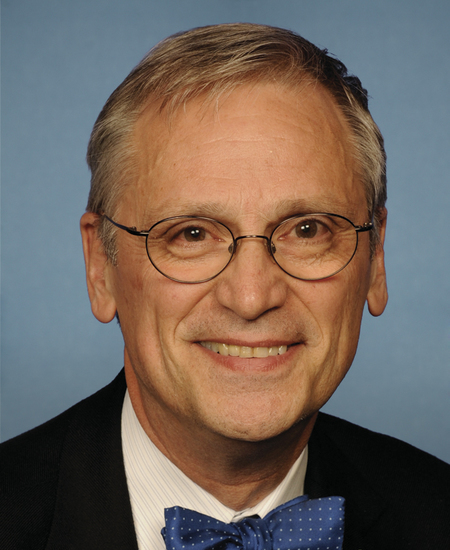
Rep. Earl Blumenauer
Sponsored bills
Salmon Focused Investments in Sustainable Habitats Act or the Salmon FISH Act This bill addresses identifying, restoring, and protecting salmon conservation areas and salmon strongholds in the United States. Specifically, the bill requires the National Oceanic and Atmospheric Administration (NOAA) and the U.S. Fish and Wildlife Service to jointly issue guidance on the process and biological criteria required to identify salmon conservation areas and salmon strongholds; and directs the National Fish and Wildlife Foundation in collaboration with NOAA to provide grants to certain entities to protect or maintain salmon conservation area or salmon stronghold features and projects that are focused on conservation and restoration within a salmon conservation area or stronghold, including to restore or maintain ecological functions and processes related to salmon productivity and diversity at watershed or subwatershed scales.
Increasing Community Access to Resiliency Grants Act of 2021 This bill directs the National and Oceanic and Atmospheric Administration (NOAA) to establish and regularly update a publicly available website that includes hyperlinks to all grants administered by NOAA and hyperlinks to other federal agencies that offer similar grants to assist state, tribal, and local governments with resiliency, adaptation, and mitigation of climate change and sea level rise; and for each such grant, the contact information for an individual who can offer assistance to such governments. NOAA shall conduct outreach activities to inform state, tribal, and local governments of the resiliency, adaptation, and mitigation grants.
Into the Light for Maternal Mental Health and Substance Use Disorders Act of 2022 or the Into the Light for MMH and SUD Act of 2022 This bill reauthorizes through FY2028 a program that addresses maternal depression and, among other changes, expands its scope to include mental health and substance use disorders. It also requires the Department of Health and Human Services to maintain a national hotline to provide mental health and substance use disorder resources to pregnant and postpartum women and their families.
Autonomy for Disabled Veterans Act This bill increases the maximum amount authorized under the Home Improvements and Structural Alterations (HISA) grant program to $10,000 for veterans with a service-connected disability and $5,000 for those with disabilities that are not service-connected. The HISA grant program provides medically necessary improvements and structural alterations to veterans' (or service members') primary residence for specified purposes (e.g., allowing for entrance to their home). The bill requires the Department of Veterans Affairs to increase the dollar amount of the grant in accordance with inflation as determined by the Consumer Price Index.
This resolution expresses that the House of Representatives must take action on climate change and address the mental health effects of climate change on children and families.
Hospital Inpatient Services Modernization Act This bill extends the Acute Hospital Care at Home Program under Medicare until two years after the end of the COVID-19 public health emergency (the program allows hospitals to treat certain patients from emergency departments or inpatient hospital beds at home during the emergency period). It also requires an evaluation of this program and the Hospital Without Walls program (the program allowed hospitals to transfer patients to outside facilities, such as hotels, to continue treatment during the emergency period).
Green Postal Service Fleet Act of 2022 This bill prohibits the U.S. Postal Service from carrying out the contract with Oshkosh Defense for the procurement of postal delivery vehicles unless each purchase is at least 75% electric or zero-emission vehicles.
Educating Against Misinformation and Disinformation Act This bill establishes a commission and requires other activities to support information and media literacy education and to prevent misinformation and disinformation. Specific duties of the commission include (1) implementing a national strategy to promote information and media literacy; and (2) identifying programs and resources on information and media literacy for use in elementary, secondary, and higher education, and adult education programs. The Department of Education (ED) must assess the effectiveness of the commission in promoting information and media literacy education. ED must also award competitive grants to nonprofits (including institutions of higher education) to develop educational materials, public awareness campaigns, and other programming to promote information and media literacy and combat misinformation and disinformation. Additionally, ED must conduct a study to evaluate information and media literacy among the American public.
Women's Health Protection Act of 2021 This bill prohibits governmental restrictions on the provision of, and access to, abortion services. Specifically, governments may not limit a provider's ability to prescribe certain drugs, offer abortion services via telemedicine, or immediately provide abortion services when the provider determines a delay risks the patient's health. Furthermore, governments may not require a provider to perform unnecessary medical procedures, provide medically inaccurate information, comply with credentialing or other conditions that do not apply to providers whose services are medically comparable to abortions, or carry out all services connected to an abortion. In addition, governments may not (1) require patients to make medically unnecessary in-person visits before receiving abortion services or disclose their reasons for obtaining such services, or (2) prohibit abortion services before fetal viability or after fetal viability when a provider determines the pregnancy risks the patient's life or health. The bill also prohibits other governmental measures that are similar to the bill's specified restrictions or that otherwise single out and impede access to abortion services, unless a government demonstrates that the measure significantly advances the safety of abortion services or health of patients and cannot be achieved through less restrictive means. The Department of Justice, individuals, or providers may bring a lawsuit to enforce this bill, and states are not immune from suits for violations. The bill applies to restrictions imposed both prior and subsequent to the bill's enactment.