

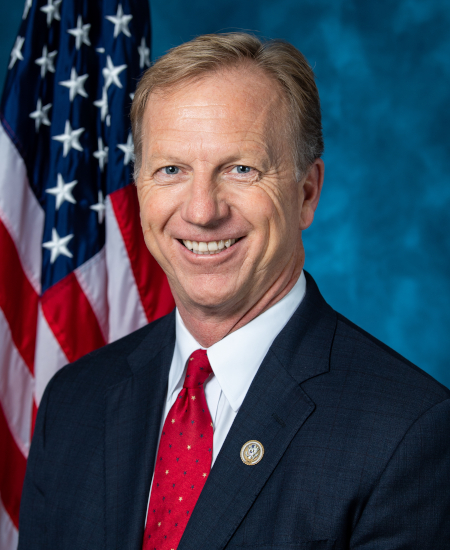
Photo of Kevin Hern
R United States House · District 1 · Oklahoma

Rep. Kevin Hern

Compare
Total votes
2,837
all sessions
Attendance
98%
48 missed
Near the chamber average
With party
92%
of cast votes
Near the chamber average
Bipartisan score
4%
crosses aisle rarely
Near the chamber average
Sponsored
531
bills & resolutions
Lower than 91% of chamber peers
Committees
3
assignments
531 bills and resolutions

Sponsored bills

Total
531
Primary
55
Co-sponsor
476
This page
531
matching current filters
Co-sponsor HR 1275
In committee · United States House · Co-sponsor
To prohibit the use of Federal funds to carry out Executive Order 14091.

Maddy summaryHR 1275 prohibits federal funding from being used to implement Executive Order 14091, which directed federal agencies to advance racial equity and support underserved communities. The bill directly affects federal agencies that would have allocated taxpayer funds toward programs or initiatives under the executive order. Its key provision blocks all federal financial resources for the order's requirements, preventing agencies from carrying out its equity-focused actions. This policy change stops the government from using public money to support the specific racial equity initiatives outlined in the executive order.

In committee Mar 1, 2023 1 co-sponsor
Co-sponsor HR 1229
In committee · United States House · Co-sponsor
Stop CRT Act

Maddy summaryHR 1229, the "Stop CRT Act," codifies Executive Order 13950 into law and restricts federal funding for entities teaching specific concepts about race. It prohibits federal grants to organizations that teach any of six specified ideas, including that race determines moral worth, the U.S. is fundamentally racist, or individuals bear responsibility for historical actions based on race. The bill directly affects schools, nonprofits, and other recipients of federal funds by banning support for educational content matching these prohibitions. Key provisions require federal agencies to deny funding to any entity advancing these concepts, making the executive order legally binding. This policy change alters how federal funds are distributed based on mandated educational content.

In committee Feb 28, 2023 1 co-sponsor
Co-sponsor HR 1228
In committee · United States House · Co-sponsor
Combating Racist Training in the Military Act of 2023

Maddy summaryHR 1228 prohibits the U.S. military and Department of Defense-operated academic institutions from promoting specific anti-American or racist theories in training. It bans military programs that teach ideas such as "the U.S. is fundamentally racist," "the Constitution is fundamentally racist," or that "an individual’s worth is determined by race." The bill explicitly states it does not restrict protected speech, research access, or educational contexts that clearly disavow military endorsement of such theories. This directly affects military training curricula, workshops, and educational materials within the armed forces.

In committee Feb 28, 2023 1 co-sponsor
Co-sponsor HR 1200
In committee · United States House · Co-sponsor
National Right-to-Work Act

Maddy summaryHR 1200, the National Right-to-Work Act, prohibits requiring workers to join a union or pay dues as a condition of employment in both private-sector workplaces (covered by the National Labor Relations Act) and railroad industries (covered by the Railway Labor Act). The bill amends key sections of these laws to eliminate provisions that allowed union security agreements, meaning workers in unionized settings would no longer be forced to pay dues to retain their jobs. This directly affects employees in unionized workplaces across the U.S., particularly those in industries with existing union contracts that included mandatory dues. The law changes the legal framework to ensure union membership and dues payment remain voluntary for all workers.

In committee Feb 27, 2023 1 co-sponsor
Co-sponsor HR 1122
In committee · United States House · Co-sponsor
CBDC Anti-Surveillance State Act

CBDC Anti-Surveillance State Act This bill limits the ability of the Federal Reserve to (1) provide direct services to individuals, and (2) use a central bank digital currency. A central bank digital currency is a digital currency (e.g., Bitcoin or Ether) issued by a government-backed central bank. Specifically, the bill prohibits the Federal Reserve and the Federal Open Market Committee from using any central bank digital currency to implement monetary policy. In addition, a Federal Reserve bank is prohibited from offering products or services directly to an individual, maintaining an account on behalf of an individual, or issuing a central bank digital currency directly to an individual. The Federal Reserve must (1) consult with each Federal Reserve bank with respect to any central bank digital currency study or pilot program, and (2) issue quarterly reports on the findings and determinations of any such study or program.

In committee Feb 21, 2023 1 co-sponsor
Co-sponsor HR 983
In committee · United States House · Co-sponsor
Second Chance at Life Act of 2023

Second Chance at Life Act of 2023 This bill requires abortion providers to disclose information about the possibility of reversing a medication abortion. This is a procedure that uses a medication regimen to terminate a pregnancy, typically with a two-drug protocol. Providers must inform patients that it may be possible to reverse the effects of a medication abortion after taking the first drug. They must also let patients know that more information and assistance is available on the Department of Health and Human Services (HHS) website. At least 24 hours before the procedure, the provider must share this information with the patient in person or by telephone. The provider must also include the information in written discharge instructions after the first drug is dispensed. The bill sets out an exception to these notification requirements when an abortion is necessary to resolve a physical injury or condition that threatens the life of the woman. The provider must document the circumstances giving rise to the exception in the patient's medical file. Furthermore, providers must post signs with this information in their offices or facilities, and HHS must maintain information about reversing medication abortions on its website.

In committee Feb 17, 2023 1 co-sponsor
Co-sponsor HR 972
In committee · United States House · Co-sponsor
Outpatient Surgery Quality and Access Act of 2023

Maddy summaryHR 972, the Outpatient Surgery Quality and Access Act of 2023, updates Medicare payment rules for outpatient surgery centers and hospital outpatient departments. It requires Medicare to publicly compare quality data for these facilities in the same geographic area on Medicare.gov, allows facilities to review data before release, and mandates that the Secretary cite specific criteria when excluding procedures from coverage. The bill also caps patient out-of-pocket costs for outpatient surgery at the hospital deductible amount and aligns annual payment updates between surgery centers and hospitals. These changes aim to improve transparency for beneficiaries and standardize payment adjustments.

In committee Feb 17, 2023 1 co-sponsor
Co-sponsor HR 1015
In committee · United States House · Co-sponsor
Dustoff Crews of the Vietnam War Congressional Gold Medal Act

Maddy summaryThis bill authorizes a single Congressional Gold Medal to honor all U.S. Army Dustoff crews who served during the Vietnam War (1962-1973). It recognizes their critical role in evacuating nearly 900,000 wounded personnel, including U.S., South Vietnamese, and allied forces, under extreme combat conditions. The medal, designed with input from the Secretary of Defense, will be presented to the U.S. Army Medical Department Museum for permanent display. Duplicate bronze medals may be sold to cover costs, but the primary action is the commemorative recognition of these crews' service.

In committee Feb 14, 2023 1 co-sponsor
Co-sponsor HR 976
In committee · United States House · Co-sponsor
TCJA Permanency Act

Maddy summaryHR 976, the TCJA Permanency Act, makes permanent many tax provisions from the 2017 Tax Cuts and Jobs Act (TCJA) that were scheduled to expire after 2025. The bill affects individual taxpayers by keeping lower tax rates, higher standard deductions, increased child tax credits, and other key changes permanently. Key provisions include permanent modifications to income tax brackets, repeal of personal exemptions, limits on state and local tax deductions, and increased estate and gift tax exemptions. These changes would prevent the tax code from reverting to pre-TCJA rates and rules for millions of taxpayers.

In committee Feb 10, 2023 1 co-sponsor
Showing 281 to 290 of 531 bills
Previous 1 … 28 29 30 … 54 Next