

Accelerating Kids' Access to Care Act This bill requires state Medicaid programs to establish a process through which qualifying out-of-state providers may enroll as participating providers without undergoing additional screening requirements. Among other things, a qualifying provider must (1) serve minors, or adults whose condition began as a minor; and (2) have previously been screened for Medicare participation or for participation in the Medicaid program of the state in which the provider is located.
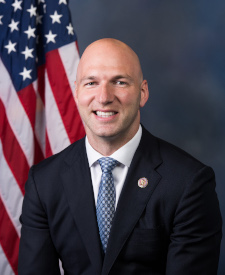
Rep. Anthony Gonzalez
Sponsored bills
China Financial Threat Mitigation Act of 2021 This bill requires U.S. representatives to certain international bodies to advocate for increased international cooperation to mitigate threats caused by the governance, opacity, or instability of financial intermediation in China. (Generally, financial intermediaries provide services, such as accounting and underwriting services, that facilitate financial transactions.) Specifically, this requirement applies to U.S. representatives to the International Monetary Fund, the Group of 20 (G20), and the Financial Stability Board (a technical body established by the G20 to coordinate the group's agenda). The bill also requires the Financial Stability Oversight Council within the Department of the Treasury to report annually to Congress on such threats.
Reinventing Economic Partnerships And Infrastructure Redevelopment Act or the REPAIR Act This bill addresses the financing of infrastructure projects through the establishment of the Infrastructure Financing Authority (IFA) and increases the national limitation on the amount of tax-exempt highway or surface freight transfer facility bonds. Specifically, the bill directs the IFA to provide direct loans and loan guarantees to facilitate certain infrastructure projects that are economically viable, in the public interest, and of regional or national significance, including the construction, consolidation, alteration, or repair of airports and air traffic control systems, highway facilities, and transmission or distribution pipelines; sets forth terms and limitations on direct loans and loan guarantees; establishes a funding mechanism to make the IFA a self-sustaining entity, including through fees and risk premiums on loans and loan guarantees; and increases from $15 billion to $16 billion the national limitation on the amount of tax-exempt highway or surface freight transfer facility bonds.
Creating Opportunities Now for Necessary and Effective Care Technologies (CONNECT) for Health Act of 2021 or the CONNECT for Health Act of 2021 This bill expands coverage of telehealth services under Medicare. Among other provisions, the bill allows the Centers for Medicare & Medicaid Services (CMS) to waive certain restrictions, such as restrictions on the types of technology that may be used; permanently removes geographic restrictions on originating sites (i.e., the location of the beneficiary) and allows the home of the beneficiary to serve as the originating site for all services; permanently allows federally qualified health centers and rural health clinics to serve as the distant site (i.e., the location of the health care practitioner); and allows the CMS to generally waive coverage restrictions during any public health emergency. Additionally, the CMS must report on the effects of expanded telehealth services during the COVID-19 public health emergency, including with respect to the utilization, quality, and outcomes of services. The Center for Medicare and Medicaid Innovation may also test alternative payment models relating to expanded telehealth services.
Mainstreaming Addiction Treatment Act of 2021 This bill removes the requirement that a health care practitioner apply for a separate waiver through the Drug Enforcement Administration (DEA) to dispense certain narcotic drugs (e.g., buprenorphine) for maintenance or detoxification treatment (i.e., substance use disorder treatment). Further, a community health aide or community health practitioner may dispense certain narcotic drugs for maintenance or detoxification treatment without registering with the DEA if the drug is prescribed by a health care practitioner through telemedicine. It preempts state laws related to licensure for this activity. The bill also directs the Substance Abuse and Mental Health Services Administration to conduct a national campaign to educate health care practitioners and encourage them to integrate substance use disorder treatment into their practices.
Eliminate Network Distribution of Child Exploitation Act or the END Child Exploitation Act This bill modifies the reporting requirements for electronic communication service providers and remote computing service providers (providers) that report information to the CyberTipline of the National Center for Missing and Exploited Children on crimes involving the sexual exploitation of children. Specifically, the bill increases the amount of time—from 90 days to 180 days—that a provider must preserve the contents of a report. Additionally, the bill permits a provider to voluntarily retain the contents for longer than 180 days to reduce the proliferation of or to prevent the online sexual exploitation of children.
Pain-Capable Unborn Child Protection Act This bill establishes a new criminal offense for performing or attempting to perform an abortion if the probable post-fertilization age of the fetus is 20 weeks or more. A violator is subject to criminal penalties—a fine, a prison term of up to five years, or both. The bill provides exceptions for an abortion (1) that is necessary to save the life of the pregnant woman, or (2) when the pregnancy is the result of rape or incest. A physician who performs or attempts to perform an abortion under an exception must comply with specified requirements. A woman who undergoes a prohibited abortion may not be prosecuted for violating or conspiring to violate the provisions of this bill.
Student Athlete Level Playing Field Act This bill generally prohibits an institution of higher education or a covered athletic organization (e.g., an athletic association, a conference, or an organization with authority over intercollegiate athletics) from restricting the ability of a student athlete to enter into an endorsement or agency contract, with exceptions. It also provides for enforcement by the Federal Trade Commission, preempts state laws relating to endorsement or agency contracts, and establishes the Covered Athletic Organization Commission.
PFC Joseph P. Dwyer Peer Support Program Act This bill requires the Department of Veterans Affairs (VA) to establish the PFC Joseph P. Dwyer Peer Support Program to make grants to eligible entities for peer-to-peer mental health programs for veterans. Eligible entities include (1) a nonprofit organization that has historically served the mental health needs of veterans; (2) a congressionally chartered veteran service organization; or (3) a state, local, or tribal veteran service agency, director, or commissioner. The VA shall establish an advisory committee to create appropriate program standards.
Defending Against Imitations and Replacements of Yogurt, milk, and cheese to Promote Regular Intake of Dairy Everyday Act or the DAIRY PRIDE Act This bill prohibits the sale of any food that uses the market name of a dairy product (such as milk , yogurt , or cream cheese ) unless the food (1) is the milk of a hooved animal, (2) is derived from such milk, or (3) contains such milk as a primary ingredient.