NICS Denial Notification Act of 2021 This bill requires the Department of Justice to notify state and local law enforcement authorities following a firearms-related background check that results in a denial.
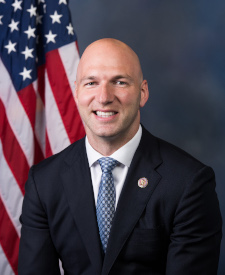
Rep. Anthony Gonzalez
Sponsored bills
Border Visibility and Security Act This bill directs the Department of Homeland Security (DHS) to install surveillance technology and take other actions with respect to the U.S.-Mexico border. DHS shall deploy the most practical and effective technology available to achieve situational awareness and operational control of the border. Such technology may include radar surveillance systems, tunnel detection technology, and unmanned aerial vehicles. DHS is authorized to waive legal requirements as necessary in order to implement the necessary surveillance technology along the border. DHS shall also (1) construct a navigable road along at least 700 miles of the southwest border, (2) permanently eradicate certain foliage that grows along the Rio Grande river, and (3) report to Congress a comprehensive strategy about the barriers and technologies needed to secure operational control along the border. Drug cartel funds that have been criminally forfeited to the U.S. government shall be reserved for security measures along the U.S.-Mexico border.
Foreign Influence Transparency Act This bill addresses foreign influence in higher education and in certain other academic, religious, and artistic pursuits. Current law exempts from foreign agent registration requirements a person engaging in activities in furtherance of religious, scholastic, academic, or scientific pursuits or of the fine arts. The bill specifies that this exemption applies only to those activities that do not promote the political agenda of a foreign government. Under current law, an institution of higher education (IHE) must disclose to the Department of Education (ED) a gift or contract that is from a foreign source and is valued at $250,000 or more, considered alone or in combination with all other gifts from or contracts with the foreign source. The bill instead requires an IHE to disclose such a gift or contract that is valued at $50,000 or more, considered alone or in combination with all other gifts or contracts. An IHE must include in its disclosure report the contents of any such contract and make the contents available for public disclosure. Additionally, an IHE that enters into an agreement with a Confucius Institute (i.e., a cultural institute directly or indirectly funded by the Chinese government) must immediately make available the full text of the agreement to the public, ED, and Congress. Finally, the bill prohibits an IHE that does not comply with these disclosure requirements from enrolling foreign students under the Student and Exchange Visitor Program.

21st Century NICS Act This bill modifies procedures for conducting firearms-related background checks through the national instant criminal background check system (NICS). Specifically, it permits the NICS to query an additional database—the National Data Exchange—as part of a firearm-related background check.
Homeland Security Investigations Victim Assistance Act of 2021 This bill provides statutory authority for a U.S. Immigration and Customs Enforcement program that assists victims of human trafficking, child sexual exploitation, and other crimes.
Non-Opioids Prevent Addiction In the Nation Act or the NOPAIN Act This bill temporarily establishes separate payments for certain non-opioid treatments under the Medicare prospective payment system for hospital outpatient department services and the payment system for ambulatory surgical center services. The bill applies to pain management treatments that are able to replace or reduce opioid consumption, as shown through clinical trials or data.
Harmful Algal Bloom Essential Forecasting Act This bill requires the Harmful Algal Bloom Operational Forecast System to continue to operate during a government shutdown by designating certain services related to the system as excepted services under the Anti-Deficiency Act.
Pregnant Workers Fairness Act This bill prohibits employment practices that discriminate against making reasonable accommodations for qualified employees affected by pregnancy, childbirth, or related medical conditions. A qualified employee is an employee or applicant who, with or without reasonable accommodation, can perform the essential functions of the position, with specified exceptions. Specifically, the bill declares that it is an unlawful employment practice to fail to make reasonable accommodations to known limitations of such employees unless the accommodation would impose an undue hardship on an entity's business operation; require a qualified employee affected by such condition to accept an accommodation other than any reasonable accommodation arrived at through an interactive process; deny employment opportunities based on the need of the entity to make such reasonable accommodations to a qualified employee; require such employees to take paid or unpaid leave if another reasonable accommodation can be provided; or take adverse action in terms, conditions, or privileges of employment against a qualified employee requesting or using such reasonable accommodations. The bill sets forth enforcement procedures and remedies that cover different types of employees in relation to such unlawful employment practices. The Equal Employment Opportunity Commission must provide examples of reasonable accommodations that shall be provided to affected employees unless the employer can demonstrate that doing so would impose an undue hardship. The bill prohibits state immunity under the Eleventh Amendment to the Constitution from an action for a violation of this bill.
Metastatic Breast Cancer Access to Care Act This bill expedites payment of Social Security Disability Insurance (SSDI) benefits and eligibility for Medicare coverage for those with metastatic breast cancer (i.e., breast cancer that has spread to other sites in the body). Specifically, the bill eliminates the 5-month waiting period for SSDI benefits and the subsequent 24-month waiting period for Medicare coverage for individuals with metastatic breast cancer. Under current law, individuals generally must wait five months after the onset of disability to begin receiving SSDI benefits and an additional 24 months to become eligible for Medicare.
Yes In My Backyard Act This bill requires certain Community Development Block Grant program recipients to submit to the Department of Housing and Urban Development information regarding their implementation of certain land-use policies, such as policies for expanding high-density single-family and multifamily zoning.