

Advanced Air Mobility Coordination and Leadership Act This bill directs the Department of Transportation to establish an Advanced Air Mobility (AAM) interagency working group to plan and coordinate efforts related to the safety, operations, infrastructure, physical security, cybersecurity, and federal investment necessary to bolster the AAM ecosystem in the United States. Advanced Air Mobility refers to a transportation system that transports people and property by air between two points in the United States using aircraft, including electric aircraft or electric vertical take-off and landing aircraft, in both controlled and uncontrolled airspace.
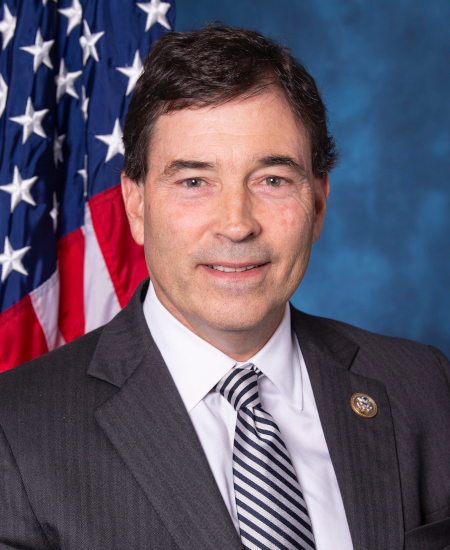
Rep. Troy Balderson
Sponsored bills
This concurrent resolution declares that Congress should not impose any new performance fee, tax, royalty, or other charge relating to the public performance of sound recordings on a local radio station for broadcasting sound recordings over the air, or on any business for such public performance of sound recordings.
Maddy summaryHRES 386 is a symbolic resolution introduced in the U.S. House of Representatives that expresses support for recognizing "National Police Week" each year. The resolution acknowledges law enforcement officers' sacrifices, particularly during the pandemic, and encourages the public to honor their service. As a non-binding statement, this resolution does not create new law or change policy but serves as a formal expression of support for law enforcement officers across the United States.
Honoring Our Promises through Expedition for Afghan SIVs Act of 2021 or the HOPE for Afghan SIVs Act of 2021 This bill authorizes the Department of State and the Department of Homeland Security (DHS) to postpone the medical exam requirement for qualifying citizens or nationals of Afghanistan seeking entry into the United States as special immigrants. Specifically, this bill applies to an existing program that provides special immigrant status to an individual (or the spouse or child of such an individual) who (1) faithfully performed sensitive and trusted duties for the U.S. government or the International Security Assistance Force in Afghanistan on or after October 7, 2001, and (2) has experienced or is experiencing an ongoing serious threat due to the performance of those duties. Under this bill, the State Department and DHS may jointly issue a blanket waiver of any requirement for such individuals to undergo a medical exam before admission into the United States. DHS shall ensure, to the greatest extent practicable, that individuals admitted under such a waiver undergo medical exams no later than 30 days after admission into the United States. Such an individual shall be admitted as a conditional permanent resident. DHS shall remove the conditions once the individual receives and passes a medical examination.
Stop Vaccine Mandates Act This bill rescinds the executive order titled Ensuring Adequate COVID Safety Protocols for Federal Contractors and the executive order titled Requiring Coronavirus Disease 2019 Vaccination for Federal Employees , both published on September 9, 2021. The bill provides that these executive orders shall have no force or effect.
Supplying America Needs Truckers Aged 18 Act or the SANTA 18 Act This bill exempts drivers who transport goods from a port of entry and another place within the same state from age restrictions and other requirements that apply to federal commercial driver's licenses.
Maddy summaryHRES 754 is a non-binding resolution expressing the House of Representatives' opposition to proposed "punitive natural gas taxes" on U.S. businesses, families, and workers. It cites claims that such taxes would raise average energy bills by 17%, reduce GDP by $9 billion, and eliminate 90,000 jobs, while disproportionately harming low-income households. The resolution argues that opposing these taxes supports U.S. energy security, national security, and continued leadership in reducing emissions through domestic natural gas production. As a procedural resolution, it does not create law but formally states the House's position against this policy approach.
State, Local, Tribal, and Territorial Fiscal Recovery, Infrastructure, and Disaster Relief Flexibility Act This bill allows states, tribes, territories, and localities to use certain COVID-19 relief funds for new categories of spending, including for natural disasters and infrastructure projects. It also makes changes to expenditure deadlines and other aspects of this funding. Specifically, recipients may use funds for emergency relief from natural disasters and associated negative economic impacts of natural disasters. In addition, recipients may use a portion of their COVID-19 relief funds for designated infrastructure projects, such as nationally significant freight and highway projects. Furthermore, the bill allows recipients to expend COVID-19 relief funds on these types of infrastructure projects until September 30, 2026. Under current law, recipients must expend the funds by December 31, 2024. Other changes in the bill include (1) modifying eligibility and allocation requirements for funding set aside for counties and Indian tribes that are near public lands, (2) allowing Indian tribes an additional year to expend their COVID-19 relief funds, and (3) establishing a process for government entities to decline COVID-19 relief funds and requiring any declined funds to be used to reduce the federal deficit.
This resolution recognizes the dedication and courage of veterans, veterans' organizations, and private citizens who have worked and continue to work to evacuate U.S. persons and vulnerable Afghans from Afghanistan. The resolution also encourages the Department of State and Department of Defense to work with veterans' service organizations and their networks to evacuate those who remain in Afghanistan.
Informing Veterans on Education for Transitioning Servicemembers Act or the Informing VETS Act This bill requires the Department of Veterans Affairs to regularly promote the Veteran Readiness and Employment program by (1) sending a letter to each veteran entitled to the program that explains the educational benefits of the program, and (2) providing in each letter and online a side-by-side comparison of benefits between the program and Post-9/11 GI Bill educational assistance.