

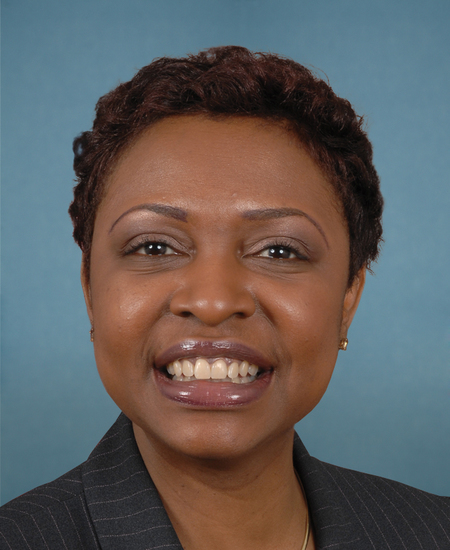
Photo of Yvette D. Clarke
D United States House · District 9 · New York On the 2026 ballot

Rep. Yvette D. Clarke

Compare
Total votes
2,837
all sessions
Attendance
99%
40 missed
Near the chamber average
With party
97%
of cast votes
Near the chamber average
Bipartisan score
2%
crosses aisle rarely
Near the chamber average
Sponsored
2,036
bills & resolutions
Higher than 92% of chamber peers
Committees
4
assignments
2,036 bills and resolutions

Sponsored bills

Total
2,036
Primary
83
Co-sponsor
1,953
This page
2,036
matching current filters
Co-sponsor HRES 1580
In committee · United States House · Co-sponsor
Supporting the designation of July as Uterine Fibroids Awareness Month.

Maddy summaryThis resolution supports designating July as Uterine Fibroids Awareness Month to highlight a health condition affecting an estimated 80% of women by age 50. It specifically recognizes the disproportionate impact on Black and Hispanic women (with 3x and 2x higher incidence rates than White women) and calls for increased public awareness about symptoms and treatment options. The resolution encourages the President to issue a proclamation urging educational activities during July to address this common but often underdiagnosed condition.

In committee Nov 18, 2024 1 co-sponsor
Primary HR 10139
In committee · United States House · Lead sponsor
American Renewable Energy Act of 2024

Maddy summaryThe American Renewable Energy Act of 2024 establishes a national standard requiring large electricity suppliers to generate increasing percentages of renewable electricity, from 20% in 2025 up to 70% by 2034. It mandates that 15-20% of required renewable energy credits must come from distributed generation (small-scale projects under 1 megawatt) and from projects in "impacted communities" - communities disproportionately affected by pollution and environmental injustice. Retail electricity suppliers can meet requirements through renewable energy credits or pay a $50 annual compliance fee (adjusted for inflation), with funds from these fees required to support renewable energy deployment, storage, and energy efficiency programs, ensuring at least 50% of benefits reach impacted communities. The law creates a national credit system while preserving existing state renewable energy programs and preventing double-counting of renewable energy credits.

In committee Nov 15, 2024 0 co-sponsors
Co-sponsor HRES 1558
In committee · United States House · Co-sponsor
Original National Domestic Violence Awareness Month Resolution of 2024

Maddy summaryThis resolution (HRES 1558) is a symbolic House of Representatives measure supporting October as "National Domestic Violence Awareness Month." It does not create new laws or allocate funding but formally expresses the House's support for raising awareness about domestic violence and its impacts, and urges continued backing for existing programs that address domestic violence. The resolution cites statistics on domestic violence prevalence (e.g., 24 people per minute affected by intimate partner violence) to underscore the importance of the observance. It directly affects public awareness efforts but does not change policies or directly impact individuals.

In committee Nov 1, 2024 1 co-sponsor
Co-sponsor HR 10090
In committee · United States House · Co-sponsor
Keeping Guns from High-Risk Individuals Act

Maddy summaryHR 10090, the "Keeping Guns from High-Risk Individuals Act," expands existing federal firearm prohibitions. It bars individuals convicted of a crime of violence (as defined in Section 16 of Title 18) within the last five years, or convicted of stalking, from purchasing or possessing firearms. This directly affects people with these specific recent convictions, adding them to the list of those prohibited under Section 922(d) (sales) and Section 922(g) (possession) of the U.S. Code. The bill makes concrete policy changes by broadening the categories of individuals barred from gun access based on certain criminal histories.

In committee Nov 1, 2024 1 co-sponsor
Co-sponsor HRES 1555
In committee · United States House · Co-sponsor
Condemning the spreading of disinformation and malicious rumors that have led to threats against disaster response personnel.

Maddy summaryHRES 1555 is a symbolic House resolution condemning the spread of false claims and malicious rumors about disaster response efforts, which have led to credible threats against FEMA personnel and disrupted aid for survivors. It specifically references incidents after Hurricanes Helene and Milton, including a pause in North Carolina door-to-door assistance due to safety threats and antisemitic targeting of officials. The resolution formally condemns those spreading disinformation for political gain and commits Congress to supporting FEMA’s efforts to combat misinformation and promote accurate recovery information. As a non-binding resolution, it does not create new laws but expresses congressional support for protecting disaster response workers and ensuring survivors receive timely aid.

In committee Oct 29, 2024 1 co-sponsor
Co-sponsor HR 10058
In committee · United States House · Co-sponsor
Medicaid Breast Cancer Access to Treatment Act

Maddy summaryThis bill expands Medicaid coverage for low-income individuals diagnosed with breast or cervical cancer. It requires Medicaid programs to cover breast reconstruction surgery after a medically necessary mastectomy, adding this as a mandatory benefit under existing Medicaid rules. The bill also modifies eligibility criteria to ensure coverage for these specific cancer patients, aligning with prior Medicaid provisions. These changes apply to all states administering Medicaid, directly affecting eligible patients seeking cancer treatment and recovery services.

In committee Oct 25, 2024 1 co-sponsor
Co-sponsor HR 9855
In committee · United States House · Co-sponsor
VA Employee Fairness Act of 2024

Maddy summaryThe VA Employee Fairness Act of 2024 modifies collective bargaining rules for employees of the Veterans Health Administration (VHA). It removes existing subsections (b), (c), and (d) from the law governing VHA employee bargaining and renumbers the remaining provision. This change streamlines the collective bargaining framework but does not alter the Secretary of Veterans Affairs' existing authorities over incentive pay and expedited hiring. The bill directly affects VHA employees by changing how their collective bargaining rights are structured under federal law. The law remains neutral, focusing solely on procedural adjustments to the existing bargaining framework.

In committee Oct 22, 2024 1 co-sponsor
Co-sponsor HR 9631
In committee · United States House · Co-sponsor
National Food as Medicine Program Act of 2024

Maddy summaryThe National Food as Medicine Program Act of 2024 creates a federal grant program to help states implement or expand initiatives that provide medically prescribed, nutrient-rich food (like fresh produce or tailored meals) to address chronic health conditions and food insecurity. States must partner with healthcare providers and community organizations to offer these interventions, using locally-sourced, sustainably produced food grown through regenerative or organic methods. The program requires states to evaluate outcomes like reduced hospital visits and improved health metrics, with reports submitted to the federal government after three years. It directly affects state Medicaid programs and healthcare providers participating in these initiatives.

In committee Oct 2, 2024 1 co-sponsor
Co-sponsor HRES 1525
In committee · United States House · Co-sponsor
Calling for comprehensive legislation that addresses United States policies contributing to forced migration and displacement, promotes an immigration system that addresses the root causes of migration, reaffirms United States commitment to asylum, and provides a roadmap to citizenship for immigrants living in the United States.

Maddy summaryHRES 1525 is a non-binding resolution calling for the U.S. government to address policies contributing to forced migration and displacement. It urges reforms such as overhauling economic sanctions, investing in developing countries to reduce poverty and instability, and reforming trade agreements to protect workers. The resolution also calls for expanding legal immigration pathways, improving asylum processing, and creating a roadmap to citizenship for immigrants living in the U.S. As a resolution, it does not create new laws but sets policy priorities for future legislative action.

In committee Oct 1, 2024 1 co-sponsor
Co-sponsor HR 9892
In committee · United States House · Co-sponsor
Smart Cities and Communities Act of 2024

Maddy summaryThe Smart Cities and Communities Act of 2024 establishes a federal framework to support cities and communities in adopting smart technologies that improve services, safety, sustainability, and equity. The bill creates an Interagency Council to coordinate federal agencies, provides $100 million annually for technology demonstration grants in cities (including small, rural, and Tribal communities), and establishes a Cybersecurity Working Group to develop security tools for smart city technologies. It also includes a TechHire workforce program to train workers in smart city technologies, a resource guide for cities on implementation best practices, and international trade programs to promote U.S. smart city technology exports. The legislation aims to reduce costs, pollution, and traffic while ensuring data privacy and cybersecurity standards for smart city systems.

In committee Oct 1, 2024 1 co-sponsor
Showing 741 to 750 of 2,036 bills
Previous 1 … 74 75 76 … 204 Next