

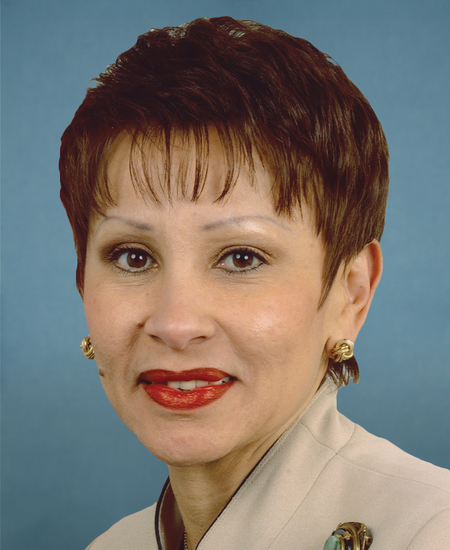
Photo of Nydia M. Velázquez
D United States House · District 7 · New York

Rep. Nydia M. Velázquez

Compare
Total votes
2,837
all sessions
Attendance
97%
92 missed
Lower than 82% of chamber peers
With party
97%
of cast votes
Near the chamber average
Bipartisan score
2%
crosses aisle rarely
Near the chamber average
Sponsored
1,849
bills & resolutions
Higher than 85% of chamber peers
Committees
4
assignments
1,849 bills and resolutions

Sponsored bills

Total
1,849
Primary
151
Co-sponsor
1,698
This page
1,849
matching current filters
Co-sponsor HJRES 193
In committee · United States House · Co-sponsor
Proposing an amendment to the Constitution of the United States providing that there is no immunity from criminal prosecution for an act on the grounds that such act was within the constitutional authority or official duties of an individual, and providing that the President may not grant a pardon to himself or herself.

Maddy summaryH.J. Res. 193 proposes a constitutional amendment to eliminate legal immunity for federal officials, including the President, from criminal prosecution for actions taken while performing official duties. It also prohibits the President from granting a pardon to themselves. The amendment would apply to all federal officers (such as the President, Vice President, and members of Congress) except for Congress members acting in their legislative role as defined in the Constitution. If ratified by 38 states, this change would become part of the U.S. Constitution, requiring no further congressional action.

In committee Jul 24, 2024 1 co-sponsor
Co-sponsor HR 9101
In committee · United States House · Co-sponsor
9/11 Responder and Survivor Health Funding Correction Act of 2024

Maddy summaryThe 9/11 Responder and Survivor Health Funding Correction Act of 2024 makes several key changes to the World Trade Center Health Program that serves 9/11 responders and survivors. It allows licensed mental health providers (not just physicians) to conduct mental health evaluations for program participants and extends the time period for adding new health conditions from 90 to 180 days. The bill also adjusts enrollment calculations by removing deceased individuals from program counts and provides $2.97 billion in new funding for fiscal year 2024 with a minimum annual funding level of $20 million for 2025. These changes aim to improve access to care while ensuring stable, long-term funding for the program that provides medical services to those affected by the 9/11 attacks.

In committee Jul 23, 2024 1 co-sponsor
Co-sponsor HR 9038
In committee · United States House · Co-sponsor
FAIR Fleets Act

Maddy summaryHR 9038, the FAIR Fleets Act, requires the U.S. Postal Service to conduct ongoing assessments of its vehicle distribution and develop a strategic plan to increase fleet availability in underserved areas using fuel-efficient, modern vehicles. The bill mandates an annual report to Congress by December 31 each year, detailing fleet distribution by state, steps taken to improve service in underserved areas, and recommendations for further action. Underserved areas are specifically defined to include rural regions, postal regions with aging vehicles, counties with significant delivery delays, high-poverty urban neighborhoods, and tribal lands. The law aims to improve fleet modernization and equitable distribution across all U.S. regions.

In committee Jul 15, 2024 1 co-sponsor
Co-sponsor HR 4581
Signed into law · United States House · Co-sponsor
Maternal and Child Health Stillbirth Prevention Act of 2024

Maddy summaryHR 4581, the Maternal and Child Health Stillbirth Prevention Act of 2024, amends Title V of the Social Security Act to explicitly allow federal funds to support stillbirth prevention efforts. The bill directs states receiving Title V maternal and child health funds to use these resources for evidence-based programs and research aimed at reducing stillbirths, including tracking fetal movements, screening for growth issues, smoking cessation, and community support. It directly affects state maternal health programs by clarifying that existing funding can now cover specific stillbirth prevention activities previously not explicitly permitted. The law changes how Title V funds may be spent, adding clear provisions for research and programs targeting stillbirth reduction. This is a policy change that updates funding guidelines without creating new programs or mandates.

Signed into law Jul 12, 2024 1 co-sponsor
Co-sponsor HCONRES 119
In committee · United States House · Co-sponsor
Expressing the sense of Congress that wrongfully or unjustly deported people who have established significant ties through years of life in the United States deserve a chance to come home to reunite with loved ones through a fair and central process within the Department of Homeland Security.

Maddy summaryHCONRES 119 is a non-binding congressional resolution expressing that people wrongfully or unjustly deported after establishing long-term ties in the U.S. (such as DACA recipients, veterans, or those with expunged convictions) deserve a fair process to return. It proposes creating a centralized unit within the Department of Homeland Security (DHS), modeled after DHS’s existing ImmVets program for veterans, to review applications for re-entry. The resolution does not change immigration law but urges DHS to establish this dedicated process to address systemic barriers like lengthy delays, complex procedures, and limited access to legal help. It specifically targets individuals separated from families after years in the U.S., including those deported due to errors, protests, or outdated convictions. The resolution emphasizes repairing past injustices without altering current legal frameworks.

In committee Jul 10, 2024 1 co-sponsor
Co-sponsor HRES 1355
In committee · United States House · Co-sponsor
Expressing support for the designation of July 10th as Journeyman Lineworkers Recognition Day.

Maddy summaryHRES 1355 is a non-binding resolution supporting the designation of July 10 as Journeyman Lineworkers Recognition Day. It honors lineworkers who maintain electrical infrastructure under hazardous conditions, including during disasters, and commemorates Henry Miller, the first president of the International Brotherhood of Electrical Workers, who died on July 10, 1896, while troubleshooting an electrical outage. The resolution encourages public recognition of these workers' contributions but does not create new laws or policies.

In committee Jul 10, 2024 1 co-sponsor
Co-sponsor HRES 1353
In committee · United States House · Co-sponsor
Impeaching Clarence Thomas, Associate Justice of the Supreme Court of the United States, for high crimes and misdemeanors.

Maddy summaryHRES 1353 is a resolution introduced by House members to impeach Supreme Court Associate Justice Clarence Thomas. The resolution outlines three articles of impeachment alleging Thomas failed to disclose gifts and financial transactions with donor Harlan Crow over 15 years, refused to recuse from cases involving his spouse's financial interests, and participated in cases concerning the 2020 election results despite his spouse's involvement in efforts to overturn them. These allegations claim Thomas violated federal ethics laws requiring judicial disclosure and recusal to maintain impartiality. The resolution would be referred to the Senate for trial if passed by the House, but it is not a law that would directly affect anyone beyond the impeachment process.

In committee Jul 10, 2024 1 co-sponsor
Co-sponsor HRES 1354
In committee · United States House · Co-sponsor
Impeaching Samuel Alito, Jr., Associate Justice of the Supreme Court of the United States, for high crimes and misdemeanors.

Maddy summaryThis resolution (HRES 1354) is a formal House of Representatives impeachment action against Supreme Court Justice Samuel Alito, introduced by multiple Democratic representatives on July 10, 2024. It alleges two violations: (1) Alito failed to recuse himself from three election-related cases (Trump v. United States, Fischer v. United States, and Trump v. Anderson) despite flying flags associated with the 2020 election denial movement outside his homes, which the resolution claims demonstrated bias; and (2) Alito allegedly failed to disclose luxury travel gifts from donors, violating financial disclosure laws. The resolution argues these actions breached his judicial oaths and federal recusal statutes (28 U.S.C. § 455) and financial disclosure requirements (5 U.S.C. §§ 13103-13104). As a procedural resolution, it initiates impeachment proceedings but does not change law or policy; the Senate would need to hold a trial for removal.

In committee Jul 10, 2024 1 co-sponsor
Co-sponsor HR 8980
In committee · United States House · Co-sponsor
SHIELD Act

Maddy summaryThe SHIELD Act (HR 8980) establishes a federal grant program to improve access to legal representation for people facing deportation. It authorizes $100 million annually for fiscal years 2025-2026 to fund workforce development and legal services infrastructure through competitive grants to states, local governments, and community organizations. The program will support recruitment, training, and retention of legal professionals to provide high-quality, culturally competent representation to immigrants in deportation proceedings. Grantees must report on services provided, outcomes achieved, and unmet needs to ensure accountability and measure the program's impact on addressing the current shortage of legal representation in immigration court.

In committee Jul 10, 2024 1 co-sponsor
Co-sponsor HR 8825
In committee · United States House · Co-sponsor
Right to Vote Act

Maddy summaryHR 8825, the Right to Vote Act, establishes a fundamental right for all citizens of legal voting age to vote in federal elections. It directly affects voters across all states and territories by prohibiting government actions that make voting harder (like restrictive ID laws or reduced polling places) unless those actions are the least restrictive way to serve a significant government interest. The bill creates two legal standards: "retrogression" (diminishing voting access) and "substantial impairment" (making voting significantly harder), allowing voters to sue in federal court to challenge such restrictions. Courts must expedite these cases, and the law applies to all federal elections occurring on or after September 1, 2024.

In committee Jul 10, 2024 1 co-sponsor
Showing 671 to 680 of 1,849 bills
Previous 1 … 67 68 69 … 185 Next