

Maddy summaryHR 7438 directs the U.S. Treasury to mint commemorative coins for the 2026 FIFA World Cup, including 100,000 $5 gold coins, 500,000 $1 silver coins, and 750,000 half-dollar coins. The coins will be sold to the public at face value plus surcharges ($35, $10, and $5 per coin, respectively), with all surcharge revenue paid to FWC2026 US, Inc. for U.S. soccer programs. These funds must support soccer initiatives, particularly in underserved communities and youth development, as specified in the bill. The coins are legal tender but will only be issued during 2026, with no net cost to the U.S. government.
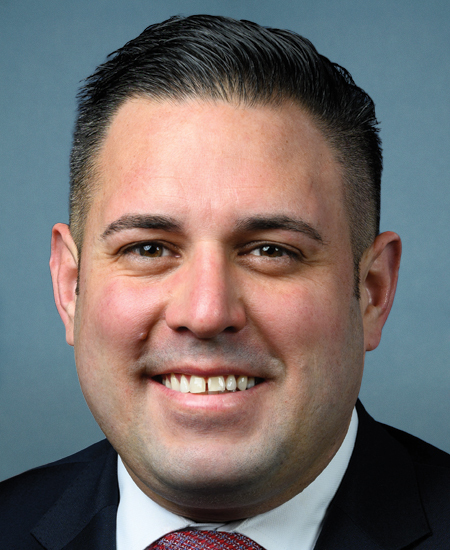
Rep. Anthony D’Esposito
Sponsored bills
Maddy summaryHR 6229, the DHS Special Events Program and Support Act, creates a new program within the Department of Homeland Security to assess security threats at pre-planned special events not already designated as National Special Security Events. It allows state, local, tribal, and territorial officials to voluntarily request a security rating for events, which could lead to DHS providing direct security and situational awareness support. The program uses a risk-based approach considering factors like event size, attendance of officials, venue, and credible threats, with expedited reassessment options. DHS must report annually on the program’s usage and support provided, and conduct research on technologies for mass gathering security. This directly affects event organizers seeking federal security assistance for non-NSS events.
Maddy summaryHR 5799, the James R. Dominguez Memorial Act of 2023, designates a U.S. Border Patrol checkpoint on U.S. Highway 90 West in Uvalde County, Texas, as the "James R. Dominguez Border Patrol Checkpoint" to honor Agent James R. Dominguez, who died in 2012 while clearing road debris. The bill updates all federal references - such as laws, maps, and documents - to use this new name for the checkpoint. It does not change border patrol operations or policies, only the official designation of the location. This memorial act directly affects the checkpoint's identity and all federal records referencing it.
Maddy summaryHR 7671, the Disaster Management Costs Modernization Act, allows local governments and organizations receiving federal disaster funds to redirect unused management costs toward disaster preparedness and mitigation. It defines "excess funds" as the difference between authorized management costs and actual spending, making these funds available for activities like building disaster recovery capacity or managing ongoing disaster operations. These redirected funds must be used within five years of availability and cannot create new spending, as the bill specifies "no additional funds" are authorized. The act also requires a GAO study to assess historical management costs for future funding decisions.
Maddy summaryThis bill authorizes the awarding of a Congressional Gold Medal to Daniel Penny for his actions on May 1, 2023, when he restrained a man with 42 prior arrests on a New York City subway, protecting passengers. The medal, to be struck by the U.S. Mint, will be presented posthumously to Penny, a Marine Corps veteran. Duplicate bronze medals may be sold to cover production costs, with proceeds deposited into the U.S. Mint fund. As a commemorative act, it has no policy impact beyond honoring Penny's actions.
Maddy summaryThis bill amends the Regulatory Flexibility Act to require federal agencies to more thoroughly assess how proposed regulations impact small businesses, including indirect costs on businesses that aren't directly regulated but are affected by the rules (e.g., suppliers or partners). It creates a new process allowing small businesses or their representatives to petition the Small Business Administration's Chief Counsel to review an agency's claim that a rule won't significantly affect small entities, with strict timelines for agency responses. If an agency fails to cooperate with this review, the final rule cannot apply to small businesses. Agencies must also publish regulatory guidance online for small businesses to comment on, ensuring greater transparency in rulemaking.
Maddy summaryHR 7480, the Disabled Veterans Housing Support Act, changes how housing programs calculate income eligibility for veterans. It requires states and local governments to exclude service-connected disability compensation from the Department of Veterans Affairs (VA) when determining if a veteran qualifies as "low or moderate income" for HUD housing programs (like Section 8 or public housing). This directly helps disabled veterans whose VA disability pay would otherwise disqualify them from housing assistance they need. The bill also mandates a report within one year examining how VA disability pay is treated across HUD programs and recommending improvements to better serve veterans. The change simplifies access to housing support by ensuring VA benefits aren't counted as income for these programs.
Maddy summaryHR 6751 authorizes the U.S. Mint to produce commemorative coins honoring Roberto Clemente, a Hall of Fame baseball player and humanitarian, including 50,000 $5 gold coins, 400,000 $1 silver coins, and 750,000 half-dollar coins. The coins must feature Clemente's image and inscriptions like "Roberto Clemente" and "2027," with all sales including a surcharge ($5-$35 per coin) paid to the Roberto Clemente Foundation. The foundation, which supports youth sports, education, and disaster relief programs, will use these funds for its mission, while the U.S. Treasury must recover all production costs. The coins will be sold exclusively in 2027, with no net cost to the government.
Maddy summaryHRES 609 is a House resolution expressing opposition to New York City's proposed Central Business District Tolling Program, which would charge drivers up to $23 daily to enter Manhattan south of 60th Street. The resolution highlights that this fee could cost daily commuters about $5,000 annually and disproportionately burden small businesses (still recovering from pandemic lockdowns), low-income families, and students. It disapproves of the program, calls for a public economic impact report, and urges federal and state authorities to halt its implementation. The resolution notes the program is intended to generate $1 billion yearly for the MTA’s capital projects and operations, following the agency’s $690 million 2022 revenue loss.
Maddy summaryThe Working Dog Commemorative Coin Act (HR 807) directs the U.S. Treasury to mint three types of commemorative coins honoring working dogs' service: $5 gold coins, $1 silver coins, and half-dollar coins with specific weight and composition requirements. Each coin will carry a surcharge ($35 for $5 coins, $10 for $1 coins, $5 for half-dollars) that will be paid directly to America's VetDogs to support their programs providing service dogs for veterans, the disabled, and others. The coins will be issued in 2027 with designs reflecting working dogs' roles in military, detection, therapy, and assistance work. The legislation specifies that all surcharge revenue must fund America's VetDogs' operations without creating new government programs. This is a commemorative measure focused on honoring working dogs' contributions through coin sales, with all surcharge funds going to a specific nonprofit organization.