

Maddy summaryHR 7566, the CARTEL Act of 2024, requires U.S. Customs and Border Protection (CBP) to publish monthly public reports on border statistics, including encounters with individuals in the terrorist screening database (both attempts and apprehensions) and those affiliated with transnational criminal organizations. The bill mandates specific data points like total encounters, drug seizures, gang affiliations, and whether apprehended individuals were released or removed. Additionally, it requires the Secretary of Homeland Security to submit an annual report to Congress assessing foreign terrorist organizations and transnational criminal organizations attempting to enter the U.S. through border regions. This bill directly affects CBP (as the reporting entity) and provides the public and Congress with detailed, monthly border enforcement data.
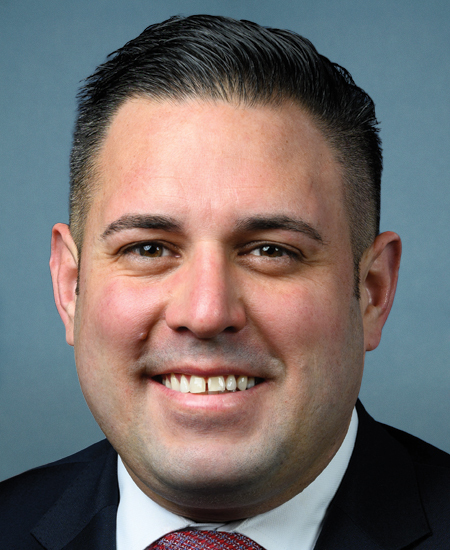
Rep. Anthony D’Esposito
Sponsored bills
Maddy summaryHR 7552, the "RECOGNIZING Judea and Samaria Act," is a procedural bill requiring the U.S. government to replace the term "West Bank" with "Judea and Samaria" in all official documents, communications, and policy materials after enactment. It prohibits federal funds from being used to prepare or distribute any materials using "West Bank," with limited exceptions for international treaty obligations and a Secretary of State waiver process. The bill amends multiple laws (including the Foreign Assistance Act and Taylor Force Act) to update terminology throughout U.S. legal texts. This is a terminology change affecting government communications, not a policy altering territorial status or impacting individuals.
Maddy summaryHRES 1041 is a non-binding resolution introduced in the U.S. House of Representatives on February 29, 2024, that condemns the International Court of Justice's (ICJ) January 26, 2024, order requiring Israel to report on measures taken to comply with provisional measures related to South Africa's genocide case against Israel. The resolution specifically condemns the ICJ's order and South Africa's case, asserts Israel's right to self-defense against Hamas, and calls on the U.S. President to direct the Secretary of State to intervene in support of Israel. It does not impose legal requirements or alter policy, as resolutions like this express congressional opinion only.
Maddy summaryThis bill amends the 2018 Anti-Boycott Act to include boycotts by international governmental organizations (IGOs), such as UN agencies, alongside boycotts by foreign countries. It expands existing requirements for U.S. entities to report boycotts they comply with, now covering IGO-initiated boycotts as well. The change directly affects U.S. businesses and organizations operating internationally who might face pressure from IGOs to participate in boycotts. Key provisions update legal definitions in the law by inserting "or international governmental organization" in relevant sections without creating new penalties.
Maddy summaryHRES 1022 is a symbolic resolution expressing the House of Representatives' support for designating March 2024 as "National March into Literacy Month." It encourages schools, parents, and communities to promote literacy through events and awareness activities during March, without creating new laws or allocating funds. The resolution highlights literacy's importance for children's success and adult workforce participation, citing research on reading skills. As a procedural measure, it has no direct impact on individuals or policy implementation.
Maddy summaryHR 7411, the Recover Pride in Service Act, requires the Department of Defense to automatically upgrade all military discharges based solely on sexual orientation to honorable status without veterans needing to apply. It directly affects veterans discharged under such policies, including those separated before September 20, 2011. Key provisions include amending review procedures to eliminate documentation requirements for veterans seeking review, establishing a Defense Outreach Unit to notify affected veterans within 60 days, and mandating a 5-year timeline for full implementation. The bill also requires annual progress reports to Congress on discharge upgrades and final reports detailing outcomes like the number of upgrades completed.
Maddy summaryThe Election Worker Recruitment and Safety Act requires the Election Assistance Commission to regularly study state programs for recruiting and training poll workers, with a focus on safety. The Commission must publish reports by December 2024 and every two years after, identifying voluntary best practices states can adopt. States can then use federal election funding to implement these recommended practices for recruiting and training poll workers. The bill does not mandate specific actions but creates a framework for states to access and apply proven safety and recruitment strategies. This aims to improve the safety and efficiency of election worker programs nationwide.
Maddy summaryThis bill requires the Secretary of Homeland Security, working with the Education Secretary and other agencies, to create a federal strategy for securing K-12 schools against terrorism threats within 180 days of enactment. The strategy must detail existing federal programs and funding for school security, identify specific vulnerabilities in school safety, outline actions to address those gaps, and recommend any needed new authorities. It applies directly to federal agencies coordinating school security efforts but does not mandate specific security measures for schools themselves. The strategy must be updated every seven years, with the requirement ending seven years after the bill's enactment.
Maddy summaryHR 7382 amends existing law to allow law enforcement agencies using Byrne JAG funds (a federal grant program) to specifically fund programs aimed at reducing demand for commercial sex trafficking. This change directly affects state and local law enforcement agencies that receive Byrne JAG grants, enabling them to allocate these funds toward demand reduction initiatives like public awareness campaigns or victim services. The key mechanism is adding "programs to reduce the demand for trafficked persons" as an explicitly authorized use of Byrne JAG funds under the 1968 Crime Control Act. This policy change expands the scope of existing federal funding to target the demand side of sex trafficking, without creating new programs or altering other funding categories.
Maddy summaryHR 7378, the Frederick Douglass Congressional Gold Medal Act, authorizes Congress to posthumously award a gold medal to honor Frederick Douglass's legacy as a pivotal abolitionist, writer, and advocate for civil rights. The medal, designed by the Treasury Secretary, will be presented to the National Museum of African American History and Culture for display, with bronze duplicates available for sale to cover costs. This ceremonial bill does not create new laws or affect current policies - it solely commemorates Douglass's historical contributions to ending slavery and advancing equality.