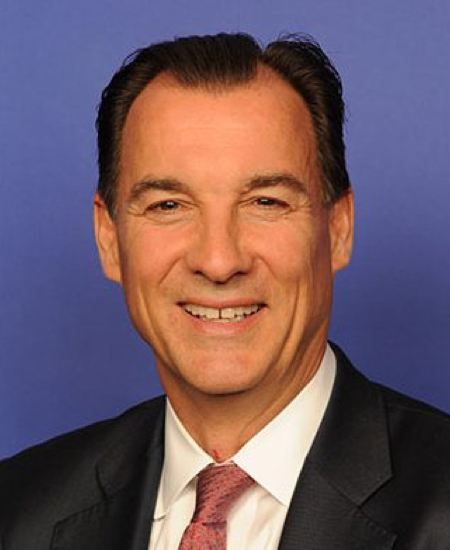
Photo of Thomas R. Suozzi
D United States House · District 3 · New York On the 2026 ballot

Rep. Thomas R. Suozzi

Compare
Total votes
2,089
all sessions
Attendance
98%
44 missed
Near the chamber average
With party
94%
of cast votes
Lower than 95% of chamber peers
Bipartisan score
3%
crosses aisle rarely
Higher than 94% of chamber peers
Sponsored
1,746
bills & resolutions
Higher than 92% of chamber peers
Committees
3
assignments
1,746 bills and resolutions

Sponsored bills

Total
1,746
Primary
52
Co-sponsor
1,694
This page
1,746
matching current filters
Co-sponsor HR 5131
In committee · United States House · Co-sponsor
Pediatric Access to Critical Healthcare Act

Pediatric Access to Critical Healthcare Act This bill requires the Health Resources and Services Administration (HRSA) to award grants to children's hospitals and other providers that predominately treat individuals under 21 for improving pediatric health care infrastructure. In awarding the grants, HRSA must prioritize recipients that serve significant numbers of patients receiving medical assistance through Medicaid or the Children's Health Insurance Program or children from other underserved groups.

In committee Sep 1, 2021 1 co-sponsor
Primary HR 3642
Signed into law · United States House · Lead sponsor
Harlem Hellfighters Congressional Gold Medal Act

Harlem Hellfighters Congressional Gold Medal Act This bill provides for the award of a Congressional Gold Medal to the 369th Infantry Regiment, commonly known as the Harlem Hellfighters, in recognition of their bravery and outstanding service during World War I.

Signed into law Aug 25, 2021 0 co-sponsors
Co-sponsor HR 1448
Signed into law · United States House · Co-sponsor
PAWS for Veterans Therapy Act

Puppies Assisting Wounded Servicemembers for Veterans Therapy Act or the PAWS for Veterans Therapy Act This bill implements a program and a policy related to service dog therapy for veterans. Specifically, the bill requires the Department of Veterans Affairs (VA) to implement a five-year pilot program to provide canine training to eligible veterans diagnosed with post-traumatic stress disorder as an element of a complementary and integrative health program. Eligible veterans are those who are enrolled in the VA health care system and have been recommended for participation by a qualified mental health care provider or clinical team. The VA must seek to enter agreements containing specified elements with accredited nongovernmental entities that have demonstrated ability to provide canine training. Veterans who participate in the program are authorized to adopt the dog they assisted in training if their health provider determines it is in the best interest of the veteran. The VA must establish processes to document and track the progress of participating veterans with respect to health benefits and improvements. The Government Accountability Office must brief Congress and submit a report on the program. The bill also authorizes the VA to provide service dogs to veterans with mental illnesses, regardless of whether they have a mobility impairment.

Signed into law Aug 25, 2021 1 co-sponsor
Co-sponsor HR 5077
In committee · United States House · Co-sponsor
REHABS Act of 2021

Removing Environmental Hazards And Building Safely Act of 2021 or the REHABS Act of 2021 This bill authorizes the Department of Housing and Urban Development (HUD) to award grants to national and regional organizations and consortia to abate and remove environmental hazards (e.g., lead, asbestos, and mold) in homes being rehabilitated for families and individuals who otherwise would be unable to afford to purchase a dwelling. Additionally, HUD must study the assessment and removal of mold in the rehabilitation of a single-family home.

In committee Aug 23, 2021 1 co-sponsor
Co-sponsor HR 5064
In committee · United States House · Co-sponsor
BEACH Act of 2021

Beaches Environmental Assessment and Coastal Health Act of 2021 or the BEACH Act of 2021 This bill reauthorizes through FY2026 and expands a program that awards grants to state and local governments to monitor the water quality at beaches and notify the public when water is not safe for recreational activities. The bill expands the program to allow the Environmental Protection Agency to award grants for researching and identifying specific sources of contamination at certain coastal recreation waters and taking actions to mitigate those sources.

In committee Aug 23, 2021 1 co-sponsor
Co-sponsor HR 5056
In committee · United States House · Co-sponsor
To amend the Internal Revenue Code of 1986 to provide tax credits for carriage of independent programmers by qualified distributors and multichannel video programming distributors.

This bill allows a new tax credit for carriage of qualified independent programmers by eligible distributors and multichannel video programming distributors based on license fees and the number of subscribers. The bill defines eligible distributor as any person engaged in the trade or business of a qualified distributor or multichannel video programming distributor and any person engaged in the trade or business of being a virtual multichannel video programming distributor. The term multchannel video programming distributor is defined in federal regulations as any entity engaged in the business of making available for purchase, by subscribers or customers, multiple channels of video programming. Such entities include, but are not limited to, a cable operator, a BRS/EBS provider, a direct broadcast satellite service, a television receive-only satellite program distributor, and a satellite master antenna television system operator, as well as buying groups or agents of all such entities. The bill defines qualified independent programmer as a U.S.-based person engaged in the production, creation, or wholesale distribution of three or fewer television channels in which no multichannel video programming distributor, cable programmer, or broadcast network has attributable interest, and includes rural, women, socially disadvantaged, and minority-owned programmers.

In committee Aug 20, 2021 1 co-sponsor
Co-sponsor HR 5035
In committee · United States House · Co-sponsor
Child Suicide Prevention and Lethal Means Safety Act

Child Suicide Prevention and Lethal Means Safety Act This bill requires the Department of Health and Human Services (HHS) to establish grant programs and set up a website to reduce suicide rates among youth and young adults (those under age 26), including by addressing the use of firearms in suicides and suicide attempts. Specifically, HHS must award grants to states, Indian tribes, health departments, hospitals, or other organizations to train health care providers on lethal means safety (e.g., safe storage of firearms), relevant laws concerning the use and possession of firearms, and other suicide prevention and intervention strategies for youth and young adults. Grantees may use a portion of funds to make secure gun storage or safety devices available to residences with an individual under age 26 who is at risk of suicide. In addition, HHS must award grants to health professional schools to integrate content into their curricula and continuing education programs about suicide prevention strategies and interventions to reduce suicide rates among youth and young adults. The bill also requires HHS to develop and maintain a website that contains information for individuals under age 26, their families, health care providers, and health professional schools concerning suicide prevention and the use of firearms in suicide attempts.


In committee Aug 16, 2021 1 co-sponsor
Co-sponsor HR 4833
In committee · United States House · Co-sponsor
Migratory Bird Protection Act of 2021

Migratory Bird Protection Act of 2021 This bill prohibits the incidental taking (e.g., capturing or killing) of migratory birds by commercial activities unless the activity is authorized under a permit or is identified as posing de minimis risk to migratory birds. The U.S. Fish and Wildlife Service (USFWS) must regulate such incidental taking, including by (1) issuing general permits for certain industries, (2) creating a mitigation fee for any incidental taking of migratory birds, and (3) identifying categories of de minimis risk activities that are exempt from liability for the taking of migratory birds. In addition, the USFWS must establish and maintain a research program (1) to evaluate the impacts of commercial activities on birds, (2) to evaluate the effectiveness of best management practices and technologies to avoid or minimize such impacts, and (3) to develop new or improved best management practices and technologies.

In committee Aug 14, 2021 1 co-sponsor
Showing 1,291 to 1,300 of 1,746 bills