

Maddy summaryHJRES 35 is a congressional resolution disapproving an Environmental Protection Agency (EPA) rule that established procedures for emissions charges on petroleum and natural gas systems. Specifically, it targets the EPA’s November 2024 rule titled "Waste Emissions Charge for Petroleum and Natural Gas Systems: Procedures for Facilitating Compliance, Including Netting and Exemptions," which would have required companies to pay fees based on emissions. The resolution, passed by both chambers in February 2025, nullifies the rule, preventing it from taking effect. This directly affects oil and gas companies subject to the EPA’s emissions regulations, removing a specific compliance mechanism they would have faced.
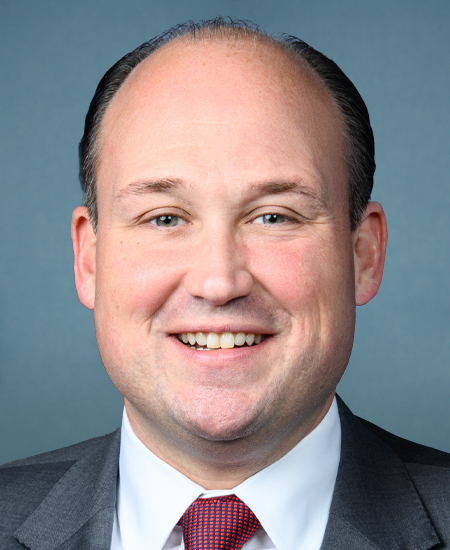
Rep. Nicholas A. Langworthy
Sponsored bills
Maddy summaryHR 2133, the "Lakes Before Turbines Act," blocks tax credits for offshore wind energy projects in the Great Lakes by amending the federal tax code. It prohibits the Investment Tax Credit (ITC) for offshore wind facilities located in the Great Lakes after 2022, directly affecting developers planning such projects. The key provision inserts "other than any of the Great Lakes" into the tax code language that previously allowed credits for wind projects in U.S. inland waters. This policy change takes effect for taxable years beginning after December 31, 2022.
Maintaining and Enhancing Hydroelectricity and River Restoration Act This bill establishes a new investment tax credit in the amount of 30% of the basis of any hydropower improvement property. The bill defines hydropower improvement property as property that adds or improves fish passage at a qualified dam; maintains or improves the quality of the water retained or released by a qualified dam; promotes downstream sediment transport and habitat maintenance; upgrades, repairs, or reconstructs a qualified dam to meet safety and security standards; improves public uses of, and access to, public waterways impacted by a qualified dam; removes an obsolete river obstruction; or places into service an approved remote dam. Further, written approval for hydropower improvement property must be obtained from the Federal Energy Regulatory Commission or state or local officials prior to January 1, 2032. The bill also allows an election to claim the investment tax credit for qualified progress expenses for some types of hydropower improvement property in advance of such property being placed into service. Any investment tax credit amount claimed for qualified progress expenses reduces the amount of the investment tax credit that may be claimed once the hydropower improvement property is placed into service. The bill authorizes certain entities, including tax-exempt and governmental entities, to treat the investment tax credit for hydropower improvement property as a payment of tax and receive a refund of any overpayment (also known as elective pay). Finally, the investment tax credit for hydropower improvement property may be transferred (i.e., sold).
Maddy summaryHR 2111 would exempt premium cigars from certain federal tobacco regulations under the Federal Food, Drug, and Cosmetic Act. It redefines "premium cigar" to include only cigars meeting strict criteria: made entirely of tobacco leaf (no filters, additives, or flavorings), handmade, and weighing over 6 pounds per 1,000 units. This exemption directly affects small, family-owned premium cigar manufacturers, shifting regulatory oversight from federal to state levels as determined by a recent court ruling. The bill cites data showing premium cigars are used primarily by adults (1% of U.S. adults), involve lower health risks than other tobacco products, and are rarely used by youth.
Homes for Every Local Protector, Educator, and Responder Act of 2025 or the HELPER Act of 2025 This bill establishes a program administered by the Department of Housing and Urban Development to provide mortgage assistance to law enforcement officers, elementary and secondary school teachers, firefighters, or other first responders. Specifically, these individuals may be eligible for a first-time mortgage on a primary family residence with no down payment. Instead, the mortgage is subject to a one-time, up-front mortgage insurance premium.
Maddy summaryThe Credit for Caring Act of 2025 creates a federal tax credit for family caregivers of elderly or disabled relatives. It allows eligible caregivers (with over $7,500 in earned income) to claim a credit equal to 30% of qualified caregiving expenses exceeding $2,000, capped at $5,000 per year. Qualified expenses include human assistance, home modifications, respite care, counseling, lost wages for unpaid time off, and transportation, all requiring certification from a licensed healthcare provider that the care recipient has long-term needs. The credit phases out for higher earners (over $75,000 single/$150,000 joint) and requires documentation of expenses and care recipient certification.
Metastatic Breast Cancer Access to Care Act This bill expedites payment of Social Security Disability Insurance (SSDI) benefits and eligibility for Medicare coverage for those with metastatic breast cancer (i.e., breast cancer that has spread to other sites in the body). Specifically, the bill eliminates the 5-month waiting period for SSDI benefits and the subsequent 24-month waiting period for Medicare coverage for individuals with metastatic breast cancer. Under current law, individuals generally must wait 5 months after the onset of disability to begin receiving SSDI benefits and an additional 24 months to become eligible for Medicare.
Maddy summaryHR 2042 establishes the Space National Guard as a reserve component of the Space Force, specifically for seven states (Alaska, California, Colorado, Florida, Hawaii, New York, and Ohio). It transfers existing Air National Guard space units - like the 213th Space Warning Squadron in Alaska and the 137th Space Warning Squadron in Colorado - to this new structure, while prohibiting additional personnel or new facilities. The bill requires the Secretary of the Air Force to implement the change within one year and provide annual reports to Congress on its status, missions, and funding. This reorganization officially recognizes these state-based units as part of the Space Force reserve without creating new military capabilities or infrastructure.
Maddy summaryHRES 208 is a non-binding House resolution expressing solidarity with New York State corrections officers who are striking over unsafe working conditions. It cites rising assaults on staff (2,070 in 2024), staffing shortages (down to 13,886 officers in 2025), and the HALT Act's restrictions on solitary confinement as key issues driving the strike. The resolution urges the New York State Legislature to repeal the HALT Act and condemns Governor Hochul's response to the strike. As a symbolic gesture, it does not create new law or directly affect policy.
Maddy summaryThis bill extends current Medicare payment rates for durable medical equipment (like wheelchairs and oxygen) in non-rural areas through December 2025. It delays implementing a new payment rule for all areas until January 2026. The law directly affects Medicare beneficiaries needing equipment and the suppliers who provide it by maintaining existing reimbursement rates for an additional year. This avoids immediate payment reductions for non-rural areas while postponing the full transition to new rates.