

Property Tax Reduction Act of 2023 This bill reduces federal Medicaid funding beginning in FY2025 for certain states that require political subdivisions to contribute funds towards medical assistance. Specifically, the bill applies to states that received, for FY2023, disproportionate share hospital (DSH) allotments greater than six times the national average. (DSHs are hospitals that receive additional payment under Medicaid for treating a large share of low-income patients.) Excepted from the bill are contributions that: (1) are required from a political subdivision that has a population greater than 5 million and imposes a local income tax upon its residents, or (2) were required for administrative expenses as of January 1, 2023.
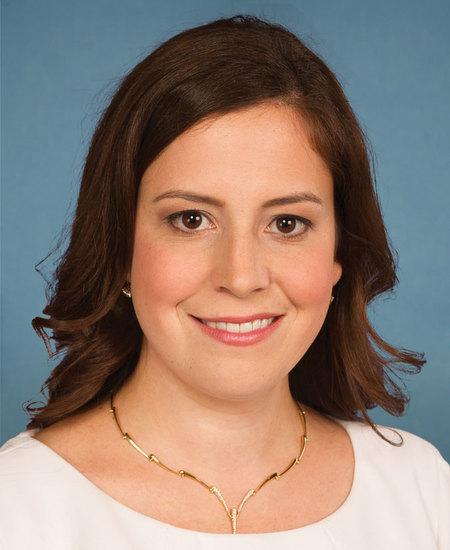
Rep. Elise M. Stefanik
Sponsored bills
Maddy summaryThe DAIRY PRIDE Act would require food products using dairy-related terms (like "milk," "yogurt," or "cheese") to meet the FDA's definition of dairy - derived from animal milk - to prevent misleading labeling of plant-based alternatives. It directly affects producers of plant-based products currently marketed with dairy terms, such as almond or oat milk, which often lack comparable nutrition. The bill mandates the FDA issue enforcement guidance within 180 days and report to Congress on actions taken after two years. This policy change aims to align product names with the FDA's existing definition of dairy products under federal law.
Maddy summaryThis bill authorizes a Congressional Gold Medal to honor the "Hello Girls" - female telephone operators who served in the Army Signal Corps during World War I. They provided critical battlefield communications in France (connecting 26 million calls), wore military uniforms, and faced combat risks, but were denied veteran benefits for 60 years due to being classified as civilian contractors. The medal recognizes their pioneering service, devotion, and the decades-long struggle to gain military recognition. The award follows similar recognition for other WWII women veterans and aims to correct the historical injustice they faced.
Maddy summaryHR 1346, the COVID-19 Origin Act of 2023, requires the Director of National Intelligence to declassify specific information related to the origin of the pandemic within 90 days of enactment. It mandates releasing details about potential links between the Wuhan Institute of Virology and COVID-19, including military connections, prior coronavirus research, and health records of researchers who fell ill in autumn 2019. The bill also requires the Director to submit an unclassified report to Congress containing this information, with only minimal redactions for security. This affects the Director of National Intelligence, who must act on the directive, and the public, who would gain access to the declassified materials.
Maddy summaryThis bill amends the World Trade Center Health Program to expand eligibility to include certain Department of Defense and Federal agency workers who responded to the September 11 attacks at the Pentagon and Shanksville, Pennsylvania. It establishes a 500-person enrollment cap for these responders, allows a broader range of licensed health care providers to conduct program evaluations, and creates two new funding mechanisms totaling $2.04 billion for the program through 2033. The bill also clarifies enrollment counts by excluding deceased individuals from program statistics and adjusts funding calculations to ensure continued support for affected responders and survivors. These changes directly affect 9/11 responders who worked at the Pentagon and Shanksville sites and their families participating in the health program.
Servicemember Credit Monitoring Enhancement Act This bill makes available to uniformed service members free electronic credit monitoring that is currently available to active duty service members.
Maddy summaryThis bill, titled misleadingly as the "Customs Business Fairness Act," is actually a narrow amendment to bankruptcy law, not customs policy. It modifies Section 507(d) of the Bankruptcy Code to exclude "subparagraph (F)" from certain debt treatment rules, affecting businesses filing for bankruptcy under Title 11 after the law's enactment. The amendment applies only to bankruptcy cases commenced after the bill becomes law, not to cases filed before it was enacted. This is a procedural change with no direct impact on customs operations or import/export regulations.
This joint resolution proposes a constitutional amendment that prohibits an individual who is not a U.S. citizen from voting in federal, state, or local elections for public office or voting on any ballot initiative or referendum held in the United States.
Maddy summaryThis bill requires the President to assess the inflation impact of major executive orders before issuing them. For any executive order projected to cost at least $1 billion annually in budget effects (excluding emergency relief, national security actions, or treaty implementation), the President must prepare a statement estimating its effect on inflation - whether it has no impact, quantifiable impact, or significant but undeterminable impact. Federal agencies must provide necessary data to support this assessment, and the President must submit an annual report to Congress detailing all such assessments. The bill does not change inflation policy but mandates a new procedural review for major executive actions.
Maddy summaryThis bill prohibits federal funding for any state, local, tribal, or private entity operating heroin injection centers that violate the federal drug law (21 U.S.C. 856, the "Crack House Statute"). It directly affects organizations running such centers by blocking all federal financial support for their operations. The key mechanism is a clear funding restriction: no federal money can be provided to entities operating centers deemed unlawful under existing federal drug law. The bill does not create new criminal penalties but prevents government funding for facilities violating current law.