

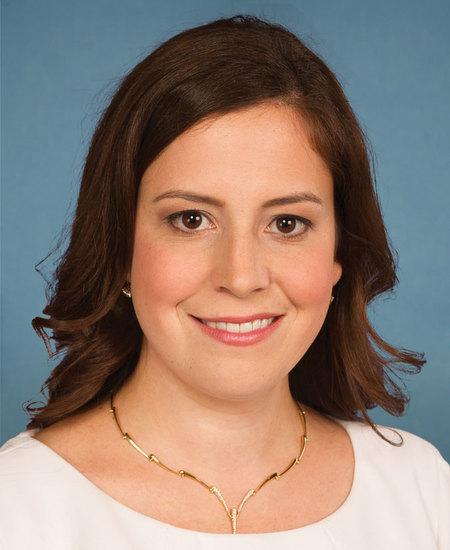
Photo of Elise M. Stefanik
R United States House · District 21 · New York

Rep. Elise M. Stefanik

Compare
Total votes
2,837
all sessions
Attendance
95%
130 missed
Lower than 97% of chamber peers
With party
96%
of cast votes
Near the chamber average
Bipartisan score
2%
crosses aisle rarely
Near the chamber average
Sponsored
1,218
bills & resolutions
Near the chamber average
Committees
9
assignments
1,218 bills and resolutions

Sponsored bills

Total
1,218
Primary
134
Co-sponsor
1,084
This page
1,218
matching current filters
Co-sponsor HR 3094
In committee · United States House · Co-sponsor
To terminate the requirement imposed by the Secretary of Homeland Security for proof of COVID-19 vaccination for foreign travelers, and for other purposes.

This bill nullifies a requirement for certain foreign travelers to show proof of being fully vaccinated against COVID-19 before being admitted into the United States. Specifically, this bill nullifies a U.S. Customs and Border Protection (CBP) rule that imposed this requirement for each traveler who is neither a U.S. national nor a lawful permanent resident arriving at land port of entry or ferry on the U.S.-Canada border. The bill also nullifies another CBP rule that applied this restriction to the U.S.-Mexico border. The bill also nullifies any subsequent decision by CBP or the Department of Homeland Security that imposes such a requirement.

In committee May 5, 2023 1 co-sponsor
Co-sponsor HR 3079
In committee · United States House · Co-sponsor
Back the Blue Act of 2023

Maddy summaryThis bill creates new federal crimes for killing or assaulting law enforcement officers and public safety personnel while they're on duty or because of their status as officers. It establishes mandatory minimum sentences of 10 years for murder of officers, with higher penalties for assaults causing serious injury or using deadly weapons. The bill also creates a new offense for fleeing to avoid prosecution for killing officers and limits federal habeas corpus relief for those convicted of killing officers. Additionally, it expands law enforcement officers' authority to carry firearms in certain locations. The bill directly affects law enforcement officers, public safety personnel, and individuals who commit violent acts against them.

In committee May 5, 2023 1 co-sponsor
Co-sponsor HR 2955
In committee · United States House · Co-sponsor
Stop Institutional Child Abuse Act

Maddy summaryHR 2955, the Stop Institutional Child Abuse Act, establishes a Federal Work Group to improve data collection and best practices for youth in residential programs (like therapeutic schools, treatment centers, and group homes). The Work Group, composed of federal agency representatives and diverse stakeholders, must develop national data standards, create risk assessment tools, and issue biennial reports with recommendations to enhance safety, reduce restraints, and expand community-based alternatives. It directly affects youth with mental health, substance use, or disability needs placed in these facilities, as well as agencies overseeing them. The bill also mandates a National Academies study to examine funding, oversight, and barriers to community care. These mechanisms aim to standardize data tracking and promote less restrictive, trauma-informed care for youth in residential programs.

In committee Apr 28, 2023 1 co-sponsor
Co-sponsor HR 2700
In committee · United States House · Co-sponsor
Employee Rights Act

Maddy summaryThe Employee Rights Act (HR 2700) amends key labor laws to strengthen employee rights in collective bargaining and privacy. It requires employers to use secret ballot elections for selecting bargaining representatives and to provide labor organizations with voter lists containing employee names and one form of contact information (chosen by the employee) within two business days of an election. The bill prohibits employers from using employee personal information for non-organizing purposes and mandates written authorization for using union dues on non-bargaining activities, with authorizations expiring after one year. Additionally, it clarifies joint employment standards to prevent misclassification and adds tribal sovereignty protections to labor law definitions.

In committee Apr 28, 2023 1 co-sponsor
Co-sponsor HJRES 59
In committee · United States House · Co-sponsor
Providing for congressional disapproval under chapter 8 of title 5, United States Code, of the rule submitted by the Department of Labor relating to "Adverse Effect Wage Rate Methodology for the Temporary Employment of H-2A Nonimmigrants in Non-Range Occupations in the United States".

This joint resolution nullifies a Department of Labor final rule entitled Adverse Effect Wage Rate Methodology for the Temporary Employment of H-2A Nonimmigrants in Non-Range Occupations in the United States and published on February 28, 2023. This rule makes changes to the methodology used to set adverse effect wage rates for H-2A workers (temporary agricultural workers), including by using Bureau of Labor Statistics wage surveys in certain instances. (Generally, the minimum wage for an H-2A worker is the highest of the adverse effect wage rate, the applicable minimum wage, the prevailing wage for that occupation in that area, or any agreed-upon collective bargaining wage.)

In committee Apr 25, 2023 1 co-sponsor
Co-sponsor HR 2826
In committee · United States House · Co-sponsor
Save Local Business Act

Maddy summaryHR 2826, the Save Local Business Act, clarifies when multiple businesses can be held jointly responsible for labor laws. It amends the National Labor Relations Act and Fair Labor Standards Act to state that a business is only a joint employer if it directly controls key employment terms like hiring, pay, schedules, or discipline for another business's workers. This directly affects franchisors, contractors, and similar business models that might previously have been deemed joint employers under broader interpretations. The bill aims to limit joint employer liability to cases where one business has clear, day-to-day control over essential worker conditions.

In committee Apr 25, 2023 1 co-sponsor
Co-sponsor HR 734
Passed · United States House · Co-sponsor
Protection of Women and Girls in Sports Act of 2023

Maddy summaryHR 734, the Protection of Women and Girls in Sports Act of 2023, amends Title IX to prohibit federally funded schools and athletic programs from allowing individuals assigned male at birth to participate in women's or girls' sports teams. The bill defines "sex" for this purpose as "reproductive biology and genetics at birth," making it a violation of federal law to permit such participation in designated women's or girls' programs. It allows males to train with women's teams only if no female is deprived of a roster spot, competition opportunity, scholarship, or other benefit tied to the team. This law directly affects public and private schools receiving federal financial assistance that operate athletic programs.

Passed Apr 25, 2023 1 co-sponsor
Co-sponsor HR 2559
In committee · United States House · Co-sponsor
Strengthening Community Care Act of 2023

Maddy summaryHR 2559, the Strengthening Community Care Act of 2023, extends funding deadlines for two key healthcare programs. It amends the Affordable Care Act to extend the authorization period for Community Health Centers and the National Health Service Corps from 2023 to 2028. This change directly affects these programs, ensuring their continued operation and funding stability through 2028. The bill makes no changes to program eligibility or services, only prolonging the existing funding authorization period.

In committee Apr 21, 2023 1 co-sponsor
Co-sponsor HR 2743
In committee · United States House · Co-sponsor
Fair Access to Banking Act

Maddy summaryHR 2743 prohibits large financial institutions (over $100 billion in assets) from denying banking services to lawful businesses based on subjective political reasons, industry type, or reputational concerns. It requires these institutions to use objective, risk-based assessments for service decisions and provide written justifications for denials. The law applies to banks, credit unions, and payment networks, with civil penalties for violations including fines up to $10,000 per incident. It specifically ensures businesses operating legally under federal law receive fair access to financial services without discrimination. The bill mandates that denials be based on documented risk factors, not political bias or category-based exclusion.

In committee Apr 20, 2023 1 co-sponsor
Co-sponsor HR 2693
In committee · United States House · Co-sponsor
Pay Our Coast Guard Parity Act of 2023

Maddy summaryHR 2693, the Pay Our Coast Guard Parity Act of 2023, ensures Coast Guard members, civilian staff, and qualifying contractors receive pay and benefits during specific funding gaps. It requires Congress to appropriate funds for Coast Guard personnel pay, allowances, and key benefits (like death gratuities and housing allowances) if a Coast Guard-specific funding lapse occurs - when Coast Guard funding isn’t approved before a fiscal year starts but Department of Defense funding is. The bill mandates these payments continue until a full appropriation is enacted or for up to two weeks after the lapse begins, with costs charged to future appropriations. This addresses a gap in funding continuity for Coast Guard personnel during government shutdowns affecting only the Coast Guard.

In committee Apr 19, 2023 1 co-sponsor
Showing 571 to 580 of 1,218 bills
Previous 1 … 57 58 59 … 122 Next