

Maddy summaryHR 3792 extends U.S. security funding for Israel through 2028 (Section 3) and expands energy cooperation to include advanced nuclear technologies and carbon capture (Section 5). It requires annual reports on regional security partnerships involving Israel (Section 6) and ensures countries in the Abraham Accords can access U.S. development programs (Section 8). The bill also mandates reports on diplomatic efforts against ICC investigations targeting the U.S. and Israel (Section 10) and encourages people-to-people programs to strengthen the Abraham Accords (Sections 7, 9). These provisions directly affect Israel’s diplomatic engagement, security partnerships, and economic cooperation in the Middle East.
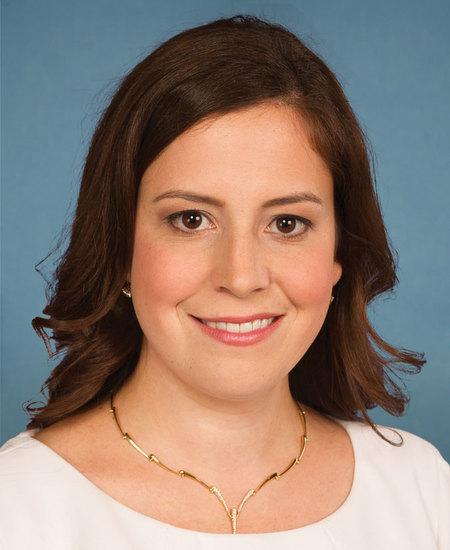
Rep. Elise M. Stefanik
Sponsored bills
Maddy summaryHR 3766, the TRACKS Act, requires federal agencies to track and disclose subawards (funds passed to subrecipients) made to entities in foreign countries designated as "countries of concern" under the 2021 National Defense Authorization Act. It directly affects prime federal award recipients and subrecipients who distribute funds to foreign entities in these designated countries. The bill mandates that covered subawards be disclosed in the same manner as standard subawards, with the Director of the Office of Management and Budget issuing implementation guidance within 90 days of enactment. This creates a new transparency requirement for federal funds flowing to foreign entities deemed high-risk by U.S. security standards.
Maddy summaryHR 3773, the Stop Anti-Semitism on College Campuses Act, requires colleges and universities receiving federal funding to prohibit any event promoting antisemitism on campus. This includes not hosting, facilitating, funding, or supporting such events. The bill adopts the International Holocaust Remembrance Alliance's 2016 definition of antisemitism - including contemporary examples - as the standard for determining prohibited conduct. The law directly affects all institutions covered by the Higher Education Act of 1965.
Maddy summaryH.J.Res. 65 designates November 9th each year as "Gold Star Father's Day" to honor fathers who have lost children serving in the U.S. Armed Forces. The resolution recognizes these fathers' sacrifice, aligns with existing recognition of Gold Star Mothers (since 1936), and supports efforts to honor military families. It does not create new benefits or legal requirements but formally designates a day for national recognition of fathers who lost children in military service. This symbolic resolution follows Georgia's 2017 designation of November 9 as "Georgia Gold Star Father's Day."
Maddy summaryHR 3693, the Migrant Relocation Transparency Act, requires federal agencies (HHS for minors, DHS for adults) to consult with state governors and local leaders at least three business days before moving non-detained migrants. It mandates monthly reports to Congress, state governors, and the public detailing migrant numbers by family status, age, gender, country of origin, housing types, work permits, federal spending, and security screenings. The reports must be published online and include specific data on resettlement methods, educational resources, and whether relocations are temporary or permanent. This bill directly affects state/local officials and federal agencies managing migrant relocation, aiming to increase transparency in federal migration policies.
Stop Our Scourge Act of 2023 or the SOS Act of 2023 This bill directs the Department of Homeland Security to designate illicit fentanyl as a weapon of mass destruction and requires the Office of National Drug Control Policy to conduct an assessment regarding that substance. Specifically, the office must assess foreign manufacturing of illicit fentanyl, the tools and capabilities across federal agencies to address trafficking of that substance, the capabilities of the Mexican military to conduct counterdrug missions with respect to that substance, the capacities and willingness of China to take specified actions with respect to that substance, and illicit fentanyl being trafficked into the United States from Mexico.
Beautifying Federal Civic Architecture Act This bill declares U.S. policy applicable to public buildings and establishes the President's Council on Improving Federal Civic Architecture. The policy includes that applicable federal public buildings should uplift and beautify public spaces, command respect from the general public, be visually identifiable as civic buildings, respect regional architectural heritage, and meet other specified criteria; in the District of Columbia, classical architecture is the preferred and default architecture for federal public buildings absent exceptional factors; buildings that do not meet specified criteria should be considered for redesign where feasible and economical, particularly with respect to the exterior of the applicable federal building; and the General Services Administration (GSA) should seek input from future users of the applicable federal public buildings and the general public in the community where such buildings will be located before selecting an architectural firm or design style and give the general public's input substantial consideration. The GSA must adhere to the policy. If the GSA proposes to approve a design for a new applicable federal public building that diverges from the preferred architecture, it must notify the Office of the Domestic Policy Advisor and Congress not later than 30 days before the date on which the GSA could reject the design without incurring substantial expenditures and describe the reasons for proposing to approve the design.
Maddy summaryHR 3639, the After Hours Child Care Act, creates a new Child Care and Development Innovation Fund to improve access to child care for parents working nontraditional hours (such as evenings, nights, or weekends). The bill directly affects working parents with young children and eligible child care providers who serve these families. It authorizes competitive grants (ranging from $25,000 to $500,000) to providers or partnerships with businesses/community organizations to expand after-hours care programs, establish workplace child care, or improve existing facilities. Grantees must cover 25% of costs, and the Secretary of Health and Human Services must report biennially on program impact to Congress.
Maddy summaryHR 3165, the Military Housing Transparency and Accountability Act, requires the military to create a new database tracking complaints about housing units occupied by service members and their families who do not own their housing. It mandates an annual report to Congress summarizing all complaints, categorized into specific types like mold or lead hazards (physiological), security issues (psychological), safety risks, and maintenance problems (timeliness and quality). This directly affects military members and their dependents living in government-provided housing. The bill aims to improve transparency by making complaint data publicly available and requiring the military to report on actions taken to resolve issues.
Maddy summaryThis bill requires that AM radio receivers be included as standard equipment in all new motor vehicles (such as cars and trucks) sold in the United States, with a rule to be issued by the Department of Transportation within one year. The rule must ensure AM radio is easily accessible on the dashboard and allows manufacturers to use digital AM radio technology instead of traditional AM. During the one-year period between the bill's enactment and the rule's effective date, manufacturers must clearly label vehicles without AM radio. The bill also directs a study to evaluate whether an alternative system could deliver emergency alerts as reliably as AM radio across the country, especially during crises.