

Maddy summaryThis bill requires all U.S. flags displayed on federal property or purchased by federal agencies to be 100% made in the United States, meaning all materials and manufacturing must occur domestically. It directly affects federal agencies (including military departments, legislative/judicial branches, and U.S.-owned corporations) and their procurement of flags for display on government property. Key provisions include a 90-day implementation for new flag purchases and a 2-year phase-in for display requirements, with a separate mandate for the FTC to study and report on country-of-origin labeling enforcement for flags within one year. The bill does not apply to private entities or flags displayed off federal property.
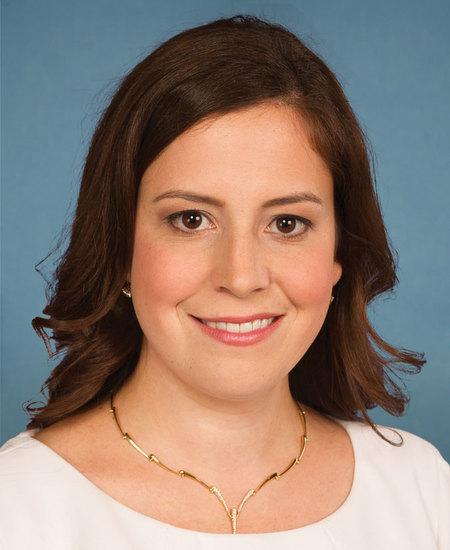
Rep. Elise M. Stefanik
Sponsored bills
Maddy summaryThis bill creates a voluntary program allowing employers with over 100 employees to submit skills-based hiring tests to the Equal Employment Opportunity Commission (EEOC) for review. The EEOC would determine if the tests are job-related and consistent with business necessity under federal anti-discrimination law, providing employers with a legal "safe harbor" against future claims. Employers pay a fee for this review, and submitted information cannot be used against them in enforcement actions or court cases. The program aims to help companies adopt skills-based hiring practices while ensuring compliance with existing civil rights protections.
Maddy summaryHR 4186 creates "employer-directed skills accounts" to fund employer-designed training programs. Employers must cover 10-50% of program costs (based on business size) and commit to hiring participants upon completion, while the federal government covers the remaining costs through these accounts. Workers selected for these programs must complete training and be hired by the employer, with programs required to lead to recognized credentials and align with local workforce needs. Local workforce boards manage the accounts, verify employer agreements, and reimburse employers after documentation of wages or program costs.
Maddy summaryThis bill (HR 4145) requires U.S. colleges and universities to disclose foreign gifts or contracts meeting specific thresholds to the Department of Education. Institutions must report gifts/contracts of $250,000 or more from foreign sources not tied to "covered nations" (as defined in 10 U.S.C. §4872(d)(2)), or *any* amount from covered nations. Within 10 days of receiving such reports, the Education Secretary must forward them to the FBI and National Intelligence Director. The law aims to increase transparency around foreign funding in higher education by mandating these disclosures and automatic intelligence sharing.
Northern Border Regional Commission Reauthorization Act of 2023 This bill makes changes to the authorities and programs of regional economic and infrastructure development commissions. Specifically, the bill reauthorizes the Northern Border Regional Commission (NBRC) and establishes and expands NBRC grant programs. Regional commissions may make grants for the planning, construction, equipment, and operation of health, nutrition, and child care projects. The bill also authorizes these regional commissions (as part of economic and infrastructure development grants) to promote the production of housing to meet economic development and workforce needs. Each commission may accept transfers of funds from other federal agencies. Discretionary grants made by a commission to implement significant regional initiatives, to take advantage of special development opportunities, or to respond to emergency economic distress may be made without regard to specified percentage limitations. The bill limits the aggregate amount of discretionary grants.
Maddy summaryThis proposed constitutional amendment would give Congress the authority to ban physical acts that desecrate the U.S. flag, such as burning or trampling. If ratified by 38 states (three-fourths of all states), it would allow federal laws prohibiting such acts. The amendment does not currently prohibit flag desecration but seeks to change the Constitution to permit it. It would directly affect individuals engaging in physical flag desecration. The bill is pending in the House Judiciary Committee and requires state ratification to become part of the Constitution.
Maddy summaryThis bill prohibits federal funding for US colleges and universities that host Confucius Institutes - Chinese government-run cultural centers. It directly affects institutions participating in these programs by cutting their eligibility for certain federal funds under the National Defense Authorization Act. The key mechanism removes a previous waiver that allowed exceptions for such institutions, making the funding ban absolute. The policy change applies to all covered federal funding streams without exception.
Maddy summaryThis bill amends federal law to criminalize "swatting" - making false reports to trigger emergency responses like police raids. It imposes criminal penalties (up to life in prison if death occurs) for intentionally spreading false information that causes emergency deployments, such as falsely reporting violent crimes. It also allows victims or responding agencies to sue for costs incurred due to these false reports. The law specifically covers false claims about serious crimes, threats to public safety, or emergencies that prompt police or emergency services action.
Maddy summaryHR 3828 designates the U.S. Postal Service facility at 80 Prospect Street in Avon, New York, as the "Officer Anthony Mazurkiewicz Memorial Post Office Building." This bill directly affects the physical location of that post office and all official references to it. The key provision updates all federal documents, maps, and records to use the new memorial name instead of the address. As a naming resolution, it has no policy impact beyond commemoration and does not alter postal services or operations.
Maddy summaryThis bill prohibits the Department of Veterans Affairs from changing its anesthesia care policies to allow nurse anesthetists (CRNAs) to provide anesthesia independently without a physician anesthesiologist. It specifically blocks implementation of a 2016 proposed rule that would have expanded CRNAs' authority in VA facilities. The law maintains current requirements that physician anesthesiologists must oversee or provide anesthesia care for veterans during surgical procedures. Emergency orders for veteran safety during surgery remain permitted under the bill's exception clause.