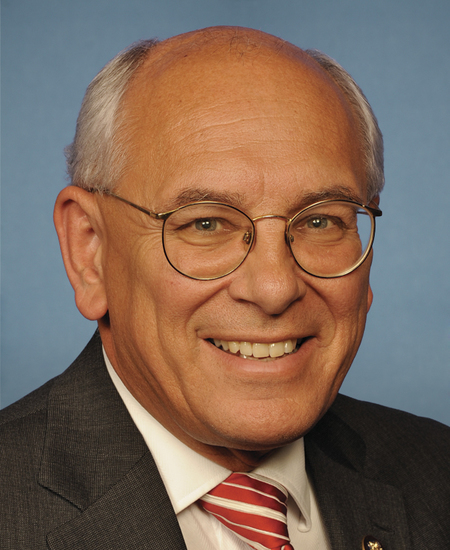
Photo of Paul Tonko
D United States House · District 20 · New York On the 2026 ballot

Rep. Paul Tonko

Compare
Total votes
2,837
all sessions
Attendance
99%
21 missed
Near the chamber average
With party
98%
of cast votes
Higher than 82% of chamber peers
Bipartisan score
1%
crosses aisle rarely
Lower than 82% of chamber peers
Sponsored
2,022
bills & resolutions
Higher than 93% of chamber peers
Committees
5
assignments
2,022 bills and resolutions

Sponsored bills

Total
2,022
Primary
95
Co-sponsor
1,927
This page
2,022
matching current filters
Co-sponsor HR 1813
In committee · United States House · Co-sponsor
FASTER Act

Funding for Aviation Screeners and Threat Elimination Restoration Act or the FASTER Act This bill repeals the requirement that a portion of aviation security service fees collected from passengers be credited as offsetting receipts and deposited in the general fund of the Treasury. It requires such fees to be deposited into a separate account in the Treasury for expenditure to pay only the costs of activities and services for which the fee is imposed (i.e., aviation security screening).

In committee Mar 12, 2021 1 co-sponsor
Co-sponsor HR 1786
In committee · United States House · Co-sponsor
Stop Tax Haven Abuse Act

Stop Tax Haven Abuse Act This bill authorizes the Department of the Treasury to impose restrictions on foreign jurisdictions or financial institutions to counter money laundering and efforts to significantly impede U.S. tax enforcement. Among other provisions, the bill expands reporting requirements for certain foreign investments and accounts held by U.S. persons, establishes a rebuttable presumption against the validity of transactions by institutions that do not comply with reporting requirements under the Foreign Account Tax Compliance Act, treats certain foreign corporations managed and controlled primarily in the United States as domestic corporations for tax purposes, treats swap payments sent offshore as taxable U.S. source income, requires corporations to disclose certain financial information on a country-by-country basis, imposes penalties for failing to disclose offshore holdings, modifies the base erosion anti-abuse tax to lower the gross receipts applicability threshold from $500 million to $100 million, makes investment advisers and persons engaged in forming new business entities subject to new anti-money laundering requirements, requires reporting of U. S. beneficial owners of foreign-owned financial accounts, and imposes additional requirements for third party summonses used to obtain information in tax investigations that do not identify the person with respect to whose liability the summons is issued (i.e., John Doe summons).

In committee Mar 11, 2021 1 co-sponsor
Co-sponsor HR 1785
In committee · United States House · Co-sponsor
No Tax Breaks for Outsourcing Act

No Tax Breaks for Outsourcing Act This bill modifies the tax treatment of the foreign source income of domestic corporations. The bill includes provisions that modify calculations of the gross income of U.S. shareholders to include net CFC tested income in the current taxable year, apply limitations on the foreign tax credit on a country-by-country basis, limit the tax deduction for the interest expense of a U.S. corporation that is a member of a financial reporting group (i.e., a group that prepares consolidated financial statements according to generally accepted accounting principles or international financial reporting standards), modify the rules for the taxation of inverted corporations (i.e., U.S. corporations that acquire foreign companies to reincorporate in a foreign jurisdiction with income tax rates lower than the United States), and treat certain foreign corporations managed and controlled primarily in the United States as domestic corporations for tax purposes.

In committee Mar 11, 2021 1 co-sponsor
Co-sponsor HR 842
Passed · United States House · Co-sponsor
Protecting the Right to Organize Act of 2021

Protecting the Right to Organize Act of 20 21 This bill expands various labor protections related to employees' rights to organize and collectively bargain in the workplace. Among other things, it (1) revises the definitions of employee , supervisor , and employer to broaden the scope of individuals covered by the fair labor standards; (2) permits labor organizations to encourage participation of union members in strikes initiated by employees represented by a different labor organization (i.e., secondary strikes); and (3) prohibits employers from bringing claims against unions that conduct such secondary strikes. The bill also allows collective bargaining agreements to require all employees represented by the bargaining unit to contribute fees to the labor organization for the cost of such representation, notwithstanding a state law to the contrary; and expands unfair labor practices to include prohibitions against replacement of, or discrimination against, workers who participate in strikes. The bill makes it an unfair labor practice to require or coerce employees to attend employer meetings designed to discourage union membership and prohibits employers from entering into agreements with employees under which employees waive the right to pursue or a join collective or class-action litigation. The bill further prohibits employers from taking adverse actions against an employee, including employees with management responsibilities, in response to that employee participating in protected activities related to the enforcement of the prohibitions against unfair labor practices (i.e., whistleblower protections). Such protected activities include providing information about a potential violation to an enforcement agency, participating in an enforcement proceeding, initiating a proceeding concerning an alleged violation or assisting in such a proceeding, or refusing to participate in an activity the employee reasonably believes is a violation of labor laws. Finally, the bill addresses the procedures for union representation elections, provides employees with the ability to vote in such elections remotely by telephone or the internet, modifies the protections against unfair labor practices that result in serious economic harm, and establishes penalties and permits injunctive relief against entities that fail to comply with National Labor Relations Board orders.

Passed Mar 11, 2021 1 co-sponsor
Co-sponsor HR 1
Passed · United States House · Co-sponsor
For the People Act of 2021

For the People Act of 2021 This bill addresses voter access, election integrity and security, campaign finance, and ethics for the three branches of government. Specifically, the bill expands voter registration (e.g., automatic and same-day registration) and voting access (e.g., vote-by-mail and early voting). It also limits removing voters from voter rolls. The bill requires states to establish independent redistricting commissions to carry out congressional redistricting. Additionally, the bill sets forth provisions related to election security, including sharing intelligence information with state election officials, supporting states in securing their election systems, developing a national strategy to protect U.S. democratic institutions, establishing in the legislative branch the National Commission to Protect United States Democratic Institutions, and other provisions to improve the cybersecurity of election systems. Further, the bill addresses campaign finance, including by expanding the prohibition on campaign spending by foreign nationals, requiring additional disclosure of campaign-related fundraising and spending, requiring additional disclaimers regarding certain political advertising, and establishing an alternative campaign funding system for certain federal offices. The bill addresses ethics in all three branches of government, including by requiring a code of conduct for Supreme Court Justices, prohibiting Members of the House from serving on the board of a for-profit entity, and establishing additional conflict-of-interest and ethics provisions for federal employees and the White House. The bill requires the President, the Vice President, and certain candidates for those offices to disclose 10 years of tax returns.


Passed Mar 11, 2021 1 co-sponsor
Primary HR 1716
In committee · United States House · Lead sponsor
COVID–19 Mental Health Research Act

COVID-19 Mental Health Research Act This bill requires the National Institute of Mental Health to support mental health research activities related to COVID-19 (i.e., coronavirus disease 2019). The institute must coordinate these activities with other components of the National Institutes of Health.

In committee Mar 10, 2021 0 co-sponsors
Co-sponsor HR 1676
In committee · United States House · Co-sponsor
Jack Reynolds Memory Medigap Expansion Act

Jack Reynolds Memory MediGap Expansion This bill expands guaranteed issue rights with respect to Medigap policies (Medicare supplemental health insurance policies) to all beneficiaries with end-stage renal disease. (Guaranteed issue rights require that a policy be offered to any eligible applicant without regard to health status.)

In committee Mar 10, 2021 1 co-sponsor
Co-sponsor HR 1672
In committee · United States House · Co-sponsor
Connect America Act of 2021

Connect America Act of 2021 This bill requires the Federal Communications Commission to establish a funding program to expand broadband access for unserved areas, areas with low-tier or mid-tier service, and unserved anchor institutions (e.g., schools or libraries). The program shall consist of both national systems of competitive bidding and grants of specified amounts to states. An area with low-tier service is an area where at least 90% of the population has access to broadband service with speeds between 25-100 megabits per second (mbps). An area with mid-tier service is an area where at least 90% of the population has access to broadband service with speeds between 100 mbps and 1 gigabit per second. Priority must be given to projects that would expand access to broadband service in areas where at least 90% of the population has no access to broadband service or to service with speeds of at least 25 mbps.

In committee Mar 10, 2021 1 co-sponsor
Co-sponsor HR 1673
In committee Mar 10, 2021 1 co-sponsor
Showing 1,921 to 1,930 of 2,022 bills