

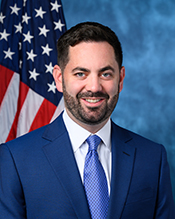
Photo of Michael Lawler
R United States House · District 17 · New York On the 2026 ballot

Rep. Michael Lawler

Compare
Total votes
1,879
all sessions
Attendance
99%
27 missed
Near the chamber average
With party
85%
of cast votes
Lower than 91% of chamber peers
Bipartisan score
8%
crosses aisle rarely
Higher than 89% of chamber peers
Sponsored
2,547
bills & resolutions
Higher than 99% of chamber peers
Committees
6
assignments
2,547 bills and resolutions

Sponsored bills

Total
2,547
Primary
194
Co-sponsor
2,353
This page
2,547
matching current filters
Co-sponsor HR 8568
In committee · United States House · Co-sponsor
First Rhode Island Regiment Congressional Gold Medal Act

Maddy summaryThis bill authorizes Congress to award a gold medal to the First Rhode Island Regiment, a historically significant Revolutionary War unit composed of Black, Indigenous, and white soldiers who served together. The medal, designed by the Treasury Secretary, will be displayed at the Rhode Island State Library, with bronze duplicates available for sale to cover costs. The bill recognizes the regiment's role as one of America's first integrated military units, formed in 1778 when Rhode Island allowed enslaved people to enlist and gain immediate freedom. The medal serves as a commemorative honor, not a policy change, with no direct effect on current individuals or legislation.

In committee May 24, 2024 1 co-sponsor
Co-sponsor HR 8466
In committee · United States House · Co-sponsor
Affordable Connectivity Program Improvement and Extension Act of 2024

Maddy summaryHR 8466 extends the Affordable Connectivity Program (ACP) through 2024 with $6 billion in funding, directly affecting low-income households receiving subsidized broadband internet. It strengthens eligibility verification by requiring use of the National Verifier, limiting eligibility to households with school meal program participation (not just provider programs), and mandating collection of partial Social Security numbers for verification. The bill adds new antifraud controls and performance measures for the FCC, requiring a report on program effectiveness within a year. It also allows households switching providers to maintain benefits only if they've used the current service for at least 180 days.

In committee May 24, 2024 1 co-sponsor
Co-sponsor HR 3916
In committee · United States House · Co-sponsor
SCREENS for Cancer Act of 2024

Maddy summaryThe SCREENS for Cancer Act of 2024 reauthorizes and expands the National Breast and Cervical Cancer Early Detection Program (NBCCEDP), which provides free screenings and care coordination to low-income, uninsured, or underinsured women. It increases annual funding from $275 million (2024) to $500 million (2028) and explicitly adds "prevention" to the program’s mission, requiring it to reduce racial and ethnic disparities in cancer outcomes. The bill mandates the program to address barriers like social determinants of health and implement evidence-based strategies to boost screenings, particularly for underserved communities disproportionately affected by pandemic-related screening declines. This directly benefits millions of women, especially Black, Hispanic, and Asian women, who face higher cancer death rates and reduced access to care.

In committee May 24, 2024 1 co-sponsor
Co-sponsor HR 619
In committee · United States House · Co-sponsor
NAPA Reauthorization Act

Maddy summaryThis bill reauthorizes the National Alzheimer's Project Act through 2035 (extending the previous deadline of 2025) and adds new requirements to promote healthy aging and reduce Alzheimer’s risk factors. It mandates the program to provide information on healthy behaviors that may lower cognitive decline risk and expands the advisory group to include representatives from agencies like the Department of Justice, FEMA, and Social Security Administration, plus experts with diverse clinical trial experience. The bill directly affects Alzheimer’s research, care programs, and the federal advisory group overseeing national efforts. Key changes include requiring annual evaluations instead of initial ones and adding a focus on reducing health disparities in Alzheimer’s initiatives.

In committee May 24, 2024 1 co-sponsor
Co-sponsor HRES 1256
In committee · United States House · Co-sponsor
Condemning the United Nations moment of silence for Ebrahim Raisolsadati as a blatant disregard of the United Nations Charter.

Maddy summaryHRES 1256 is a symbolic congressional resolution condemning the United Nations Security Council's decision to observe a moment of silence for Iran's late president, Ebrahim Raisi, following his death. The resolution claims this action contradicts the UN Charter's principles of promoting human rights, citing Raisi's alleged role in Iran's 1988 mass executions and subsequent human rights abuses. It specifically denounces U.S. UN Deputy Ambassador Robert Wood for participating in the moment of silence. As a non-binding resolution, it does not create new law or directly affect any individuals or policies.

In committee May 23, 2024 1 co-sponsor
Co-sponsor HRES 1255
In committee · United States House · Co-sponsor
Calling upon all Americans on this Memorial Day, 2024, to honor the men and women of the Armed Forces who have died in the pursuit of freedom and peace.

Maddy summaryHRES 1255 is a non-binding House resolution introduced on May 23, 2024, that calls on all Americans to observe Memorial Day 2024 as a day of remembrance for military personnel who died in service. The resolution specifically honors "the men and women of the Armed Forces who have died in the pursuit of freedom and peace" and urges the public to demonstrate appreciation for their sacrifices. It does not create new laws or policies but serves as a symbolic expression of national gratitude, emphasizing respect for those who died while defending democratic values. The resolution was co-sponsored by multiple House members and aligns with the traditional observance of Memorial Day.

In committee May 23, 2024 1 co-sponsor
Co-sponsor HR 8533
In committee · United States House · Co-sponsor
Safe Air on Airplanes Act

Maddy summaryHR 8533, the Safe Air on Airplanes Act, requires the Federal Aviation Administration to update aircraft safety regulations to address bleed air systems. It prohibits new jet and turboprop aircraft designs from using these systems, mandates filters to remove oil fumes in new aircraft within 7 years, and sets a 30-year phase-out schedule for existing aircraft designs (25% by year 10, 50% by year 20, 100% by year 30). The bill directly affects aircraft manufacturers and airlines by changing requirements for new aircraft production and fleet modifications. It focuses on technical air quality standards for cabin air, not health outcomes or costs.

In committee May 23, 2024 1 co-sponsor
Co-sponsor HR 8551
In committee · United States House · Co-sponsor
Confronting CCP Malign Influence Act

Maddy summaryThis bill requires the Director of National Intelligence to produce an unclassified public report within 90 days of enactment detailing the wealth and alleged corrupt activities of top Chinese Communist Party (CCP) leaders, including the General Secretary and Politburo members. It also mandates that the Director (or a designee) testify in open hearings before the House and Senate Intelligence Committees within 180 days about the report's findings. The legislation directly affects U.S. intelligence and foreign policy agencies responsible for compiling and presenting this information. The focus is solely on creating a transparency mechanism for public disclosure, with no additional policy changes or funding specified.

In committee May 23, 2024 1 co-sponsor
Co-sponsor HR 3498
In committee · United States House · Co-sponsor
HELP Act of 2023

Maddy summaryThe HELP Act of 2023 provides $550 million annually for 2024-2025 and $450 million for 2026-2030 to strengthen 211 (human services information and referral) and 988 (mental health crisis) services nationwide. It requires states to develop coordinated systems that ensure 24/7 accessibility, reduce non-emergency 911 calls, and connect individuals to appropriate human services and mental health resources. The bill mandates states to create comprehensive service databases, ensure accessibility for people with disabilities, and establish oversight councils with diverse representation to monitor racial equity and service effectiveness. States must also implement diversion programs to connect individuals with mental health responders instead of law enforcement for non-emergency situations. The legislation includes regular reporting requirements and biennial evaluations to measure how effectively the program connects people to needed services and reduces unnecessary law enforcement interactions.

In committee May 23, 2024 1 co-sponsor
Co-sponsor HR 895
In committee · United States House · Co-sponsor
Combating Organized Retail Crime Act of 2023

Maddy summaryHR 895, the Combating Organized Retail Crime Act of 2023, expands federal law to better prosecute organized retail theft by amending sections 2314 and 2315 of Title 18. It clarifies that crimes involving stolen goods valued at $5,000 or more over 12 months - including retail theft - can be prosecuted under existing federal statutes, and broadens definitions to include goods taken via "any facility of interstate or foreign commerce." The bill also creates a new Organized Retail Crime Coordination Center within Homeland Security, requiring it to coordinate federal, state, and local law enforcement efforts, share threat information with retailers, and produce annual public reports on trends. This directly affects law enforcement agencies, retailers, and criminal justice systems by standardizing prosecution thresholds and enhancing interagency collaboration.

In committee May 23, 2024 1 co-sponsor
Showing 1,551 to 1,560 of 2,547 bills