

American Teacher Act This bill directs the Department of Education to award four-year grants to states and, through them, subgrants to local educational agencies to establish a minimum annual salary of $60,000 (adjusted for inflation) for public elementary and secondary school teachers.
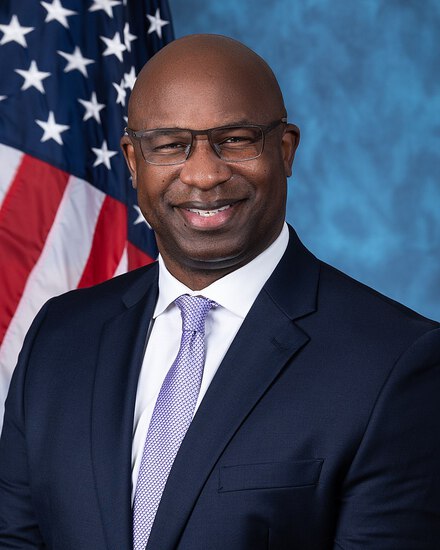
Rep. Jamaal Bowman
Sponsored bills
Student Loan Relief for Medicare and Social Security Recipients Act of 2022 This bill requires the Department of Education to forgive the outstanding balance of principal, interest, and fees due on eligible federal student loans for borrowers who are recipients of Medicare or Social Security Disability Insurance.
Access to School Supplies Act of 2022 This bill directs the Department of Education to carry out a pilot program to make competitive grants for up to 10 qualified local educational agencies to purchase school supplies. School supplies refer to books, supplies, and supplementary materials used by students and instructional staff in the classroom.
Developing Alternative Mitigation Systems for Beavers Act or the DAMS for Beavers Act This bill directs the U.S. Fish and Wildlife Service (FWS) to establish a competitive grant program to assist projects that use nonlethal measures to reduce property damage caused by beavers and maintain or enhance habitat for beavers and other wildlife. In awarding grants, the FWS may prioritize projects that (1) include monitoring and research that facilitates evaluation of such projects and identification of best practices, (2) includes educational and outreach activities, (3) are located in an area that ensures grant recipients represent diverse geographic areas, and (4) satisfy any other criteria to effectively reduce damage to property and maintain or enhance habitat for beavers and other wildlife.
Respect for Marriage Act This act provides statutory authority for same-sex and interracial marriages. Specifically, the act replaces provisions that define, for purposes of federal law, marriage as between a man and a woman and spouse as a person of the opposite sex with provisions that recognize any marriage between two individuals that is valid under state law. (The Supreme Court held that the current provisions were unconstitutional in United States v. Windsor in 2013.) The act also replaces provisions that do not require states to recognize same-sex marriages from other states with provisions that prohibit the denial of full faith and credit or any right or claim relating to out-of-state marriages on the basis of sex, race, ethnicity, or national origin. (The Supreme Court held that state laws barring same-sex marriages were unconstitutional in Obergefell v. Hodges in 2015; the Court held that state laws barring interracial marriages were unconstitutional in Loving v. Virginia in 1967.) The act allows the Department of Justice to bring a civil action and establishes a private right of action for violations. The act does not (1) affect religious liberties or conscience protections that are available under the Constitution or federal law, (2) require religious organizations to provide goods or services to formally recognize or celebrate a marriage, (3) affect any benefits or rights that do not arise from a marriage, or (4) recognize under federal law any marriage between more than two individuals.
Developing Innovative Partnerships and Learning Opportunities that Motivate Achievement Act or the DIPLOMA Act This bill authorizes the Department of Education to award grants to states and, through them, subgrants to consortia of local educational agencies and community partners to address school readiness and achievement. Subgrants may be used for activities including early learning, academic support services, parent-education programs, and teacher training.
Veteran Service Recognition Act of 2022 This bill addresses immigration-related issues pertaining to noncitizen (or non-U.S. national) military veterans, including by authorizing the Department of Homeland Security (DHS) to provide lawful permanent resident status to a veteran subject to removal. If a noncitizen veteran appears to be eligible for lawful permanent resident status under this bill, that veteran must receive a reasonable opportunity to apply for such status and may not be removed until there is a final administrative decision on the veteran's eligibility. For the purposes of providing such status under this bill, DHS may waive any applicable grounds of inadmissibility, except for certain crime- or security-related grounds. The bill also extends certain deadlines relating to obtaining citizenship after serving in the Armed Forces. DHS must create a system for identifying noncitizens who are or may be veterans. Before initiating removal proceedings against a noncitizen, DHS must attempt to determine whether the noncitizen is a veteran. DHS must ensure that veteran status is considered in immigration proceedings. The bill also requires U.S. Citizenship and Immigration Services (USCIS) and the Department of Defense to take certain actions to facilitate opportunities for military recruits and veterans to obtain U.S. citizenship, such as by training Judge Advocate General Corps members to act as liaisons between the Armed Forces and USCIS on servicemember citizenship applications. The bill also establishes the Military Family Immigration Advisory Committee to provide recommendations on cases involving the removal of a servicemember, veteran, or certain family members of a servicemember or veteran. Such an individual may not be removed until the committee has provided a recommendation to DHS about the individual's case, unless the individual is inadmissible due to a conviction for an aggravated felony. The bill also waives certain grounds of inadmissibility (e.g., being unlawfully present in the United States) for certain noncitizens applying for lawful permanent resident status as an immediate relative of a U.S. citizen who has served at least two years in the Armed Forces.
Maddy summaryHR 7075 designates a specific triangular area in Washington, D.C. (bounded by 22nd Street NW, P Street NW, and Florida Avenue NW) as "Ukrainian Independence Park," including National Park Service reservations 57D and 360 (which contains the Taras Shevchenko Memorial). The bill updates all federal references to this area to use the new name and authorizes signage highlighting Ukraine's independence and U.S.-Ukraine solidarity. This is a procedural designation bill with no substantive policy changes, solely renaming a park area.
Climate Adaptation Science Centers Act or the CASC Act This bill provides statutory authority for the Department of the Interior's National and Regional Climate Adaptation Science Centers. The centers must provide scientific expertise to managers of natural resources, cultural resources, and ecosystem services to inform decisions that aid adaptation to a changing climate and extreme weather events. The program shall include a National Climate Adaptation Science Center and Regional Climate Adaptation Science Centers. Among its activities, the National Center shall serve as the national office for the regional centers, develop and facilitate coordination among the regional centers, and conduct research on cross-regional and national science priorities. Regional centers shall develop research, education, training, and advisory service priorities regarding the impacts of climate trends and variability on natural and cultural resource management. Interior shall establish an Advisory Committee on Climate and Natural Resource Sciences to advise the National and Regional Climate Adaptation Science Centers on specified matters, including (1) the contents of a national strategy identifying key climate adaptation science priorities to advance the management of natural and cultural resources in the face of climate change; and (2) the integration of equity, particularly for historically underserved communities, in the operation of the National Center and regional centers.
Truth and Healing Commission on Indian Boarding School Policies Act This bill establishes the Truth and Healing Commission on Indian Boarding School Policies in the United States and sets forth its powers, duties, and membership. Among other duties, the commission must investigate the impacts and ongoing effects of the Indian Boarding School Policies (federal policies under which American Indian, Alaska Native, and Native Hawaiian children were forcibly removed from their family homes and placed in boarding schools). Further, the commission must develop recommendations on ways to (1) protect unmarked graves and accompanying land protections; (2) support repatriation and identify the tribal nations from which children were taken; and (3) discontinue the removal of American Indian, Alaska Native, and Native Hawaiian children from their families and tribal communities by state social service departments, foster care agencies, and adoption agencies.