

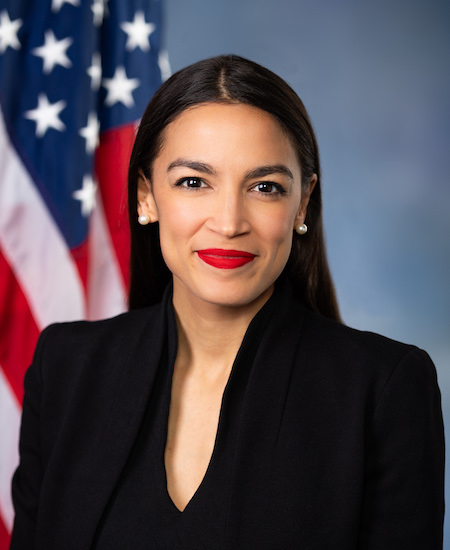
Photo of Alexandria Ocasio-Cortez
D United States House · District 14 · New York On the 2026 ballot

Rep. Alexandria Ocasio-Cortez

Compare
Total votes
2,837
all sessions
Attendance
98%
65 missed
Near the chamber average
With party
94%
of cast votes
Near the chamber average
Bipartisan score
3%
crosses aisle rarely
Near the chamber average
Sponsored
1,176
bills & resolutions
Near the chamber average
Committees
4
assignments
1,176 bills and resolutions

Sponsored bills

Total
1,176
Primary
42
Co-sponsor
1,134
This page
1,176
matching current filters
Co-sponsor HR 8533
In committee · United States House · Co-sponsor
Safe Air on Airplanes Act

Maddy summaryHR 8533, the Safe Air on Airplanes Act, requires the Federal Aviation Administration to update aircraft safety regulations to address bleed air systems. It prohibits new jet and turboprop aircraft designs from using these systems, mandates filters to remove oil fumes in new aircraft within 7 years, and sets a 30-year phase-out schedule for existing aircraft designs (25% by year 10, 50% by year 20, 100% by year 30). The bill directly affects aircraft manufacturers and airlines by changing requirements for new aircraft production and fleet modifications. It focuses on technical air quality standards for cabin air, not health outcomes or costs.

In committee May 23, 2024 1 co-sponsor
Co-sponsor HR 5754
Passed · United States House · Co-sponsor
To designate the United States courthouse located at 350 W. 1st Street, Los Angeles, California, as the "Felicitas and Gonzalo Mendez United States Courthouse".

Maddy summaryHR 5754 renames the U.S. courthouse at 350 W. 1st Street, Los Angeles, California, as the "Felicitas and Gonzalo Mendez United States Courthouse." The bill updates all federal references - such as legal documents, maps, and records - to use the new name. This is a ceremonial designation with no policy changes or direct impact on citizens or laws. The bill solely affects the courthouse's official name and related federal paperwork.

Passed May 22, 2024 1 co-sponsor
Co-sponsor HR 8485
In committee · United States House · Co-sponsor
No Foreign Emoluments Without Congressional Consent Act

Maddy summaryHR 8485, the "No Foreign Emoluments Without Congressional Consent Act," prohibits senior federal officials - including the President, Vice President, Cabinet members, Members of Congress, and high-level presidential staff - from accepting foreign payments (such as from foreign governments or entities controlled by them) without prior congressional approval. It requires officials to submit detailed written notices to the Office of Government Ethics before accepting such payments, triggering a 90-day congressional review period during which Congress must approve via a specific concurrent resolution. The bill covers payments received during official service and for two years after leaving office, with strict penalties including civil fines up to $5,000 plus the payment's value or criminal charges for violations. Excluded are standard gifts or decorations under existing law and certain large investment entities meeting specific SEC criteria.

In committee May 21, 2024 1 co-sponsor
Co-sponsor HR 8323
In committee · United States House · Co-sponsor
Comprehensive Addiction Resources Emergency Act of 2024

Maddy summary# Summary of Legislative Text This is a comprehensive legislative proposal focused on addressing substance use disorder through public health approaches, with significant funding and program requirements. Key elements include: 1. **Major Funding Programs:** - **Subtitle A (Local Grants):** $3.0 billion annually (2024-2033) for local entities to provide prevention, treatment, and recovery services - **Subtitle B (State/Regional Grants):** $4.6 billion annually (2024-2033) for state-level programs - **Subtitle C (Other Grants):** $1.0 billion annually (2024-2033) for specific entities and underserved populations - **Subtitle D (Innovation/Training):** $1.5 billion annually (2024-2033) for training, research, and capacity building 2. **Key Program Requirements:** - Mandates for evidence-based treatment services across multiple levels of care - Requirements for cultural competency, particularly for Native American communities - Specific focus on harm reduction, prevention, and recovery support - Provisions for naloxone distribution and overdose reversal programs 3. **Regulatory Changes:** - New certification requirements for covered manufacturers, distributors, and dispensers of Schedule II controlled substances - Penalties for failure to submit certifications or submitting false certifications - Creation of a "Comprehensive Addiction Resources Fund" for penalty revenues 4. **Focus Areas:** - Prevention services (including trauma-informed approaches) - Early intervention services - Recovery support services - Harm reduction programs - Workforce development for treatment providers - Special attention to underserved populations (rural communities, racial minorities, formerly incarcerated individuals) 5. **Funding Priorities:** - 10% of funds for Native American communities - Specific requirements for cultural competency and language access - Mandated data collection and reporting systems This legislation represents a significant shift toward public health approaches to substance use disorder, emphasizing prevention, treatment, and recovery support rather than punitive measures, with substantial funding commitments over a decade.

In committee May 17, 2024 1 co-sponsor
Co-sponsor HR 8426
In committee · United States House · Co-sponsor
Public Service Freedom to Negotiate Act of 2024

Maddy summaryThe Public Service Freedom to Negotiate Act of 2024 establishes federal minimum standards for collective bargaining rights for public employees and supervisory employees. The Federal Labor Relations Authority will determine if each state's laws "substantially provide" for these rights, and if not, federal standards will apply to that state. These standards include the right to self-organization, collective bargaining, recognition of labor organizations, and procedures for resolving disputes. The bill preserves existing collective bargaining agreements and excludes certain employee categories like emergency services workers from some provisions.

In committee May 16, 2024 1 co-sponsor
Co-sponsor HR 1797
Passed · United States House · Co-sponsor
Setting Consumer Standards for Lithium-Ion Batteries Act

Maddy summaryThis bill requires the Consumer Product Safety Commission (CPSC) to create new safety standards for lithium-ion batteries used in electric bicycles and scooters within 180 days of the bill's enactment. The standards aim to prevent battery-related fires by setting specific safety requirements for these batteries and devices. The CPSC must define which battery types and devices fall under the rule as part of the standard. Once established, the standard will function as an official safety rule under existing consumer product safety law.

Passed May 16, 2024 1 co-sponsor
Co-sponsor HR 8370
In committee · United States House · Co-sponsor
Rights for the TSA Workforce Act of 2024

Maddy summaryThe Rights for the TSA Workforce Act of 2024 would transition Transportation Security Administration (TSA) employees, particularly screening agents, from TSA-specific personnel rules to the standard federal government personnel system under Title 5 of the U.S. Code by December 31, 2024. The bill prohibits changes to current personnel policies for covered employees until the transition date and ensures no reduction in pay or benefits during the conversion process. It preserves certain benefits like law enforcement availability pay for Federal air marshals and maintains collective bargaining rights for screening agents. The bill also requires various reports to Congress on recruitment, implementation, diversity, and workplace safety to be submitted within specified timeframes.

In committee May 14, 2024 1 co-sponsor
Co-sponsor HR 8253
In committee · United States House · Co-sponsor
BUILD GREEN Infrastructure and Jobs Act

Maddy summaryThe BUILD GREEN Infrastructure and Jobs Act establishes a $50 billion annual grant program (2025-2034) to fund electrified transportation infrastructure projects that reduce greenhouse gas emissions and improve transportation access. It prioritizes projects in frontline, vulnerable, or disadvantaged communities (requiring 40% of funds), with 30-40% allocated to rural areas and 60-70% to urban areas. The bill mandates recipients use 5% of grant funds for workforce training, pay a minimum wage of $17 per hour (increasing annually), and use renewable energy sources for project operations. Eligible projects include electric buses, rail systems, port infrastructure with EV charging, and micromobility initiatives that reduce emissions and improve transportation services.

In committee May 8, 2024 1 co-sponsor
Co-sponsor HR 7924
In committee · United States House · Co-sponsor
ACCESS in Mental Health Act

Maddy summaryThis bill creates grants to support mental and behavioral health graduate programs at minority-serving institutions like historically Black colleges, tribal colleges, and other institutions serving communities of color. It requires at least 5% of grant funds to provide scholarships for students from health professional shortage areas. The grants can help institutions establish or improve programs that train professionals to provide culturally responsive and trauma-informed care. The goal is to increase the number of mental health professionals serving in underserved communities and diversify the mental health workforce.

In committee May 6, 2024 1 co-sponsor
Co-sponsor HR 8231
In committee · United States House · Co-sponsor
James Earl Jones Congressional Gold Medal Act

Maddy summaryHR 8231, the James Earl Jones Congressional Gold Medal Act, authorizes a Congressional Gold Medal to be awarded to actor James Earl Jones in recognition of his distinguished career in theater and film, and his role in advancing inclusion and equal opportunities for people of all backgrounds in the entertainment industry. The Treasury will strike the medal with an image and inscription of Jones, and may produce and sell bronze duplicates to cover costs, with proceeds deposited into the U.S. Mint's public enterprise fund. This bill serves as a ceremonial honor with no new legal requirements or policy changes.

In committee May 2, 2024 1 co-sponsor
Showing 501 to 510 of 1,176 bills
Previous 1 … 50 51 52 … 118 Next