

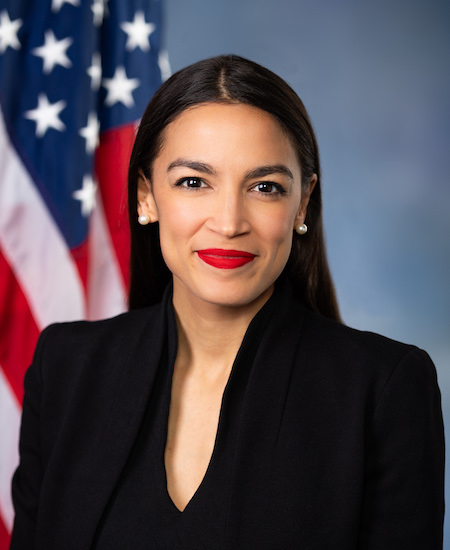
Photo of Alexandria Ocasio-Cortez
D United States House · District 14 · New York On the 2026 ballot

Rep. Alexandria Ocasio-Cortez

Compare
Total votes
2,837
all sessions
Attendance
98%
65 missed
Near the chamber average
With party
94%
of cast votes
Near the chamber average
Bipartisan score
3%
crosses aisle rarely
Near the chamber average
Sponsored
1,172
bills & resolutions
Near the chamber average
Committees
4
assignments
1,172 bills and resolutions

Sponsored bills

Total
1,172
Primary
40
Co-sponsor
1,132
This page
1,172
matching current filters
Co-sponsor HR 1368
In committee · United States House · Co-sponsor
Mental Health Justice Act of 2021

Mental Health Justice Act of 2021 This bill creates a grant program for states and local governments to train and dispatch mental health professionals to respond, instead of law enforcement officers, to emergencies that involve people with behavioral health needs. The Substance Abuse and Mental Health Services Administration (SAMHSA) must manage the program in consultation with the Department of Justice (DOJ). SAMHSA may cancel grants that increase incarceration or institutionalization. Grantees must use funds for purposes including de-escalation and anti-racism training. The Department of Health and Human Services and the DOJ must evaluate this program.

In committee Apr 28, 2021 1 co-sponsor
Co-sponsor HR 1378
In committee · United States House · Co-sponsor
Do No Harm Act

Do No Harm Act This bill prohibits the application of the Religious Freedom Restoration Act of 1993 (RFRA) to specified federal laws or the implementation of such laws. Currently, RFRA prohibits the government from substantially burdening a person's exercise of religion even if the burden results from a rule of general applicability, except in furtherance of a compelling governmental interest when using the least restrictive means. Under the bill, RFRA is inapplicable to laws or the implementation of laws that protect against discrimination or the promotion of equal opportunity (e.g., the Civil Rights Act of 1964); require employers to provide wages, other compensation, or benefits, including leave; protect collective activity in the workplace; protect against child labor, abuse, or exploitation; or provide for access to, information about, referrals for, provision of, or coverage for, any health care item or service. The bill prevents RFRA from being used to deny (1) goods or services the government has contracted, granted, or made an agreement to provide to a beneficiary of or participant in a program or activity funded by such government contract, grant, agreement, or other award; or (2) a person's full and equal enjoyment of a government-provided good, service, benefit, facility, privilege, advantage, or accommodation. In order for a person to assert a RFRA claim or defense in a judicial proceeding, the government must be a party to the proceeding.

In committee Apr 28, 2021 1 co-sponsor
Co-sponsor HR 1308
In committee · United States House · Co-sponsor
New Deal for New Americans Act of 2021

New Deal for New Americans Act of 2021 This bill provides assistance to immigrants and addresses issues related to naturalization. The bill establishes the National Office of New Americans to (1) welcome and support immigrants, (2) promote and support immigrant integration, and (3) promote the pursuit of U.S. citizenship among immigrants. The bill also establishes grant programs for eligible entities that provide (1) legal services for immigrants, (2) English language education that focuses on integrating students into society, and (3) workforce development training that supports the economic integration of immigrants. The bill also reauthorizes the Citizenship and Integration Grant Program within U.S. Citizenship and Immigration Services (USCIS). USCIS shall establish a nonprofit entity to spur innovation in the expansion of citizenship preparation programs and to support assistance for immigrants seeking permanent resident status or citizenship. The bill also requires the Department of Homeland Security to (1) report to Congress before increasing fees for immigration adjudication and naturalization services above the levels of such fees on January 1, 2019, and (2) waive or reduce certain immigration-related fees for low-income aliens. The bill also (1) waives the English proficiency requirement for the naturalization of certain permanent residents, (2) repeals the public charge ground for deportation, (3) requires states to provide for automatic voter registration to qualifying new citizens unless that individual declines, and (4) sets a floor of 125,000 to the maximum number of refugees who may be admitted into the United States each year.

In committee Apr 28, 2021 1 co-sponsor
Co-sponsor HR 2850
In committee · United States House · Co-sponsor
Nuclear Weapons Abolition and Economic and Energy Conversion Act of 2021

Nuclear Weapons Abolition and Economic and Energy Conversion Act of 2021 This bill directs the U.S. government to sign and ratify the United Nations Treaty on the Prohibition of Nuclear Weapons or a similar international agreement that calls for the elimination of all nuclear weapons in every country. The government shall (1) redirect resources currently used in nuclear weapons programs toward building an ecologically beneficial peace economy and addressing human and infrastructure needs, and (2) actively promote policies to induce all other countries to take similar actions.

In committee Apr 26, 2021 1 co-sponsor
Co-sponsor HR 994
In committee · United States House · Co-sponsor
Justice is Not For Sale Act of 2021

Justice is Not For Sale Act of 2021 This bill prohibits private for-profit entities from operating confinement facilities (e.g., prisons) or providing electronic monitoring of released persons at the federal, state, and local levels. The bill also establishes various requirements related to the standards of detention and availability of services at confinement facilities. The bill provides for the establishment of limits on the fees and charges for financial services (e.g., money transfer services), caps on the rates charged for communications services, detention standards and oversight requirements related to the detention of noncitizens, and community-based alternatives to the detention or separation of family units apprehended under immigration authorities.

In committee Apr 23, 2021 1 co-sponsor
Co-sponsor HR 959
In committee · United States House · Co-sponsor
Black Maternal Health Momnibus Act of 2021

Black Maternal Health Momnibus Act of 2021 This bill directs multi-agency efforts to improve maternal health, particularly among racial and ethnic minority groups, veterans, and other vulnerable populations. It also addresses maternal health issues related to COVID-19 (i.e., coronavirus disease 2019). The Department of Health and Human Services (HHS) and other specified departments must address the social determinants of maternal health, which include child care, housing, food security, transportation, and environmental conditions. The bill also extends to 24 months postpartum eligibility for the Special Supplemental Nutrition Program for Woman, Infants, and Children. Additionally, HHS and other agencies must take actions to grow and diversify the maternal health workforce. To increase access to maternity care, HHS and other agencies must (1) award specified grants; (2) test an alternative payment model for perinatal care under Medicaid and the Children's Health Insurance Program (CHIP); and (3) support training, technology, and telehealth initiatives. The bill also increases research and data collection on maternal morbidity and mortality, particularly among tribal populations and minority groups. The Bureau of Prisons and the Department of Justice must establish programs to improve maternity care for incarcerated populations. The Medicaid and CHIP Payment and Access Commission must also report on the impact of Medicaid ineligibility for pregnant and postpartum prisoners. Additionally, as a condition for certain grants, states and territories must have laws limiting the use of restraints on pregnant individuals in prisons. The bill also directs activities to mitigate adverse maternal health outcomes associated with climate change and to improve maternal vaccination rates.

In committee Apr 23, 2021 1 co-sponsor
Co-sponsor HR 948
In committee · United States House · Co-sponsor
Justice for Incarcerated Moms Act of 2021

Justice for Incarcerated Moms Act of 2021 This bill establishes new requirements related to grants, programs, and reports to improve the treatment and care of pregnant and postpartum women who are incarcerated. Specifically, the bill requires the following: states must restrict the use of restraints on pregnant women in prison in order to receive full funding under the Edward Byrne Memorial Justice Assistance Grant program; the Bureau of Prisons must establish programs to optimize maternal health outcomes for pregnant and postpartum women in federal prisons; the Bureau of Justice Assistance must award state grants for programs to support pregnant and postpartum women in state and local prisons and jails; the Government Accountability Office must report on adverse maternal and infant health outcomes among incarcerated individuals and infants born to such individuals, with a particular focus on racial and ethnic disparities; and the Medicaid and CHIP Payment and Access Commission must report on the impact of Medicaid ineligibility for pregnant and postpartum women in prison.

In committee Apr 23, 2021 1 co-sponsor
Co-sponsor HR 1333
Passed · United States House · Co-sponsor
NO BAN Act

National Origin-Based Antidiscrimination for Nonimmigrants Act or the NO BAN Act This bill imposes limitations on the President's authority to suspend or restrict aliens from entering the United States. It also prohibits religious discrimination in various immigration-related decisions, such as whether to issue an immigrant or nonimmigrant visa, unless there is a statutory basis for such discrimination. The President may temporarily restrict the entry of any aliens or class of aliens after the Department of State determines that the restriction would address specific and credible facts that threaten U.S. interests such as security or public safety. The bill also imposes limitations on such restrictions, such as requiring the President, State Department, and the Department of Homeland Security (DHS) to (1) only issue a restriction when required to address a compelling government interest, and (2) narrowly tailor the suspension to use the least restrictive means to achieve such an interest. Before imposing a restriction, the State Department and DHS shall consult with Congress. The State Department and DHS shall report to Congress about the restriction within 48 hours of the restriction's imposition. If such a report is not made, the restriction shall immediately terminate. Individuals or entities present in the United States and unlawfully harmed by such a restriction may sue in federal court. DHS may suspend the entry of aliens traveling to the United States on a commercial airline that failed to comply with regulations related to detecting fraudulent travel documents.

Passed Apr 22, 2021 1 co-sponsor
Co-sponsor HR 51
Passed · United States House · Co-sponsor
Washington, D.C. Admission Act

Washington, D.C. Admission Act This bill provides for admission into the United States of the state of Washington, Douglass Commonwealth, composed of most of the territory of the District of Columbia. The commonwealth shall be admitted to the Union on an equal footing with the other states. The Mayor of the District of Columbia shall issue a proclamation for the first elections to Congress of two Senators and one Representative of the commonwealth. The bill applies current District laws to the commonwealth and continues pending judicial proceedings. The commonwealth (1) shall consist of all District territory, with specified exclusions for federal buildings and monuments, including the principal federal monuments, the White House, the Capitol Building, the U.S. Supreme Court Building, and the federal executive, legislative, and judicial office buildings located adjacent to the Mall and the Capitol Building; and (2) may not impose taxes on federal property except as Congress permits. District territory excluded from the commonwealth shall be known as the Capital and shall be the seat of the federal government. The bill maintains the federal government's authority over military lands and specified other property. The bill provides for expedited consideration of a joint resolution repealing the Twenty-third Amendment to the Constitution, which provides for the appointment of electors of the President and Vice President. The bill continues certain federal authorities and responsibilities, including regarding employee benefits, agencies, courts, and college tuition assistance, until the commonwealth certifies that it is prepared to take over the authorities and responsibilities. The bill establishes the Statehood Transition Commission to advise the President, Congress, and District and commonwealth leaders on the transition.

Passed Apr 22, 2021 1 co-sponsor
Showing 1,061 to 1,070 of 1,172 bills