

Maddy summaryThis bill requires public schools (K-12) to integrate Asian American, Native Hawaiian, and Pacific Islander (AANHPI) history into their American history and civics curricula. It amends the Elementary and Secondary Education Act to mandate that all required history content "shall include" AANHPI history, updating existing standards for teachers, textbooks, and national assessments. The law directs the Smithsonian Institution’s Asian Pacific American Center to provide educational resources for schools implementing this change. It directly affects school districts, educators, and curriculum developers by requiring concrete revisions to history instruction. The bill does not fund new programs but modifies existing federal education law to ensure AANHPI contributions and experiences are included in required teaching.
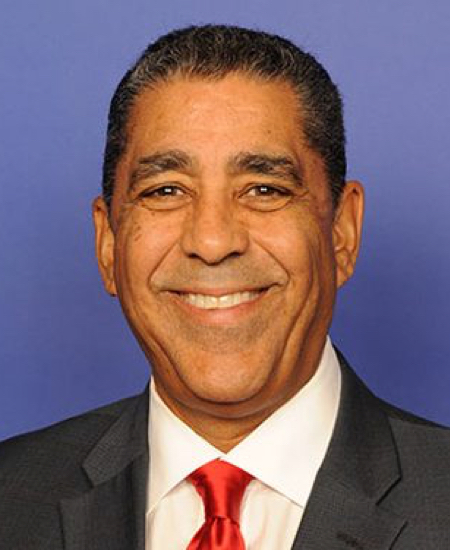
Rep. Adriano Espaillat
Sponsored bills
Maddy summaryHR 3422, the Judiciary Act of 2023, would amend the structure of the U.S. Supreme Court by increasing the number of associate justices from eight to twelve. It would also raise the required quorum for court proceedings from six to eight justices. This bill directly affects the Supreme Court's operational structure and composition. The change is purely procedural, altering the Court's size and voting requirements without impacting other legal processes or specific groups of people.
Maddy summaryHRES 319 is a symbolic resolution passed by the U.S. House of Representatives on April 24, 2023, recognizing the federal government's duty to develop a Green New Deal. It states the House believes the government should create a comprehensive plan to address climate change and economic inequality through a 10-year national mobilization. The resolution outlines goals like achieving net-zero emissions by 2050, creating high-wage union jobs, upgrading infrastructure, and prioritizing frontline communities, but it does not establish binding policy or funding mechanisms. As a non-binding resolution, it serves as a statement of legislative intent rather than a law.
Maddy summaryThis bill extends eligibility for the WIC nutrition program to new mothers for 24 months after childbirth (up from six months) and extends breastfeeding support periods to 24 months (up from one year). It directly affects new mothers and infants who rely on WIC for nutrition assistance, breastfeeding support, and health services. Key provisions include amending the Child Nutrition Act to lengthen these benefit periods and requiring a report within two years evaluating health outcomes, breastfeeding rates, and family experiences. The report must assess impacts on maternal/infant health, racial disparities, and program effectiveness. This is a substantive policy change focused on improving access to critical postpartum support.
Justice for Incarcerated Moms Act This bill establishes new requirements related to grants, programs, and reports to improve the treatment and care of pregnant and postpartum women who are incarcerated. Specifically, the bill requires the following: states must restrict the use of restraints on pregnant women in prison in order to receive full funding under the Edward Byrne Memorial Justice Assistance Grant program; the Bureau of Prisons must establish programs to optimize maternal health outcomes for pregnant and postpartum women in federal prisons; the Bureau of Justice Assistance must award state grants for programs to support pregnant and postpartum women in state and local prisons and jails; and the Government Accountability Office must report on adverse maternal and infant health outcomes among incarcerated individuals and infants born to such individuals, with a particular focus on racial and ethnic disparities.
Maddy summaryThis bill directs the U.S. Department of Agriculture to prioritize urban forestry assistance for communities with the lowest tree equity scores - measured by how tree canopy coverage aligns with community factors like income, race, health, and employment. It also creates a $30 million pilot program for public elementary and secondary schools to establish rooftop gardens, requiring at least 20% native plants, organic methods, and curriculum integration on urban agriculture or pollinator habitats. Schools in areas with high population density, respiratory illness rates, or low existing garden access receive priority for funding. The program mandates annual inspections of funded gardens and defines "tree equity score" using tools like American Forests' methodology.
Maddy summaryHRES 372 is a non-binding House resolution expressing support for designating May 2023 as "Mental Health Awareness Month." It does not create new laws or allocate funds but formally urges the nation to recognize mental health as a priority. The resolution supports reducing stigma around mental illness, expanding access to mental health services, and emphasizing that mental well-being is as important as physical health. It highlights the need for greater awareness and resources, particularly for youth, veterans, and communities of color facing mental health disparities, but does not mandate any specific policy changes.
Maddy summaryThe PAST Act of 2023 amends the Horse Protection Act to ban specific devices used to cause pain (soring) in horses at shows, particularly affecting Tennessee Walking Horses, Racking Horses, and Spotted Saddle Horses. It defines prohibited "action devices" (like boots or chains causing friction) and requires licensed, conflict-free inspectors at events to enforce rules. The bill increases penalties for violations to up to $5,000 fines or 3 years in jail, and mandates longer disqualifications for repeat offenses (180 days → 1 year → 3 years). Horse show organizers, exhibitors, and participants must comply with these new inspection and penalty requirements.
Aaron Salter, Jr., Responsible Body Armor Possession Act This bill establishes a federal statutory framework to restrict the purchase, ownership, or possession of enhanced body armor by civilians. The term enhanced body armor means body armor, including a helmet or shield, with a ballistic resistance that meets or exceeds the ballistic performance standard of Type III armor, as determined using the National Institute of Justice standard in effect at the time the person purchases, owns, or possesses the armor.
Maddy summaryThis bill requires U.S. public schools to include Asian Pacific American history in all K-12 American history and civics education. It amends the Elementary and Secondary Education Act to mandate that curriculum standards, teacher training, and national assessments explicitly cover this history as part of American history. The policy directly affects students and teachers nationwide by changing how history is taught in public schools. The key mechanism is requiring specific curriculum updates to address gaps in current Eurocentric teaching, ensuring students learn about APA contributions, experiences, and challenges as integral to U.S. history.