

Maddy summaryHR 7826, the Tribal Community Protection Act of 2024, amends the Edward Byrne Memorial Justice Assistance Grant Program to require written notification about restraining orders issued on tribal lands. It directly affects federally recognized Indian tribes and tribal lands by mandating that law enforcement send certified mail notifications to tribes and the Bureau of Indian Affairs regarding such orders. The key provision specifies that written notification must be sent via registered or certified mail with return receipt, ensuring tribes receive official notice of restraining orders affecting their communities. This change applies to programs funded under the Justice Assistance Grant Program and uses existing definitions for "tribal lands" and "Indian tribe" from federal law.
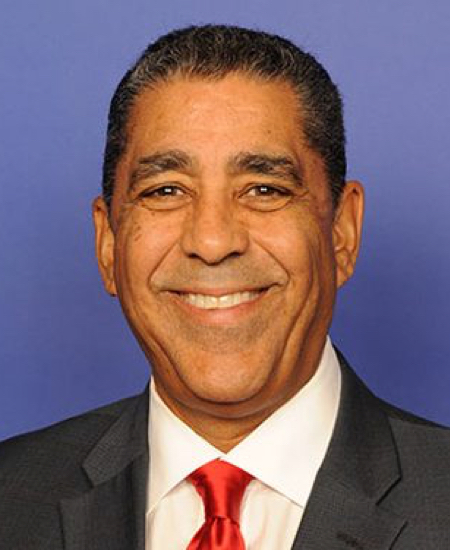
Rep. Adriano Espaillat
Sponsored bills
Maddy summaryHRES 1090 is a non-binding resolution designating the first week of April as "Adolescent Immunization Action Week" to raise awareness about vaccinating adolescents and young adults. It does not create new laws but calls on communities, health providers, and government agencies to support immunization efforts. Key provisions include urging health care providers to address vaccine mistrust in underserved communities and encouraging broader public participation in promoting adolescent vaccinations. The resolution focuses on improving vaccination rates for preventable illnesses, particularly amid post-pandemic declines and disparities in rural, low-income, and minority communities. It specifically references Healthy People 2030 goals and aims to strengthen community health through education and collaboration.
Maddy summaryHR 7801, the Sultana Steamboat Disaster Commemorative Coin Act of 2024, authorizes the U.S. Mint to produce commemorative coins honoring the 1865 Sultana steamboat disaster - the worst maritime disaster in U.S. history, which killed nearly 1,200 people. The bill specifies three coin types ($5 gold, $1 silver, and half-dollar clad) to be minted between January 1, 2027, and December 31, 2027, with surcharges from sales directed to the Sultana Historical Preservation Society for museum development and artifact preservation. The coins will be sold at face value plus surcharges ($5-$35 per coin), and the funds must support constructing a museum, exhibits, and preserving disaster-related history. This bill does not create new laws but enables commemorative coin sales to fund a specific historical preservation effort.
Maddy summaryThis bill would provide federal grants to public housing agencies to modernize public housing through energy efficiency upgrades, infrastructure improvements, and renewable energy systems. It requires all public housing to become "zero-carbon homes" that produce enough renewable energy to meet their own consumption within 10 years. The bill includes specific requirements for workforce development, hiring from low- and very low-income communities (40% in year 1, 50% in year 2, 90% after that), and contracting with resident-owned businesses (20% in year 1, 30% in year 2, 50% after that). It also mandates resident and community engagement in planning, and requires public housing agencies to meet specific energy efficiency and water quality standards. The bill directly affects all public housing agencies managing housing for low- and very low-income residents across the United States, including tribal housing entities.
Maddy summaryHR 7770, the Rosie the Riveter Commemorative Coin Act, authorizes the U.S. Mint to produce and sell three commemorative coins honoring women who worked on the U.S. home front during World War II. It specifies $5 gold coins (max 50,000), $1 silver coins (max 400,000), and half-dollar coins (max 750,000), all to be issued between January 1, 2025, and December 31, 2025. Each coin sale includes a surcharge ($35 for gold, $10 for silver, $5 for half-dollar), with all surcharge funds directed to the Rosie the Riveter Trust for maintaining the Rosie the Riveter WWII Home Front National Historical Park and educational programs. The coins will feature designs reflecting the legacy of diverse women workers and must meet specific weight, diameter, and composition standards.
Maddy summaryHRES 1095 is a symbolic resolution expressing congressional support for designating March 2024 as "Music in Our Schools Month." It recognizes music's cultural importance, its long history in U.S. schools, and the unequal access to music education faced by students in underserved communities (including urban/rural schools and schools with high percentages of Black, Hispanic, or Native American students). The resolution does not create new laws, allocate funding, or mandate school actions - it simply affirms the value of music education and calls for greater support. This non-binding resolution was introduced by multiple representatives and referred to the Education Committee.
Maddy summaryThis concurrent resolution (HCONRES 97) recognizes the gender wage gap, noting that women working full-time earn 84 cents for every dollar earned by men. It highlights racial disparities (e.g., Latinas earn 57 cents, Black women 69 cents) and the economic impact of the gap, including $965 billion in annual lost wages for women. As a symbolic resolution, it does not create new laws or policies but formally acknowledges the issue and reaffirms Congress’s commitment to addressing wage inequality.
Maddy summaryThis bill establishes a Federal Advisory Panel to analyze climate change risks to federal retirement investments and advise on transitioning toward low-carbon portfolios. It directly affects the Federal Retirement Thrift Investment Board (which manages retirement funds for over 5 million federal employees) by requiring the panel to assess fossil fuel investments, examine other pension funds' climate strategies, and produce a report within one year. Key mechanisms include creating a new "Climate Choice Stock Index Fund" that excludes fossil fuel companies (if the Board determines fossil fuel investments aren't financially sound), and mandating annual climate cost reports from the Federal Reserve and SEC. The bill focuses on aligning retirement fund investments with climate risk management while maintaining financial responsibility, without mandating immediate divestment.
Maddy summaryHRES 1048 is a non-binding House resolution calling on the Department of Homeland Security (DHS) to establish a humanitarian parole program for Cameroonians fleeing violence in their home country. It specifically targets Cameroonians who arrived in the U.S. after October 5, 2023 - after the expiration of temporary protected status (TPS) that covered earlier arrivals - and who face risks of deportation to Cameroon amid ongoing conflicts, human rights abuses, and discriminatory treatment in U.S. immigration enforcement. The resolution cites over 6,000 deaths from violence in Cameroon since 2016, 1.7 million needing humanitarian aid, and DHS’s existing authority under Section 212(d)(5)(A) of the Immigration and Nationality Act to create such a program. It emphasizes that no African nation has ever received a humanitarian parole program under this mechanism, highlighting systemic gaps in U.S. immigration policy.
Maddy summaryThis resolution honors the Greensboro Four (Joseph McNeil, Jibreel Khazan, Franklin McCain, and David Richmond) for their 1960 sit-in at a Greensboro, North Carolina Woolworth's store, which sparked the civil rights movement. It formally recognizes their role in challenging racial segregation and inspiring nationwide protests during Black History Month. The resolution encourages schools to include the Greensboro Four's story in their educational curriculum to highlight their contributions to civil rights. As a commemorative resolution, it has no binding effect but aims to promote historical awareness.