

Maddy summaryThe Combating Hate Across Campus Act (HR 7998) requires colleges and universities to collect and report campus hate crime statistics with more detailed demographic breakdowns. It amends the Higher Education Act to mandate that institutions disaggregate hate crime data by the specific identity of the targeted individual or group (such as race, religion, or sexual orientation), using the FBI's most recent hate crime data collection guidelines. This change ensures reports provide precise information about the nature and scope of hate incidents on campus. The requirement applies to all institutions of higher education receiving federal student aid under the Higher Education Act.
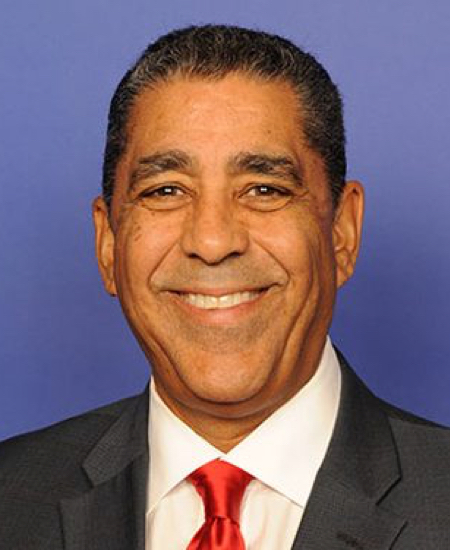
Rep. Adriano Espaillat
Sponsored bills
Baltimore Bridge Response Invests and Delivers Global Economic Relief Act or the Baltimore BRIDGE Relief Act This bill allows for full federal funding (i.e., 100% federal cost-share) for emergency relief funds to respond to damage caused by the cargo ship Dali to the Francis Scott Key Bridge, including reconstruction of that bridge and its approaches. The Francis Scott Key Bridge is located in Baltimore City, Baltimore County, and Anne Arundel County, Maryland. This bill takes effect as if enacted on March 26, 2024.
Maddy summaryHRES 1127 is a symbolic House resolution commemorating the 45th anniversary of the Taiwan Relations Act (TRA) and reaffirming U.S. policy toward Taiwan. It does not create new law but formally reiterates the U.S. commitment to Taiwan under the TRA framework, including regular defense transfers to support Taiwan's self-defense and advocacy for Taiwan's meaningful participation in international organizations. The resolution highlights longstanding U.S.-Taiwan cooperation on trade, security, education, and global challenges like public health and cybersecurity. It specifically calls on the Secretary of State to advance Taiwan's international engagement and supports existing programs like the Taiwan Fellowship Program and the American Institute in Taiwan. As a procedural resolution, it expresses congressional support for current policy without altering legal obligations.
Maddy summaryHR 7926, the Airline Travelers Right to Know Act, requires airlines to disclose potential toxic fume exposure risks to passengers before ticket purchase and to crew members. It mandates that airlines provide specific information about harmful chemicals (including those linked to cancer or birth defects) in jet fumes, safety measures to prevent exposure, and procedures for responding to fume events. Airlines must install toxic fume sensors, make oxygen masks available for crew during incidents, and immediately notify passengers and crew if fumes are detected. The bill directly affects passengers, pilots, and cabin crew by ensuring they receive clear, pre-travel health information and safety protocols. Violations, such as missing reports or false statements, trigger civil penalties up to $100,000.
This resolution recognizes the anniversary of the Civil Rights Act of 1866 and its impact on establishing that all Americans are protected equally under the law.
Maddy summaryThis bill requires federal agencies to include specific equity goals in their planning documents. Agencies must set at least one goal (or 20% of total goals, whichever is greater) focused on improving services for underserved communities and individuals, defined as groups systematically denied full participation in economic, social, and civic life. Agencies must also consult with community groups, local governments, and research partners when developing these plans. The law amends existing planning requirements under Titles 5 and 31 of the U.S. Code to implement these changes.
Maddy summaryThis bill requires each federal agency to establish an Equity Advisory Team with at least 10 specific agency roles represented, including leadership from civil rights, data, human capital, and policy teams. It creates an Equity Subcommittee within the Performance Improvement Council to coordinate equitable service delivery guidance across agencies and share best practices. The bill also mandates that Chief Data Officers ensure agencies follow equitable data collection and use standards, and establishes an Equitable Data Working Group to report quarterly on achieving equity in federal data practices. These provisions directly affect all federal agencies by requiring new internal structures and reporting on equitable operations.
Maddy summaryHRES 1110 is a symbolic resolution passed by the U.S. House of Representatives in March 2024 to commemorate March 2024 as National Women’s History Month. It formally supports the month’s goals, recognizes women and organizations advancing women’s history education, and highlights the intersectional contributions of Black, Hispanic, Asian, Native American, Pacific Islander, LGBTQ+, and disabled women throughout U.S. history. The resolution has no legal effect or policy changes - it serves solely as a ceremonial acknowledgment of historical milestones and ongoing advocacy for gender equality. It directly affects all Americans by affirming the significance of women’s historical contributions through official congressional recognition.
Maddy summaryThis bill, the BIKE Act of 2024, directs federal funding toward school-based bicycle safety education for elementary and secondary students. It amends existing law to require grant funds for on-bicycle education programs and mandates the Secretary of Transportation to revise safety guidelines within one year. The revised guidelines must specifically encourage skills training, roadway navigation, traffic rule awareness, safety precautions, and helmet use for students. These updated materials will be shared with state education agencies, and the Secretary must report to Congress within three years on implementation efforts and outcomes. The bill directly affects public school systems by integrating structured bike safety education into curricula.
Maddy summaryHRES 1109 is a symbolic resolution commemorating the 1913 Woman Suffrage Procession in Washington, DC, where suffragists led by Alice Paul and Inez Milholland marched to demand voting rights for women. It honors the participants' courage during a protest that drew 500,000 spectators despite violent opposition, highlighting how this event advanced the national push for the 19th Amendment. The resolution does not create new laws but reaffirms support for voting rights equality, connecting the 1913 march to ongoing efforts to protect democratic access. It specifically acknowledges the intersectional struggles of women of color in the suffrage movement. As a commemorative resolution, it has no binding policy effect.