

Maddy summaryThis symbolic House Resolution (HRES 62) supports designating a day to honor Juan Pablo Duarte, the founding father of the Dominican Republic, and urges the U.S. to recognize his ideals. It specifically calls for the House to support "Juan Pablo Duarte Day" and recommends establishing a national day of recognition for Duarte in the United States. The resolution primarily aims to acknowledge Duarte's historical role in Dominican independence and encourage observance by the American public, with particular relevance to Dominican American communities. It does not create new laws or allocate funds, as it is a non-binding expression of congressional support.
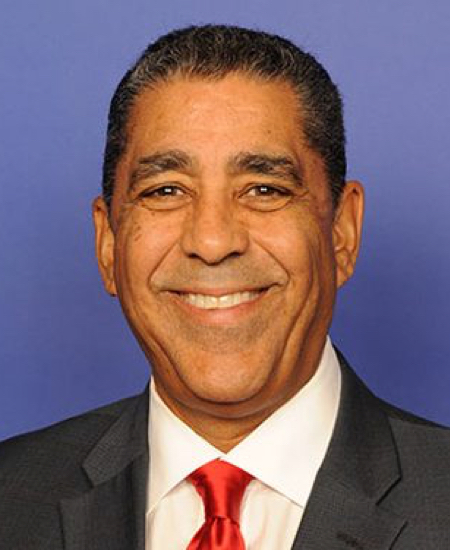
Rep. Adriano Espaillat
Sponsored bills
Maddy summaryHR 609, the Assuring Medicare's Promise Act of 2025, directs revenue from the net investment income tax (currently applied to investment income) into the Medicare Hospital Insurance Trust Fund. It expands the tax base to include certain business income for high-income individuals with modified adjusted gross income exceeding $400,000 ($500,000 for joint filers), with a phase-in to limit the tax increase. The bill ensures this tax revenue directly supports Medicare's hospital insurance program, applying to taxable years beginning after December 31, 2025. The changes do not alter the tax rate but broaden the income types subject to the tax for high earners.
Neighbors Not Enemies Act This bill repeals provisions authorizing the President to apprehend and remove from the United States the citizens of a particular nation, if the United States has declared war against that nation or that nation has threatened an invasion against the United States.
Maddy summaryThe Close the Medigap Act of 2025 would prohibit Medigap insurance issuers from denying coverage or charging higher premiums based on health status, pre-existing conditions, genetic information, or other factors. It requires insurers to spend a minimum percentage of premiums on health care claims and improves the Medicare Plan Finder website to provide clearer information about coverage options, out-of-pocket costs, and guaranteed issue requirements. The bill applies to Medigap policies effective January 1, 2026, with full implementation by 2031, and requires Medigap brokers to disclose payments they receive from insurers. These changes would directly affect Medicare beneficiaries, particularly those with pre-existing conditions who have historically faced barriers to obtaining affordable supplemental coverage.
Maddy summaryHR 596, the "Report on Grant Consolidation Authority for Puerto Rico Act," requires the U.S. Comptroller General to study whether Puerto Rico should be allowed to consolidate federal grants like other U.S. insular areas. The bill mandates a report within one year of enactment analyzing how Puerto Rico currently accesses federal funding programs, identifying potential program additions to consolidation, and assessing challenges in meeting existing grant requirements. The study aims to determine if grant consolidation would reduce administrative burdens on Puerto Rico's public sector - facing economic hardship and post-disaster recovery - while improving access to federal funds. This procedural bill does not change current policy but seeks to evaluate a potential efficiency measure for Puerto Rico.
Maddy summaryHRES 48 is a ceremonial resolution honoring Dr. Martin Luther King, Jr., by commemorating his 96th birthday on January 20, 2025. The resolution affirms his teachings on diversity, equality, and nonviolence, and specifically condemns hate, discrimination, and harassment targeting Black Americans, Indigenous peoples, Jewish communities, Asian-American/Pacific Islander groups, Muslim communities, Hispanic/Latino communities, LGBTQ+ individuals, and others. It calls on all people to uphold Dr. King’s values of justice, tolerance, and peace. As a symbolic gesture, this resolution has no legal effect but expresses the House’s commitment to these principles.
Maddy summaryHRES 52 is a symbolic resolution recognizing community organizations and individuals who create and maintain services and educational programs for LGBTQIA+ communities. It does not establish new laws, funding, or policy changes, but formally honors their work in fostering safe spaces and resilience. The resolution cites historical examples like Stonewall and ACT UP, along with statistics on declining LGBTQIA+ venues and hate violence, to underscore the importance of these efforts. It calls for Congress to acknowledge this work through non-binding statements of support.
Maddy summaryHR 486, the Young Americans Financial Literacy Act, authorizes $27.5 million to $55 million annually through 2029 to fund competitive grants for centers of excellence focused on financial literacy education for individuals aged 8-24. These centers, established by eligible institutions like schools, nonprofits, or financial organizations, must develop research-based programs covering budgeting, debt management, student loan guidance, and avoiding pitfalls like predatory lending. The bill specifically requires programs to address at-risk populations, include evidence-based teaching methods, and serve groups such as high school graduates, college students, young families, and military personnel. It mandates annual reporting to Congress on grant recipients and the populations they serve, with funding ending in 2029.
Maddy summaryThis bill expands eligibility for FEMA disaster assistance by broadening the types of evidence considered proof of property ownership for survivors without formal deeds. It allows applicants to submit documents like property tax receipts, mortgage records, insurance papers, or even death certificates (in states without will requirements) to demonstrate "constructive ownership" of their home. The bill also permits a simple signed declaration under penalty of perjury - without notarization - to support claims when other evidence is insufficient. These changes apply to disaster assistance funds appropriated after the bill's enactment, directly helping individuals affected by major disasters who lack traditional ownership documentation.
Maddy summaryHR 429, the Rosie the Riveter Commemorative Coin Act, authorizes the U.S. Treasury to mint and sell three types of commemorative coins ($5 gold, $1 silver, and half-dollar) to honor women who worked on the U.S. home front during World War II. The coins will be sold at face value plus surcharges ($35 for gold, $10 for silver, $5 for half-dollar), with all surcharge revenue directed to the Rosie the Riveter Trust to support the Rosie the Riveter WWII Home Front National Historical Park and related educational programs. The coins must be issued between January 1, 2028, and December 31, 2028, in specified quantities (50,000 gold, 400,000 silver, 750,000 half-dollar), with all costs covered by the sales revenue to avoid net government expense.