

Maddy summaryThis bill adds "spotted lanternfly control" as a priority research area under federal agricultural funding, authorizing grants to develop and share tools for combating the invasive spotted lanternfly pest (Lycorma delicatula). It directly affects farmers, agricultural communities, and state departments of agriculture in states like Pennsylvania where the pest causes significant crop damage. The key provision amends existing law to allow research grants focused on creating effective treatments and management strategies for the pest. The bill also extends the funding period for all high-priority research initiatives through 2030.
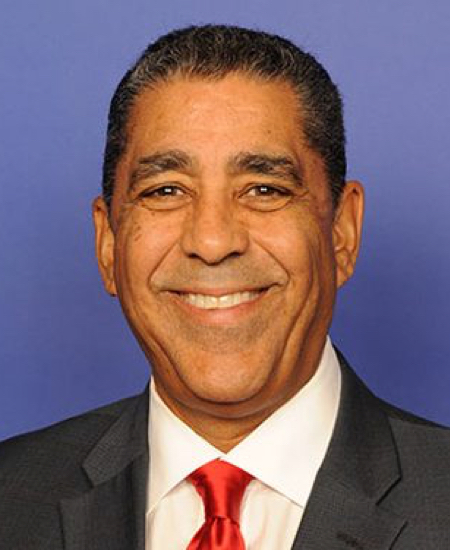
Rep. Adriano Espaillat
Sponsored bills
Maddy summaryHR 4652 makes it illegal for non-ICE personnel to wear, display, or sell apparel, badges, or insignia bearing "ICE" or "Immigration and Customs Enforcement" in a way that could deceive the public into believing they are federal officers. Violators face criminal penalties of up to 7 years in prison for impersonation or civil fines of $100,000 per violation for selling fake ICE gear. The bill also requires the Department of Homeland Security to establish public awareness campaigns, a national reporting hotline and online portal for suspected impersonation, and mandates regular studies on the issue. It directly affects individuals posing as ICE officers, businesses selling counterfeit gear, and communities impacted by such fraud.
Resident Physician Shortage Reduction Act of 2025 This bill increases the number of residency positions eligible for graduate medical education payments under Medicare for qualifying hospitals, including hospitals in rural areas and health professional shortage areas. The bill provides for an additional increase of 2,000 positions per fiscal year from FY2026-FY2032; during this period, each hospital may receive up to 75 additional positions in total under the bill and current law. Additionally, one-third of the positions that are made available under the bill must be allocated to hospitals that are already operating above applicable resident limits. The bill also requires the Government Accountability Office to report on strategies to increase the diversity of the health professional workforce, including with respect to representation from rural, low-income, and minority communities.
Maddy summaryHR 4650, the Safe Return Act, changes the U.S. State Department's repatriation program from providing loans to offering grants for citizens and certain residents needing help returning to the U.S. It directly affects U.S. citizens, lawful permanent residents (green card holders), and third-country nationals stranded abroad. The key provision replaces all "loans" with "grants" in the program, eliminating repayment requirements, and updates the Foreign Affairs Manual to reflect this change. This policy shift ensures affected individuals receive assistance that does not require repayment.
Maddy summaryThe End Polluter Welfare Act of 2025 eliminates federal subsidies for fossil fuel production by repealing tax incentives, increasing royalty rates, and prohibiting federal funding for fossil fuel projects. It directly affects oil, gas, and coal companies by terminating tax credits like the enhanced oil recovery credit (Section 43), ending special tax treatments for fossil fuel activities, and increasing offshore royalty rates to 18 3/4 percent. The bill prohibits U.S. International Development Finance Corporation and Export-Import Bank funding for fossil fuel projects, ends interest payments on royalty overpayments, and terminates tax provisions allowing accelerated depreciation for fossil fuel infrastructure. These changes apply to taxable years beginning after the bill's enactment date, with specific provisions targeting coal, petroleum, and natural gas production.
Maddy summaryH.J. Res. 108 proposes a constitutional amendment to remove legal immunity for federal officials, including the President, from criminal prosecution for actions taken while performing official duties. It would prohibit the President from granting pardons to themselves and eliminate the defense that "official authority" excuses violations of federal or state law (with limited exceptions for certain congressional actions). If ratified, this amendment would require Congress to pass implementing laws to enforce these changes. The proposal is currently in the House Judiciary Committee and requires approval by three-fourths of state legislatures to become part of the Constitution.
Maddy summaryHR 4482, the Stop NOAA Closures Act, imposes a temporary moratorium on closing, suspending, or limiting access to National Oceanic and Atmospheric Administration (NOAA) facilities, effective until a report is submitted to Congress by January 21, 2029. The bill requires NOAA and the General Services Administration to submit detailed reports to specific congressional committees before any future facility closure, suspension, lease termination, or consolidation - outlining cost-benefit analyses, service impacts, and justification. Exceptions apply only for emergencies posing immediate threats to personnel safety. This bill directly affects NOAA's facility management decisions and mandates congressional oversight for future closures.
Maddy summaryHRES 597 is a congressional resolution condemning the 1994 bombing of Argentina's AMIA Jewish Community Center in Buenos Aires, which killed 85 people and injured over 300. The resolution expresses support for Argentina's recent court ruling (April 2024) that declared Iran responsible for the attack as a crime against humanity, and urges accountability for Iranian officials and Hezbollah operatives involved. It calls on the U.S. government to support Argentina's efforts to hold perpetrators accountable, including through INTERPOL arrest requests, and commends Argentina for designating Hezbollah as a terrorist organization. The resolution primarily addresses the victims' families, the Argentine government's legal actions, and international efforts to pursue justice for this historic attack.
Maddy summaryThis bill establishes the Office of Climate Change and Health Equity within the Department of Health and Human Services to coordinate federal efforts addressing climate change's health impacts. It requires the creation of a National Strategic Action Plan to identify communities most affected by climate-related health threats - including environmental justice communities, medically underserved communities, and Tribal communities - and develop strategies for preparedness and response. The plan must address specific health impacts like extreme heat, air pollution, infectious diseases, and mental health effects, while prioritizing health equity and environmental justice. The bill also creates a Science Advisory Board to provide expert guidance and authorizes funding for these initiatives over several years. These provisions are designed to strengthen the health sector's ability to respond to climate change impacts across the United States.
Maddy summaryHR 4539, the Texture Positive Act of 2025, provides federal grants to states to fund subgrants for eligible entities (like minority- or women-owned businesses with 5+ years of experience) to integrate textured hair care training into cosmetology school curricula. The bill requires these entities to teach students specific techniques for shampooing, deep conditioning, braiding, twisting, and styling naturally coiled, curly, or wavy hair. It directly affects cosmetology schools, their students, and approved training providers by mandating this specialized education as part of their curriculum. The law includes reporting requirements to track how funds are used and the number of students and instructors trained.