

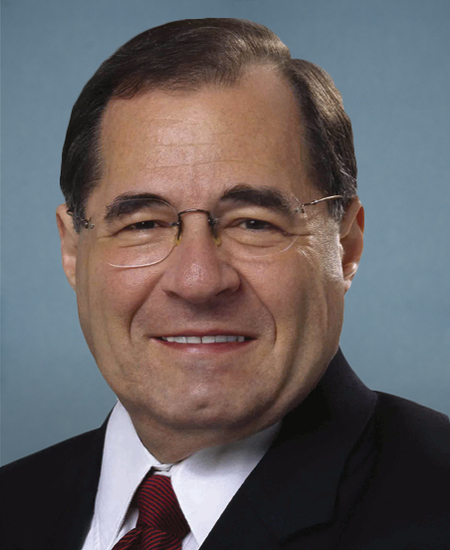
Photo of Jerrold Nadler
D United States House · District 12 · New York

Rep. Jerrold Nadler

Compare
Total votes
2,837
all sessions
Attendance
96%
126 missed
Lower than 94% of chamber peers
With party
98%
of cast votes
Higher than 87% of chamber peers
Bipartisan score
1%
crosses aisle rarely
Lower than 87% of chamber peers
Sponsored
1,727
bills & resolutions
Higher than 77% of chamber peers
Committees
6
assignments
1,727 bills and resolutions

Sponsored bills

Total
1,727
Primary
59
Co-sponsor
1,668
This page
1,727
matching current filters
Co-sponsor HRES 425
In committee · United States House · Co-sponsor
Supporting the designation of July 19, 2023, as "Glioblastoma Awareness Day".

Maddy summaryHRES 425 is a non-binding House resolution designating July 19, 2023, as "Glioblastoma Awareness Day" to increase public recognition of glioblastoma, an aggressive brain cancer. It directly supports patients, caregivers, and families affected by the disease, which has a low 5-year survival rate (6.9%) and no effective screening methods. The resolution encourages greater public awareness, honors those impacted by the disease, and urges continued research investments, including through the Glioblastoma Therapeutics Network. It does not create new laws or alter funding but serves as a symbolic statement to advance understanding and support for glioblastoma research.

In committee May 19, 2023 1 co-sponsor
Co-sponsor HR 3548
In committee · United States House · Co-sponsor
Pursuing Equity in Mental Health Act

Maddy summaryHR 3548, the Pursuing Equity in Mental Health Act, aims to reduce mental health disparities for racial and ethnic minority groups by directing federal funding and policy changes. It increases annual grants for primary/behavioral health services to $60 million in 2023 and $80 million yearly through 2029, prioritizing entities serving minority communities. The bill requires the NIH to study mental health disparities within 9 months and mandates new training for mental health professionals (including social work and psychiatry) on culturally appropriate care. Additionally, it funds a $15 million annual outreach strategy to combat stigma and improve access to care, requiring materials tailored to cultural and language needs of minority groups.

In committee May 19, 2023 1 co-sponsor
Co-sponsor HR 3503
In committee · United States House · Co-sponsor
NIH Clinical Trial Diversity Act of 2023

Maddy summaryThis bill requires sponsors of NIH-funded or NIH-approved clinical trials (for drugs, devices, biological products, or behavioral interventions) to set specific, measurable goals for recruiting participants reflecting race, ethnicity, age, and sex - either based on disease prevalence or the U.S. population. Key mechanisms include mandating detailed plans for achieving these goals, annual reporting of demographic data (without personally identifiable information), and strategies to reduce participation barriers like virtual visits or flexible scheduling. It also requires training for researchers on diversity and health inequities, and establishes a remediation process if goals aren’t met. The law aims to improve representation in clinical trials to ensure medical research better serves all patient groups.

In committee May 19, 2023 1 co-sponsor
Co-sponsor HR 3413
In committee · United States House · Co-sponsor
AM Radio for Every Vehicle Act of 2023

Maddy summaryThis bill requires that AM radio receivers be included as standard equipment in all new motor vehicles (such as cars and trucks) sold in the United States, with a rule to be issued by the Department of Transportation within one year. The rule must ensure AM radio is easily accessible on the dashboard and allows manufacturers to use digital AM radio technology instead of traditional AM. During the one-year period between the bill's enactment and the rule's effective date, manufacturers must clearly label vehicles without AM radio. The bill also directs a study to evaluate whether an alternative system could deliver emergency alerts as reliably as AM radio across the country, especially during crises.

In committee May 19, 2023 1 co-sponsor
Co-sponsor HR 3420
In committee · United States House · Co-sponsor
My Body, My Data Act of 2023

Maddy summaryHR 3420, the My Body, My Data Act of 2023, restricts how companies can handle reproductive and sexual health data - such as pregnancy details, contraceptive use, or abortion-related information - by requiring them to collect only what’s necessary for requested services and limiting employee access. It gives individuals the right to access, correct, or delete their data, see which third parties received it, and get clear privacy policies explaining data practices. The Federal Trade Commission enforces the law, with penalties for violations including $100-$1,000 per violation per day, and bans retaliation for exercising these rights. The law applies to companies (like health apps or insurers) but excludes HIPAA-covered healthcare providers and entities subject to existing federal health privacy rules.

In committee May 19, 2023 1 co-sponsor
Co-sponsor HR 3312
In committee · United States House · Co-sponsor
Moms Matter Act

Maddy summaryHR 3312, the Moms Matter Act, establishes a $25 million annual grant program (2024-2027) for community organizations, health providers, and local governments to address maternal mental health and substance use disorders. It prioritizes funding for initiatives in areas with high maternal mortality rates, health disparities, or health professional shortage areas, focusing on evidence-based services like integrated mental health care in prenatal settings, postpartum support, stigma reduction, and provider training. The bill also creates a $15 million annual workforce program (2024-2028) to diversify maternal mental health providers through scholarships, training in bias/racism, and recruitment in underserved communities. These grants directly affect pregnant and postpartum individuals in high-risk demographic groups and aim to improve access to specialized care through concrete program requirements.

In committee May 19, 2023 1 co-sponsor
Co-sponsor HR 3304
In committee · United States House · Co-sponsor
Maternal Health Pandemic Response Act

Maddy summaryHR 3304, the Maternal Health Pandemic Response Act, allocates $190 million to improve maternal and infant health outcomes during public health emergencies. It funds CDC programs to collect and analyze racial, ethnic, and demographic data on pregnant and postpartum individuals affected by infectious diseases, requiring public reporting of disaggregated data (by race, ethnicity, and geography) to address health disparities. The bill also establishes a federal task force to develop recommendations for respectful, equitable maternity care during emergencies, including telehealth access, mental health support, and culturally appropriate services. These provisions directly affect pregnant and postpartum people, particularly those from racial and ethnic minority groups facing higher maternal mortality risks.

In committee May 19, 2023 1 co-sponsor
Co-sponsor HR 3302
In committee · United States House · Co-sponsor
Protecting Moms and Babies Against Climate Change Act

Maddy summaryThe Protecting Moms and Babies Against Climate Change Act establishes a federal grant program to help communities address climate change risks that affect pregnant people, new mothers, and infants under 3 years old. It allocates $100 million over four years for community-based organizations to provide climate-related health services, including air conditioning, housing assistance, mental health support, and training for health care providers on climate risks. The bill also creates a grant program for health profession schools to integrate climate change education into medical training and establishes a National Institutes of Health research consortium to study climate impacts on maternal health. All grant recipients must address racial and ethnic disparities, collect data by demographic factors, and prevent negative environmental or housing impacts in their initiatives.

In committee May 19, 2023 1 co-sponsor
Co-sponsor HR 3305
In committee · United States House · Co-sponsor
Black Maternal Health Momnibus Act

Maddy summary# Comprehensive Summary: Maternal Health and Vaccination Legislation This proposed legislation establishes a comprehensive framework to improve maternal health outcomes across multiple dimensions, with a strong focus on equity and addressing systemic disparities. The bill is organized into 13 titles covering various aspects of maternal health care. ## Key Focus Areas 1. **Maternal Health Equity**: The legislation emphasizes reducing racial and ethnic disparities in maternal health outcomes, with specific provisions targeting communities of color and underserved populations. 2. **Incarcerated Mothers**: Includes provisions to end shackling of pregnant individuals in correctional facilities and establishes programs for maternal health care in prisons and jails. 3. **Technology and Telehealth**: Creates grant programs for telehealth models, technology-enabled collaborative learning, and digital tools to improve access to maternal care. 4. **Climate Change Impact**: Addresses how climate change affects maternal and infant health, with a focus on vulnerable populations. 5. **Public Health Emergencies**: Establishes protocols for maternal care during public health crises like pandemics. 6. **Vaccinations**: Expands maternal vaccination awareness and equity campaigns. ## Major Provisions **Maternal Vaccination Campaign (Title XIII)**: - Expands awareness campaigns to specifically target pregnant and postpartum individuals - Allocates $17 million annually (2024-2028) for vaccination outreach - Includes specific efforts to increase vaccination rates among racial/ethnic minority groups **Technology and Telehealth (Titles IX)**: - $6 million annually for technology-enabled collaborative learning models - $6 million annually for digital tools to promote equity in maternal health - Creates a demonstration project for alternative payment models in maternal care **Climate Change and Maternal Health (Title XII)**: - $100 million for a grant program to protect vulnerable mothers and babies from climate change risks - $5 million for education and training at health profession schools - Establishes a National Institutes of Health Consortium on Birth and Climate Change Research **Incarcerated Mothers (Title VIII)**: - Requires 25% grant reduction for states that don't restrict restraints on pregnant incarcerated individuals - Establishes model programs in Bureau of Prisons facilities for pregnant and postpartum incarcerated individuals - $10 million annually for State and local prison and jail programs **Public Health Emergency Response (Title XI)**: - $100 million for data collection on maternal health during public health emergencies - $30 million for expanding maternal mortality reviews - $45 million for Pregnancy Risk Assessment Monitoring System (PRAMS) - $15 million for research on public health emergencies' impact on maternal health ## Cross-Cutting Themes - **Equity Focus**: Nearly every provision includes specific measures to address racial and ethnic disparities - **Data Collection**: Strong emphasis on collecting and analyzing demographic data - **Community Involvement**: Requires input from community-based organizations and affected populations - **Interagency Coordination**: Mandates collaboration between multiple federal agencies - **Long-Term Investment**: All funding is allocated for 5-year periods (2024-2028) The legislation represents a comprehensive, multi-faceted approach to improving maternal health outcomes in the United States, with particular attention to vulnerable populations and systemic barriers that contribute to poor maternal health outcomes.

In committee May 19, 2023 1 co-sponsor
Co-sponsor HR 3470
In committee · United States House · Co-sponsor
Keeping All Students Safe Act

Maddy summaryThe Keeping All Students Safe Act prohibits the use of "unlawful" seclusion and restraint in schools, including physical restraint that's life-threatening, contraindicated for a student's disability, or not properly trained for. It requires schools to use less restrictive interventions first, mandates training for school personnel in crisis intervention, and establishes reporting requirements for restraint incidents, including immediate parent notification and annual public reporting. The bill prohibits using physical restraint as a planned intervention in student education plans and requires states to submit compliance plans with data on restraint incidents disaggregated by race, disability status, and other factors. It applies to public schools and programs receiving federal funding, but does not affect private schools not receiving federal funds or home schools.

In committee May 18, 2023 1 co-sponsor
Showing 861 to 870 of 1,727 bills
Previous 1 … 86 87 88 … 173 Next