

Maddy summaryHR 3828 designates the U.S. Postal Service facility at 80 Prospect Street in Avon, New York, as the "Officer Anthony Mazurkiewicz Memorial Post Office Building." This bill directly affects the physical location of that post office and all official references to it. The key provision updates all federal documents, maps, and records to use the new memorial name instead of the address. As a naming resolution, it has no policy impact beyond commemoration and does not alter postal services or operations.
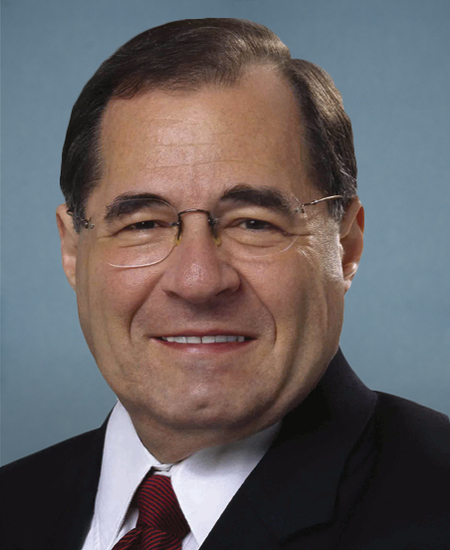
Rep. Jerrold Nadler
Sponsored bills
Maddy summaryHR 698, the Assault Weapons Ban of 2023, prohibits the sale, manufacture, transfer, and possession of specific firearms and ammunition devices commonly referred to as "assault weapons" and "large capacity magazines" in interstate commerce. The bill defines "semiautomatic assault weapons" to include rifles like AR-15s and AK-47s, as well as firearms with specific features such as folding stocks, pistol grips, threaded barrels, and detachable magazines holding more than 15 rounds. It exempts law enforcement, military, antique firearms, and weapons already lawfully owned before the law's enactment (known as "grandfathered" weapons). The bill also requires new identification markings on these weapons and large capacity magazines, and adds background check requirements for transfers of grandfathered weapons.
Maddy summaryH.Res. 460 is a non-binding resolution expressing the House of Representatives' support for Congress to enact the Older Americans Bill of Rights. This resolution does not create new laws but calls for a proposed bill that would establish specific rights for older Americans, including access to affordable health care, financial security, and community participation. It highlights challenges like high prescription drug costs, retirement insecurity, and barriers to care, urging Congress to address these through legislative action. The resolution directly affects older Americans (ages 65+) and their families by advocating for policy changes to ensure dignity and independence.
Maddy summaryThis House resolution symbolically recognizes May as Jewish American Heritage Month, celebrating Jewish Americans' historical contributions to U.S. society and culture. It references rising antisemitism in 2022 (including ADL data showing a 36% increase in incidents) and includes a non-binding call for leaders to combat antisemitism. As a purely symbolic resolution, it does not create new policies or legal requirements.
Maddy summaryThe Disaster Assistance Fairness Act helps condominiums and housing cooperatives (types of residential common interest communities) access federal disaster aid more easily after major disasters. It requires the President to issue rules allowing debris removal from these communities when state or local officials determine the debris threatens safety, health, or economic recovery. The bill also expands federal funding to cover repairs of essential shared areas (like roofs, elevators, and electrical systems) in these communities, provided owners can document their share of costs. This change applies to disasters declared after the bill's enactment.
Maddy summaryThe Universal School Meals Program Act of 2023 would establish a universal school meals program providing free breakfast and lunch to all children enrolled in participating schools, regardless of family income. Key provisions include eliminating income-based eligibility requirements for school breakfast and lunch programs, setting specific reimbursement rates ($2.80 for breakfast and $4.63 for lunch with annual inflation adjustments), and prohibiting schools from collecting debt for unpaid meals or "shaming" students. The bill also replaces references to "free or reduced price" with "economically disadvantaged students" in related laws and establishes new methods for identifying children from low-income backgrounds. This legislation would directly affect all public schools participating in the National School Lunch Program and School Breakfast Program.
Maddy summaryThis bill removes a barrier for college students seeking food assistance by amending the SNAP program rules. It directly affects students enrolled at least half-time in recognized colleges or training programs, who were previously automatically ineligible unless they met separate requirements. The key change eliminates the prior restriction (in section 6(e)) that barred most higher education students from SNAP, allowing them to qualify under the new provision in section 3(m)(5)(F). The changes take effect January 2, 2024.
Maddy summaryThe Closing the Meal Gap Act of 2023 amends the Food and Nutrition Act to update how SNAP (Supplemental Nutrition Assistance Program) benefits are calculated. It replaces the "thrifty food plan" with a "low-cost food plan" based on a specific 4-person family diet, requiring the government to reevaluate this plan by 2029 and every 5 years after. The bill also updates medical expense deductions, eliminates time limits on benefits, and allows Puerto Rico to join SNAP with specific transition requirements. These changes directly affect SNAP recipients, particularly in Puerto Rico, Hawaii, and Alaska, by adjusting benefit calculations to better reflect current food costs.
Maddy summaryHR 3776, the Family Stability and Opportunity Vouchers Act of 2023, creates a new housing voucher program targeting families with young children facing instability. It provides up to 50,000 incremental vouchers annually (2024-2029) for families who either have a child under 6, will welcome a minor child within 300 days, and are homeless, unstably housed, living in high-poverty areas, or at risk of displacement from neighborhoods with high-performing schools. Public housing agencies receiving funds must offer mobility services to help these families relocate to areas with quality schools or childcare, without requiring participation as a voucher condition. The bill defines key terms like "opportunity area for children" and mandates evidence-based services to support family transitions. This policy directly affects low-income families with young children in unstable housing situations seeking better educational opportunities.
Enhancing Questions to Understand Intentions for Pregnancy Act of 2023 or the EQUIP Act of 2023 This bill requires the Centers for Disease Control and Prevention to provide eligible health organizations with demonstration program grants to implement routine screenings about people's pregnancy intentions in order to provide better contraceptive and prepregnancy care.