

Maddy summaryThis bill creates federal funding for community-based violence intervention programs in high-violence areas, targeting communities with 35+ homicides annually or 20+ homicides with rates double the national average. It establishes grants for community organizations to implement trauma-informed violence interruption strategies, hospital-based programs for injured patients, and job training for "opportunity youth" (16-25 year olds not in school or work). The legislation authorizes $300 million in 2026, increasing to $700 million annually through 2033, with requirements for evidence-based approaches that reduce violence without contributing to mass incarceration. It creates a National Community Violence Response Center to coordinate data collection, research, and best practices for these programs. The focus is on prevention through economic opportunity, trauma care, and community-driven interventions rather than traditional law enforcement approaches.
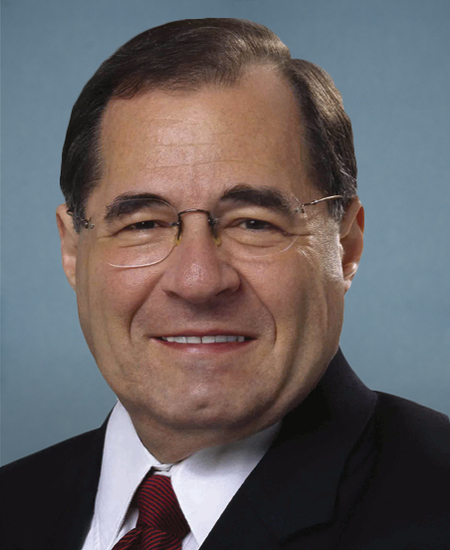
Rep. Jerrold Nadler
Sponsored bills
Maddy summaryHRES 533 is a non-binding House resolution calling on the President to lift the indefinite suspension of U.S. refugee admissions, which has left over 100,000 refugees stranded in limbo since January 2025. It specifically references Executive Order 14163 (2025) that halted refugee arrivals, citing the plight of refugees conditionally approved for resettlement, including Afghans, Rohingya, and Sudanese. The resolution reaffirms U.S. commitments under the Refugee Act of 1980 and international obligations, urging restoration of the U.S. Refugee Admissions Program to protect vulnerable refugees. It also calls for increased international cooperation, support for frontline host countries, and meeting global refugee protection pledges. The resolution does not create new law but expresses congressional intent to address the refugee crisis.
Maddy summaryThis bill adds specific Medicare coverage for treatments of dialysis-related amyloidosis, a condition affecting some long-term dialysis patients. It defines these treatments as FDA-approved items/services provided in dialysis facilities, including necessary adjunct supplies. Medicare will pay 100% of reasonable charges for these treatments separately, outside standard dialysis payment bundles. This directly affects Medicare beneficiaries receiving these specific treatments at approved dialysis facilities.
Maddy summaryHR 4017, the American Royalties Too Act of 2025, requires art dealers to pay visual artists a royalty when their work is resold for $5,000 or more. Artists (or their successors) receive 5% of the sale price, capped at $50,000, paid to designated collecting societies within 90 days of the sale. These societies distribute the funds to eligible artists who are U.S. citizens, domiciled in the U.S., or created their work in the U.S. or a country with similar resale royalty laws, after deducting reasonable administrative costs. The bill establishes clear payment timelines, unclaimed funds procedures, and enforcement mechanisms for non-compliance.
Maddy summaryHRES 509 is a symbolic resolution expressing the U.S. House of Representatives' support for designating June 2025 as "Black Music Month." It does not create new laws or directly affect any individuals or entities; instead, it urges the public to recognize and celebrate Black music's cultural impact through voluntary actions like promoting artists and spreading awareness. The resolution highlights Black music's historical influence across genres - from spirituals to hip-hop - and calls for honoring its legacy in education, media, and community initiatives. It follows a tradition started by President Carter in 1979 but has no legal force.
Maddy summaryHRES 514 is a resolution commemorating the ninth anniversary of the June 12, 2016, Pulse nightclub shooting in Orlando, Florida, which killed 49 people. It honors the victims and their families, recognizes the bravery of first responders, and affirms the need for continued efforts on gun safety and mental health legislation. The resolution does not create new laws or policies but serves as a symbolic statement of remembrance and support for the affected community. It directly addresses the House of Representatives and the public, emphasizing unity in the face of hate.
Maddy summaryThis bill requires U.S. Immigration and Customs Enforcement (ICE) agents to visibly identify themselves during enforcement operations in the United States by not wearing facial coverings and wearing garments showing their name and agency affiliation. It directly affects ICE agents conducting activities like arrests, raids, or investigations. Exceptions exist for imminent threats or safety gear, but supervisors must review and document such uses within 48 hours. The bill also mandates annual reports to Congress on disciplinary actions and complaints related to violations.
Maddy summaryThe Domestic Workers Bill of Rights Act (HR 3971) would establish key labor protections for domestic workers, including nannies, housekeepers, and caregivers who work in private homes. The bill requires written agreements for workers employed 8+ hours per week, provides earned sick days (1 hour for every 30 hours worked), mandates fair scheduling practices with 72-hour notice for schedule changes, and extends overtime protections to live-in domestic employees. It also prohibits unfair wage deductions, guarantees meal and rest breaks, and ensures privacy protections including no monitoring in private living spaces. The bill directly affects approximately 2.2 million domestic workers across the U.S., who are disproportionately women of color and immigrants. Enforcement would be handled by the Department of Labor through new complaint resolution mechanisms and oversight.
Maddy summaryThis bill, HR 3916 (My Body, My Data Act of 2025), requires businesses and other "regulated entities" to minimize collection and sharing of personal reproductive or sexual health data - such as pregnancy status, contraceptive use, or abortion-related information - and gives individuals specific rights. It mandates that entities provide individuals with easy access to their data, the ability to correct inaccuracies, and the right to request deletion of such information within 15 days. The law also requires clear privacy policies detailing data practices and prohibits retaliation against individuals who exercise these rights, such as charging higher prices or denying services. It applies broadly to most businesses (excluding HIPAA-covered healthcare providers) and is enforced by the FTC with private lawsuits allowed for violations.
Maddy summaryThis bill requires private firearm transfers between individuals to go through a licensed dealer who must conduct a background check. It applies to most private sales but includes exceptions for transfers between family members (like parents and children), law enforcement, emergencies preventing harm, and temporary loans at shooting ranges or for hunting. Dealers must provide background check notices in both English and Spanish. The law aims to prevent prohibited individuals from obtaining firearms through private transactions while maintaining existing state authority on firearm laws.