

Judicial Ethics and Anti-Corruption Act of 2022 This bill makes various changes to the federal framework governing judicial ethics. Among the changes, the bill prohibits federal judges and Supreme Court Justices from owning individual stocks and securities; requires the Judicial Conference of the United States to issue regulations restricting the solicitation or acceptance of gifts in connection with a private judicial seminar; expresses the sense of Congress that the Code of Conduct for U.S. Judges shall apply to Supreme Court Justices; requires federal judges and Supreme Court Justices to report on each association or interest that would require recusal, including any financial interest of a spouse or minor child who resides in the household; and establishes a committee to review complaints against the Supreme Court.
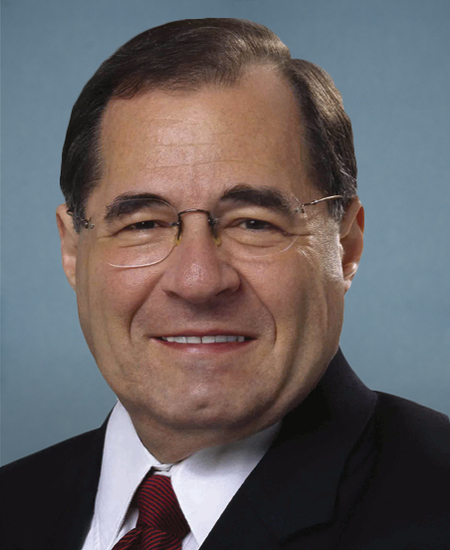
Rep. Jerrold Nadler
Sponsored bills
Stop Human Trafficking in School Zones Act This bill establishes an enhanced penalty—an additional prison term of up to five years—for certain human trafficking offenses that occur in a school zone or on or within 1,000 feet of a premises on which a school-sponsored activity is taking place.
Oil and Gas Industry Antitrust Act This bill requires the Federal Trade Commission to investigate and report on whether the price of gasoline is being manipulated by reducing refinery capacity or by any other form of market manipulation. The report must include a long-term strategy for the commission and Congress to address manipulation of oil and gas markets during times of national or international crisis or emergency.
Generic Substitution Noninterference Act This bill prohibits drug manufacturers from helping or directing health care providers to limit prescriptions to brand-name drugs when generic versions are available. The Federal Trade Commission and states may enforce this bill through civil actions.
21st Century Courts Act of 2022 This bill provides for the establishment of a code of conduct for Supreme Court Justices, judges of the courts of appeals, judges of the district courts, and judges of the Court of International Trade. The bill also requires court proceedings to be recorded and published on the internet.
Jumpstart Our Legal Immigration System Act or the Jumpstart Act This bill makes unused employment-based and family-based immigrant visas from FY1992 through FY2021 available in subsequent fiscal years. It also makes diversity immigrant visas available to individuals who were selected for such a visa between FY2017-FY2021 but were unable to receive the visa due to certain (1) executive actions, or (2) limitations related to COVID-19. The bill also establishes supplemental fees for certain immigration-related applications.
Housing for All Act of 2022 This bill modifies existing, and creates new, grants and programs concerning affordable housing and homelessness. In particular, the bill authorizes federal funding of the Housing Trust Fund, which supports affordable housing activities. Currently, contributions to the fund come from the earnings of Fannie Mae and Freddie Mac. Additionally, the bill (1) expands eligibility for housing choice vouchers, which provide rental assistance to low-income individuals; and (2) entitles certain individuals to the vouchers. Other matters addressed in the bill include permanently authorizing the U.S. Interagency Council on Homelessness (which terminates on October 1, 2028) and modifying existing programs that support housing for the elderly, individuals with disabilities, and individuals experiencing homelessness or at risk of homelessness. The bill also creates various housing-related grant programs to, for example, support overnight parking for individuals who live in vehicles and no-cost legal assistance with evictions for low-income individuals. The bill also incorporates housing into certain transportation grants and programs.
Latonya Reeves Freedom Act of 2022 This bill prohibits government entities and insurance providers from denying community-based services to individuals with disabilities that require long-term service or support that would enable such individuals to live in the community and lead an independent life. Specifically, these entities may not discriminate against such individuals in the provision of community-based services by such actions as imposing prohibited eligibility criteria, cost caps, or waiting lists or failing to provide a specific community-based service. Additionally, community-based services must be offered to individuals with such disabilities prior to institutionalization. Institutionalized individuals must be notified regularly of community-based alternatives. The bill requires the Department of Justice to issue regulations requiring government entities and insurance providers to offer community-based long-term services to individuals with such disabilities who would otherwise qualify for institutional placement. Government entities must ensure sufficient availability of affordable, accessible, and integrated housing that is not a disability-specific residential setting or a setting where services are tied to tenancy. Regulations shall also (1) require government entities and insurance providers to perform self-evaluation on current services, policies, and practices and concerning compliance with requirements of this bill; and (2) require government entities to submit a transition plan. The bill provides funds for FY2022 for the Department of Health and Human Services to provide technical assistance with respect to transition plans. The bill allows civil actions by individuals subjected to, or about to be subjected to, a violation of its requirements.
Schedules That Work Act This bill provides employees with the right to request changes to their work schedules related to the number of hours they are required to work or be on call, the location of the work, the amount of notification about work schedule assignments, and fluctuations in work hours. Employers must negotiate in good faith with employees who make such requests and comply with certain work schedule notice and split shift pay requirements for retail, food service, cleaning, hospitality, or warehouse employees.
Climate Resilience Workforce Act This bill sets forth provisions to establish a climate resilience workforce, a national climate resilience action plan, an Office of Climate Resilience within the White House, and related efforts and entities.