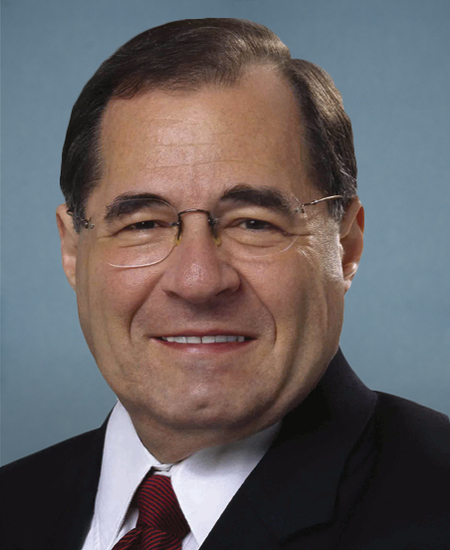
Photo of Jerrold Nadler
D United States House · District 12 · New York

Rep. Jerrold Nadler

Compare
Total votes
2,837
all sessions
Attendance
96%
126 missed
Lower than 94% of chamber peers
With party
98%
of cast votes
Higher than 87% of chamber peers
Bipartisan score
1%
crosses aisle rarely
Lower than 87% of chamber peers
Sponsored
1,727
bills & resolutions
Higher than 77% of chamber peers
Committees
6
assignments
1,727 bills and resolutions

Sponsored bills

Total
1,727
Primary
59
Co-sponsor
1,668
This page
1,727
matching current filters
Co-sponsor HRES 499
In committee · United States House · Co-sponsor
Expressing support for the designation of June 26 as "LGBTQ Equality Day".

This resolution expresses support for (1) equal rights and protections for all people, regardless of actual or perceived sexual orientation or gender identity; and (2) the designation of LGBTQ Equality Day on June 26 to commemorate Supreme Court decisions handed down on that day in 2003, 2013, and 2015. The resolution also acknowledges the need for further legislation to ensure that people in the United States are free from all forms of discrimination on the basis of actual or perceived sexual orientation or gender identity.

In committee Nov 1, 2022 1 co-sponsor
Co-sponsor HRES 490
In committee · United States House · Co-sponsor
Reaffirming the importance of the United States to promote the safety, health, and well-being of refugees and displaced persons.

Maddy summaryHRES 490 is a symbolic House resolution (not a law) passed on June 22, 2021, that reaffirms the U.S. commitment to supporting refugees and displaced persons globally. It highlights the scale of the global displacement crisis (over 82 million forcibly displaced people in 2020) and emphasizes the importance of the U.S. refugee resettlement program as a tool for security, diplomacy, and humanitarian aid. The resolution calls on the Secretary of State to continue robust funding, uphold U.S. leadership in refugee protection, support host countries, and meet refugee admissions goals. It directly affects U.S. foreign policy implementation and international humanitarian efforts, though it does not create new legal requirements or allocate funds.

In committee Nov 1, 2022 1 co-sponsor
Co-sponsor HRES 489
In committee · United States House · Co-sponsor
Encouraging the celebration of the month of June as LGBTQIA+ Pride Month.

This resolution expresses the sense of the House of Representatives that (1) lesbian, gay, bisexual, transgender, queer, intersex, and asexual (LGBTQIA+) rights are human rights and protected by the U.S. Constitution; (2) LGBTQIA+ Pride Month should be celebrated; and (3) all Americans should be treated equally regardless of sexual orientation or gender identity.

In committee Nov 1, 2022 1 co-sponsor
Primary HR 9110
In committee · United States House · Lead sponsor
Student Borrower Bankruptcy Relief Act of 2022

Student Borrower Bankruptcy Relief Act of 2022 This bill allows student loans to be discharged in bankruptcy. Under current law, these loans are only dischargeable if such debt imposes an undue hardship on the debtor.

In committee Nov 1, 2022 0 co-sponsors
Co-sponsor HR 8936
In committee · United States House · Co-sponsor
Circuit Court Judgeships Act of 2022

Maddy summaryHR 8936, the Circuit Court Judgeships Act of 2022, authorizes additional judgeships for specific U.S. Courts of Appeals. It adds 1 judge to the First, Sixth, and Eighth Circuits; 7 to the Second; 2 to the Fourth; 13 to the Fifth; 16 to the Ninth; and 10 to the Eleventh Circuit. The bill amends a table in federal law to reflect these increased judicial staffing levels. This change directly affects the operational capacity of these federal appellate courts by expanding their bench size.

In committee Nov 1, 2022 1 co-sponsor
Co-sponsor HR 8862
In committee · United States House · Co-sponsor
PRO–LIFE Act of 2022

Providing Real Opportunities and Lifelong Investments For Everyone Act of 2022 or the PRO-LIFE Act of 2022 This bill establishes new, and modifies existing, programs related to maternal and child health, tax credits and other benefits for parents and caregivers, and support for childcare infrastructure. The bill requires multi-agency efforts to improve maternal health and reduce maternal mortality, particularly among racial and ethnic minority groups, veterans, and other vulnerable populations, by addressing both health-related factors and the social determinants of health (i.e., nonmedical factors that influence health outcomes, such as housing, food security, transportation, and environmental conditions). Additionally, the bill permanently extends the Children's Health Insurance Program (CHIP) and related measures. Further, the bill (1) sets up a family medical leave insurance benefit that entitles employees to a monthly benefit payment for a period of qualified caregiving; and (2) imposes a tax on employers, employees, and self-employed individuals to fund the benefits. The bill also increases the amount of the child tax credit and makes the credit fully refundable and payable in advance on a monthly basis. In addition, the Department of Labor must carry out a program to certify and recognize employers that implement family-friendly workplace programs (e.g., providing paid family and sick leave or subsidizing childcare). The bill also requires support for childcare infrastructure, for example by establishing grants for childcare facilities and scholarship and loan repayment programs for childcare educators.


In committee Nov 1, 2022 1 co-sponsor
Co-sponsor HR 8777
In committee · United States House · Co-sponsor
Competitive Prices Act

Competitive Prices Act This bill makes a consciously parallel pricing coordination (i.e., a tacit agreement among two or more persons to raise, lower, change, maintain, or manipulate pricing for the purchase or sale of reasonably interchangeable products or services) a prohibited form of price fixing.

In committee Nov 1, 2022 1 co-sponsor
Co-sponsor HR 8685
In committee · United States House · Co-sponsor
Afghan Adjustment Act

Afghan Adjustment Act This bill expands eligibility for special immigrant visas to certain Afghan nationals (and accompanying spouse and children) and addresses related issues. The Department of Homeland Security may provide such visas to Afghan nationals who provided qualifying service as a member of the Afghan Air Force or other specified entities and meet eligibility requirements, such as passing a background check. Currently, special immigrant visas for Afghan nationals are generally only available to those who were employed by or on behalf of the U.S. government in Afghanistan. Such visas shall also be available to an Afghan national who is a qualifying relative of a veteran or member of the U.S. Armed Forces. The bill also modifies procedures for providing lawful permanent resident status to certain classes of Afghan nationals, such as by (1) providing a streamlined process with specified vetting requirements for certain individuals, including those who provided support to the U.S. government in Afghanistan; and (2) preserving the eligibility of certain battered spouses whose eligibility for such status stemmed from a marriage that has terminated. Furthermore, the Department of State (1) must respond to inquiries from Members of Congress about specific applications from Afghan nationals seeking special immigrant or refugee status; and (2) establish an office in Afghanistan to perform certain tasks, such as issuing visas, if no U.S. embassies are operational in Afghanistan. The President must establish a task force to develop and implement a strategy to assist Afghan nationals who qualify for admission to the United States.

In committee Nov 1, 2022 1 co-sponsor
Co-sponsor HR 8500
In committee · United States House · Co-sponsor
Supreme Court Tenure Establishment and Retirement Modernization Act of 2022

Maddy summaryThe Supreme Court Tenure Establishment and Retirement Modernization Act of 2022 would require the President to nominate one Supreme Court justice every other year (during the first and third years after a Presidential election), with Senate confirmation. New justices would serve an 18-year term before automatically retiring, while current justices would be deemed retired in order of their service duration (starting with the longest-serving) as new appointments occur. If the Court's membership falls below the required number due to vacancies, the most recently retired justice under this system would serve as an associate justice until the full complement is restored. This bill directly affects the appointment process, term lengths, and retirement mechanics for all Supreme Court justices.

In committee Nov 1, 2022 1 co-sponsor
Co-sponsor HR 8433
In committee · United States House · Co-sponsor
Renewing Immigration Provisions of the Immigration Act of 1929

Renewing Immigration Provisions of the Immigration Act of 1929 This bill expands eligibility for a program that authorizes the Department of Homeland Security to, at its discretion, provide lawful permanent resident status to certain long-term residents of the United States, including individuals who are unlawfully present. Currently, this program, sometimes referred to as the Registry program, is only available to eligible non-U.S. nationals ( aliens under federal law) who entered the United States before January 1, 1972. The bill removes this entry cutoff date and opens up the program to eligible individuals who have resided in the United States for at least seven years. Existing requirements (e.g., the individual must not be inadmissible or deportable due to certain grounds related to crime or terrorism) continue to apply.

In committee Nov 1, 2022 1 co-sponsor
Showing 1,121 to 1,130 of 1,727 bills