

Maddy summaryHR 40 would establish a 15-member commission to study the legacy of slavery and systemic discrimination against African Americans in the United States, and develop proposals for reparations. The commission would examine historical and ongoing effects of slavery, discriminatory policies (including redlining and educational disparities), and recommend remedies through education and potential reparations. Composed of members appointed by the President, House Speaker, and Senate President pro tempore, the commission would have 18 months to submit a report to Congress, with $20 million authorized for its work. This legislation creates a study process but does not provide reparations directly.
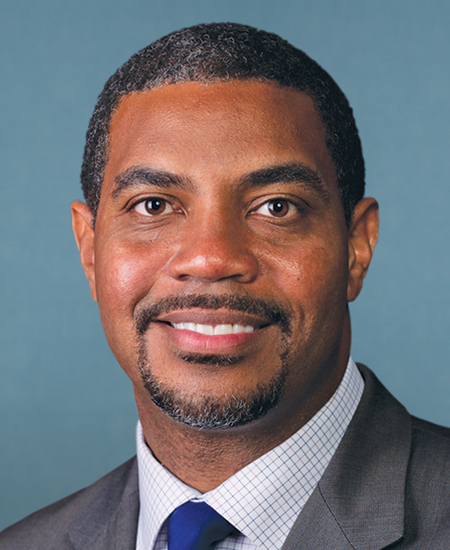
Rep. Steven Horsford
Sponsored bills
Washington, D.C. Admission Act This bill provides for the establishment of the State of Washington, Douglass Commonwealth, and its admission into the United States. The state is composed of most of the territory of the District of Columbia (DC), excluding a specified area that encompasses the U.S. Capitol, the White House, the U.S. Supreme Court building, federal monuments, and federal office buildings adjacent to the National Mall and the U.S. Capitol. The excluded territory shall be known as the Capital and serve as the seat of the government of the United States, as provided for in Article I of the Constitution. The state may not impose taxes on federal property except as Congress permits. The bill provides for the DC Mayor to issue a proclamation for the first elections to Congress of two Senators and one Representative of the state. The bill eliminates the office of Delegate to the House of Representatives. The bill applies current DC laws to the state. DC judicial proceedings and contractual obligations shall continue under the state’s authority. The bill also provides for specified federal obligations to transfer to the state upon its certification that it has funds and laws in place to assume the obligations. These include maintaining a retirement fund for judges and operating public defender services. The bill establishes a commission that is generally comprised of members who are appointed by DC and federal government officials to advise on an orderly transition to statehood.
Maddy summaryThe Treat and Reduce Obesity Act of 2023 expands Medicare coverage for obesity treatment by allowing a wider range of healthcare providers - including nurse practitioners, dietitians, psychologists, and community-based counseling programs - to deliver intensive behavioral therapy for obesity, provided they coordinate with primary care providers. It also adds Medicare Part D coverage for medications used to treat obesity or for weight loss management in overweight individuals with related health conditions like diabetes or high blood pressure. These changes directly affect Medicare beneficiaries, particularly older adults (65+), who face higher obesity rates and associated costs, including $50 billion annually in Medicare spending for obesity-related care. The bill requires annual reports to Congress on implementation to improve coordination of obesity care across federal health programs.
Maddy summaryThis bill, HR 1097 (Everett Alvarez, Jr. Congressional Gold Medal Act of 2023), authorizes the award of a Congressional Gold Medal to Everett Alvarez, Jr., in recognition of his service as a U.S. Navy pilot and Vietnam War prisoner of war. It directly honors Alvarez, who was the first U.S. pilot shot down in the Vietnam War, spent over 8.5 years in captivity, and later served in the Peace Corps and Veterans Administration. The bill’s key mechanism is directing the U.S. Mint to strike a gold medal bearing his name and image, with bronze duplicates available for sale to cover costs. It does not create new policies or affect any group beyond the honoree.
Maddy summaryHR 6070 clarifies the Department of Defense's authority to conduct specific military activities at Nevada's Test and Training Range. It explicitly authorizes emergency response, construction of up to 15 small electronic tracking sites (max 150x150 feet), and maintenance of existing roads for threat emitters. The bill also requires the Department of Defense and the Department of the Interior to jointly establish an interagency committee to coordinate activities and minimize conflicts with the Desert National Wildlife Refuge. This update ensures military operations align with wildlife refuge protections under existing law.
Maddy summaryThe Save Our Sequoias Act establishes a coordinated approach to protect giant sequoia groves in California from wildfires, insects, and drought. It creates a Giant Sequoia Lands Coalition including federal agencies, state governments, and the Tule River Indian Tribe to assess grove health, develop protection projects, and recommend forest management activities. The bill streamlines implementation of certain projects through categorical exclusion from environmental reviews, authorizes $10-40 million annually for conservation efforts, and establishes a fund for philanthropic support of sequoia protection.
Maddy summaryThis bill amends the International Emergency Economic Powers Act to explicitly prohibit the President from using emergency powers to impose import taxes (tariffs), tariff-rate quotas, or other import quotas. It directly affects the President's authority under this law, removing a potential tool for trade restrictions during emergencies. The key provision inserts a new subsection (c) clarifying that the President cannot impose such import barriers through emergency authority. This is a procedural change to existing law, not a new policy affecting specific industries or individuals.
Maddy summaryHR 9774, the Health Care Affordability Act of 2024, would expand premium tax credits under the Affordable Care Act for households earning between 150% and 400% of the federal poverty level. It modifies the sliding scale calculation to reduce the percentage of monthly insurance premiums these households must pay, with the lowest out-of-pocket costs for those near 400% of poverty. This directly affects individuals and families purchasing health insurance through marketplace plans who qualify for these tax credits. The changes apply to tax years beginning after December 31, 2025.
Maddy summaryHR 9152, the "SCHOOL Professionals Act of 2024," clarifies that contractors primarily providing operations or logistics services to educational organizations must be treated like direct employees for health coverage purposes under federal tax law. This means educational institutions using such contractors must determine if these workers qualify as "full-time" for health insurance requirements, similar to their own employees. The bill directly affects schools and colleges that rely on external contractors for facility or support services, requiring them to apply the same full-time employee rules to these contractors when assessing health coverage obligations. The rule change applies to months beginning after the bill's enactment date.
Maddy summaryThe Patient Debt Relief Act requires Medicare-participating hospitals to establish clear financial assistance policies by January 2026, including publicly available eligibility criteria and 30-day pre-payment screening for charity care. It prohibits hospitals from placing home liens, garnishing wages, or selling debt to collectors without offering income-based repayment plans (capping payments at 4% of gross monthly income) and eliminates interest for patients earning under 250% of the poverty line. Hospitals failing to comply face civil penalties up to $1 million per violation. The bill also creates a $100 million grant program to fund nonprofits that discharge medical debt for individuals meeting income thresholds (5% of income or under 400% of poverty line), with quarterly reporting requirements. These provisions apply directly to hospitals and low-income patients with medical debt.